Context avant-gardes 3. Georges Vantongerloo

Submitted by brandcode_deweloper on
IVAM Collection of Valencia

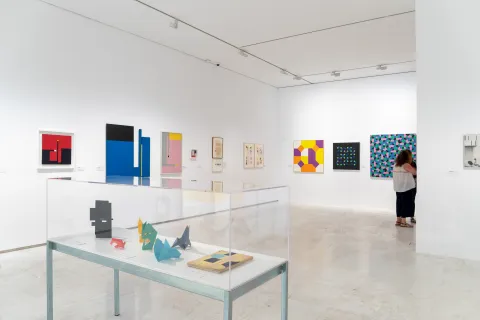
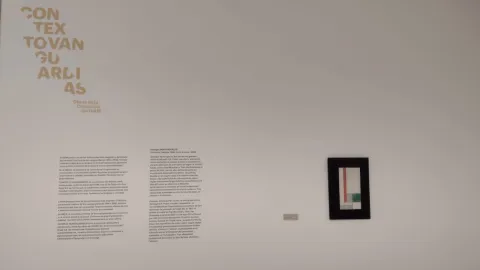
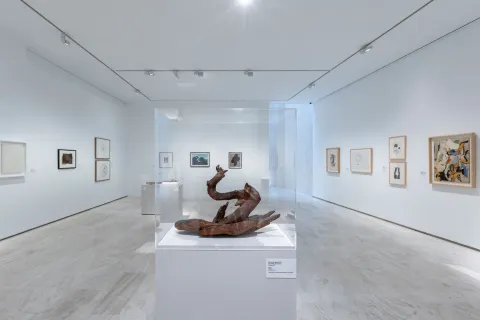
The MACA presents the third exhibition within the "Avant-garde Context" program with a work by Georges Vantongerloo. This program aims to maintain a permanent dialogue between the works from the IVAM collection belonging to the avant-garde movements of the first decades of the 20th century and the works from the 20th Century Art Collection, so that complementary readings are established, transversal perspectives, support and context for some pieces that, in communication with others, strengthen their language and message, while completing the vision of a fundamental era of modernity that travels paths between tradition and the new.

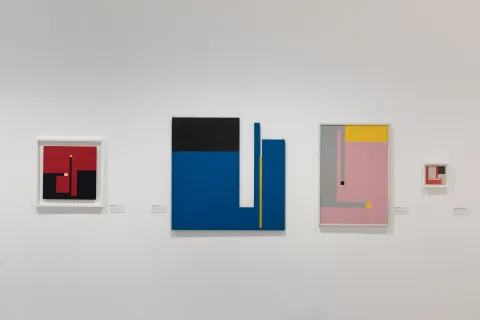
This third exhibition consists of a work from the IVAM collection by Belgian artist Georges Vantongerloo titled "Painted cement relief" from 1930, which is shown alongside other contemporary artists such as Julio González, Pablo Gargallo, and Juan Gris.

The Artist

Georges Vantongerloo (Antwerp, Belgium, 1886- Paris, France, 1965) was one of the great theorists of the 20th century. Painter, sculptor and architect, he reconceptualized the pictorial and sculptural space of abstract art in the early 20th century. In 1917 he founded the De Stijl group together with Piet Mondrian and Theo Van Doesburg, and in the 1930s he was part of the Abstraction-Création movement. His painting, based on the right angle and the relationship between lines and surfaces of flat colors, follows strictly geometric rules sustained by the idea of emptiness, silence and the absolute. Vantongerloo thus became the founder of mathematical thinking in modern art.
EXPO-0055
Imagen
WhatsApp-Image-2024-01-30-at-11.15.53.jpeg
Georges Vantongerloo
Rosa María Castells
Obras del Instituto Valenciano de Arte Moderno (IVAM)

Art in a Wasteland

Submitted by brandcode_deweloper on
IVAM Collection of Valencia

The endings of the Spanish Civil War and the Second World War propose antagonistic worlds, radically different scenarios, but both must be built upon barren ground; in pain, in the ruins and material and ethical debris that absolute destruction from war produces. And it does so under complex vital conditions: in exile, in emigration, in repression.

The two postwar periods represented a radical break for the history of culture. In Franco's Spain, the aesthetic project imagined from the Falange would attempt to reduce culture to state propaganda, break with the experimentalism of the avant-gardes and return to a certain academicism articulated from the idea of the national and the Catholic. In the nineteen fifties the need for international legitimation of the Regime would seek to continue instrumentalizing culture, but from an approach to more contemporary languages. That said, without losing the essences of "the Spanish and the Catholic." In the rest of the world, devastated after the war and its horrors, the break with the previous avant-gardes would come from the disturbing question about the relationship between civilization and barbarism. In both cases totalitarianisms, violence or cultural misery forced numerous artists to emigrate, to go into exile, and to work in the open. But their journey singularly enriched those territories that welcomed them.

Constituted fundamentally by works belonging to the IVAM collection, this exhibition attempts a reading in which more than the differences in style, continuities are contemplated, similarities, mutual echoes, the shared effort, when the fabric of historical events is such that it becomes absolutely determining in poetic, discursive, formal or stylistic decisions; in humanity's gaze and thought about itself

EXPO-0054
Imagen
3F1A2020.jpg
/sites/default/files/inline-images/resources/exposiciones/EXPO-0054/FOLLETO-ARTE-BALDIA_7.pdf
Manuel Ángeles Ortiz, Francesc Catalá i Roca, Man Ray, Henri Michaux, László Moholy Nagy, Jorge Oteiza, Kurt Schwitters, Georges Vantongerloo, Mauricio Amster Cats, Karel Appel, Monika Buch, Vicente Castellano Giner, José Miguel de Miguel Ruiz, Marcel Duchamp, Lucio Fontana, Menchu Gal, Manolo Gil Pérez, Jacinta Gil Roncalés, Arshile Gorky, Adolph Gottlieb, George Grosz, Raoul Hausmann, Hermanos Mayo, Asger Jorn, Franz Kline, Lee Krasner, Lucebert (Lubertus Jacobus Swaanswijk), Marcel Mariën, André Masson, Fausto Melotti, Barnett Newman, Carlos Pascual de Lara, Ad Reinhardt, Josep Renau, Pierre Soulages, Friedrich Vordemberge, Gildewart, Herbert List, Óscar Domínguez, Ricard Giralt, Miracle, Maruja Mallo, Mathias Goeritz, Luis Felipe Vivanco, Ángel Gullón, José Gumbau, Matilde Salvador
Esteban Vicente
Rosa María Castells
Obras de la colección del IVAM. La muestra ha estado con anterioridad en el Museo de Bellas Artes de Castellón.

Bruno Munari

Submitted by brandcode_deweloper on

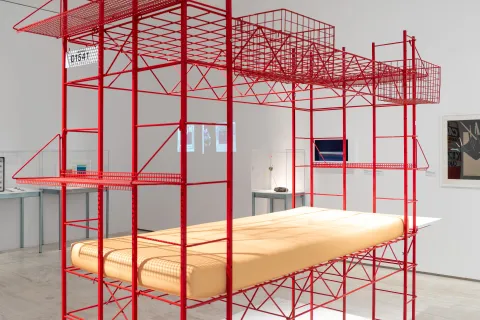
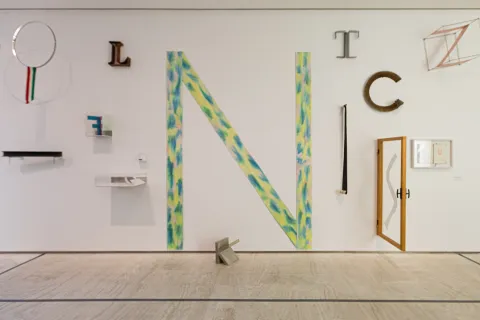
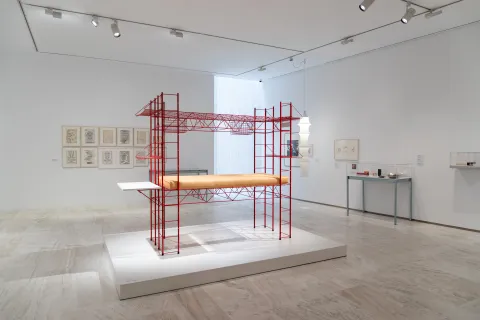
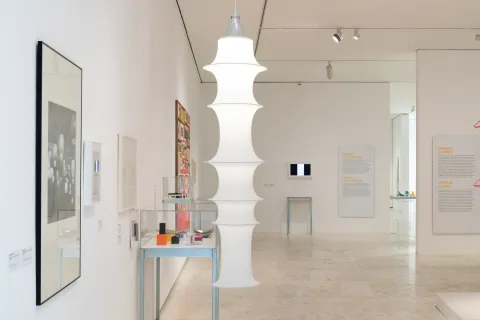
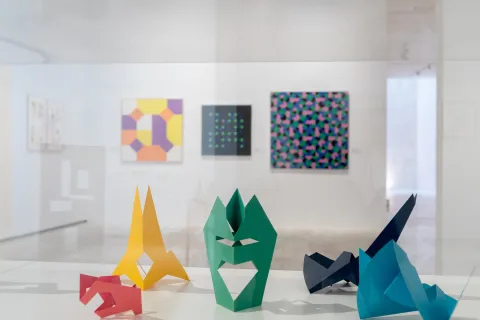
There are artists who have had a significant influence on twentieth-century culture and yet few people know them. Bruno Munari (Milan, 1907-1998), whom Picasso defined as "a Leonardo of our time", is one of those paradigmatic cases. This is the first retrospective exhibition dedicated in our country to Munari, conceived by the Juan March Foundation, which travels with a selection of works to the MACA, the Juan March Foundation Museum in Palma and the Spanish Museum of Abstract Art in Cuenca. Through approximately one hundred thirty pieces, it presents his plural activity in full and reveals the breadth of media that the author used in his plastic and visual research, always experimental and innovative. Indeed, in his work we find, as a pioneer, objects as works of art, graphic design as a profession, books as projects and games as investigations.

In 1927, at barely 20 years old, Munari exhibited his work for the first time, alongside that of second-generation Italian Futurist artists. Later he would distance himself from them to develop his own, extremely singular project. In 1930 he would make a turn towards abstraction, which culminated in his first "aerial machine". From that peculiar "machine" would be born his series of "useless machines", curious pieces based on the dynamism of forms. Munari's early interest in this subject would lead him later to investigate with technologies and processes that were then new, such as the photocopier or computer programming. His experiments with light would follow, and a type of works that overflowed with poetic ingenuity, such as the Fossils of 2000, the Travel Sculptures, the Speaking Forks, the Prebooks and the Illegible Books. Parallel to his work as an artist, Munari developed a very relevant activity as a graphic and editorial designer, in which he applied a rigorous method that purges the designed of the unnecessary, simplifies it and optimizes its function, thus making it enduring in taste and in time.

All of Munari's work seems animated by a strong pedagogical vocation. At the end of the 1970s he launched his "laboratories" for children at the Pinacoteca di Brera in Milan, workshops with active proposals to learn by doing, experimenting and playing. The present exhibition includes a "laboratory" specially designed for the occasion, to which a dedicated space is allocated within the rooms where children and young people will coexist with pieces from the great Lucini Alphabet, letters created by the artist from diverse materials. This monograph on the author has been conceived as if it were "a collective exhibition of Bruno Munari" (a subtitle that he himself gave to one of his exhibitions), because it presents a very varied set of processes and results that, with imagination and method, one person produced as if by magic: Bruno Munari.

EXPO-0053
Imagen
042A5538.jpg
/sites/default/files/inline-images/resources/exposiciones/EXPO-0053/IMPRENTA_BM_programa_de_mano_7.pdf
Bruno Munari
Rosa María Castells
En cooperación con la Fundación Juan March y cuenta con la colaboración del Consorci de Museus.

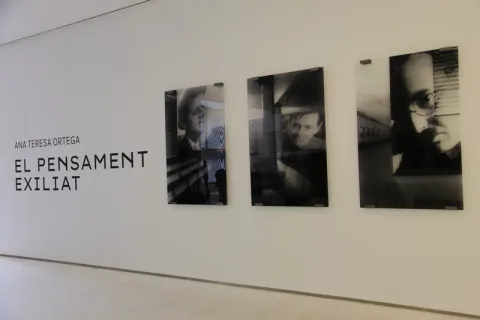
Exiled Thought. Ana Teresa Ortega

Submitted by brandcode_deweloper on
Contemporary Art Collection of the Valencian Generalitat

Ana Teresa Ortega is the 2020 National Photography Prize winner. The jury has recognized one of the artists who has most contributed to making photography a form of contemporary art. Her work is guided by an investigative will regarding the limits and possibilities of photography as a hybrid language, which dialogues with three-dimensionality and is in constant reflection.

Her work freed photography from the documentary function that dominated the medium until the seventies. Her early works experimented with visual rhetoric using the medium and montage techniques, especially with her photosculptures from the 1990s. In the early decades of the 2000s, Ortega understands photography as a tool for constructing collective memory and history, and her images invoke another time in which forgotten past and history that never was can appear.

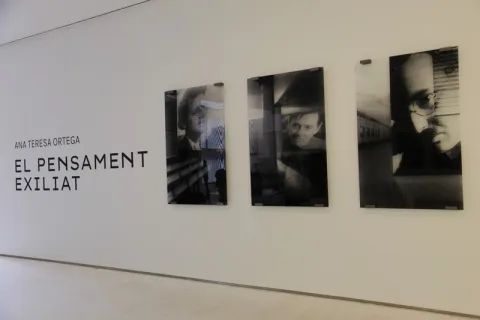
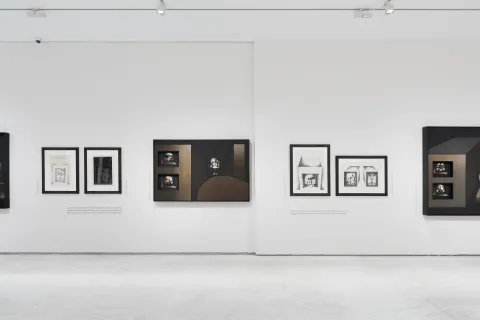
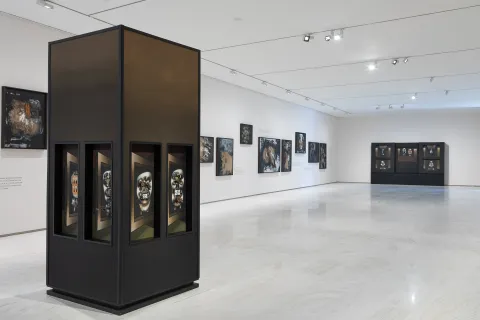
This is what happens in Thinkers (2002), where reflection on the intellectual heritage of the twentieth century and its transmission become image. Through a play between installation and photomontage, projections of writers' faces are photographed on empty architectural spaces. The images show these portraits, extracted from encyclopedias, on facades, interior walls, hallways or in doorways and stairwells: the enlarged face of Walter Benjamin is cut off at the corner of a factory; the gaze of Ángel Valente is framed between cement pillars; Joyce seems to sigh, pensive, long like a venetian blind.

The series consists of 24 images of projected portraits, from Zambrano's Z to Arendt's A, and forms an inverted alphabet of the century's intellectual legacy, with one peculiarity: all the portraits belong to exiled thinkers. Writers reluctant to the social, political and cultural environment of their time, who saw in writing the place and refuge to express their discontent with the world. Their committed writings reflect freedom, intelligence and hope, and their different conceptions of the world remain alive in our memory today.

The photographs were taken in suburban spaces, because they speak of thought in the margins, a metaphor for the physical or psychological confinement that all of them suffered. It is about thinking exile. Not about bringing back those who left—perhaps they were never present—but about invoking them as lost. And doing so through photographs of projected photographs of a third photograph that is the encyclopedic portrait, with a reflection on the trace: photographs, as imprints of light, are the trace and form the trail of that which is exiled in memory: an exile of light. To look at the gaze of Valente, Joyce and Benjamin and think about their trace. As if the past were not dead. As if it were not even past.

This work belongs to the Art Contemporani Collection of the Generalitat Valenciana. Since 2017, the Ministry of Education, Culture and Sport has maintained a line of acquisition of artworks with the dual purpose of stimulating the contemporary art market, while also gathering a collection of works representative of the artistic present in our Community. Different generations and sensibilities that approach the artistic creation process, offering new perspectives on your closest world.

EXPO-0052
Imagen
IMG_8790.jpg
Rosa María Castells
Col·lecció Art Contemporani de la Generalitat Valenciana

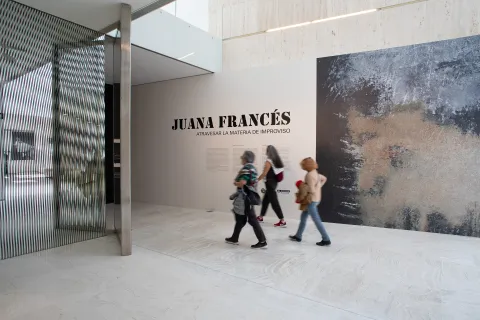
Juana Francés. Crossing Matter Unexpectedly

Submitted by brandcode_deweloper on
Juana Francés Collection of the MACA

Juana Francés de la Campa (Alicante, 1924 – Madrid, 1990) is one of the most powerful artists in the Spanish art scene of the second half of the twentieth century. There were very few women in the avant-garde front line, but she was always there, with her own personality, attentive to the artistic concerns of a generation of artists who revolutionized art, driven by a coercive political, social and cultural situation.

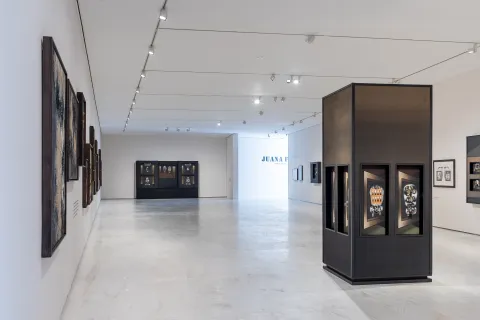
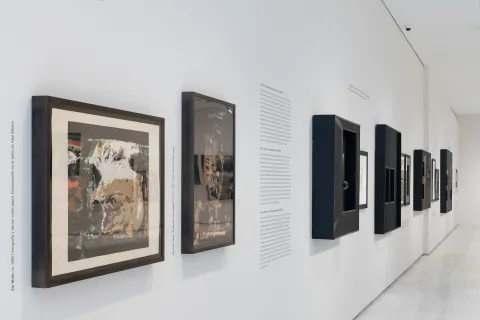
Juana's painting emanates a persistent murmur: a profound unease, an anguish that surfaces in all her works. Whether through subject matter, composition, gesture, material or color, Juana Francés' painting is wrapped in an unbreathable atmosphere. They are hard, complex, committed and suffocating works… but of great pictorial quality that stood out then in the most important biennials and international exhibitions of contemporary Spanish art. Juana enjoyed national and international recognition. Art history has forgotten her since. And it is necessary to recover her.

Juana Francés performed an act of generosity toward the city of Alicante in 1990. Upon her death, she donated her collection to the museums of four Spanish cities: Zaragoza, Madrid, Valencia and Alicante. Thus it was, and today, the Juana Francés Legacy belongs to the collections of the Museum of Contemporary Art in Alicante for the enjoyment of all.

EXPO-0051
Imagen
042A0228.jpg
/sites/default/files/inline-images/resources/exposiciones/EXPO-0051/HOJA-SALA-ESPANOL_7.pdf
Rosa María Castells

Abel Martín in the Geometric Context of the 20th Century Art Collection

Submitted by brandcode_deweloper on

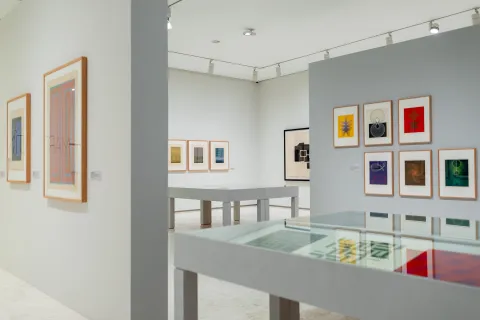
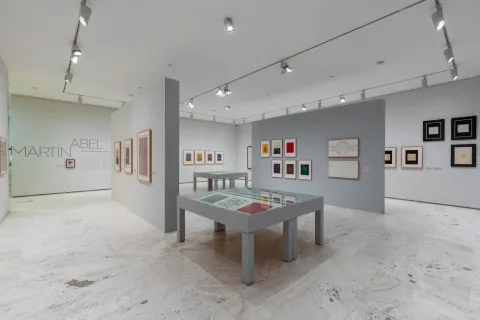
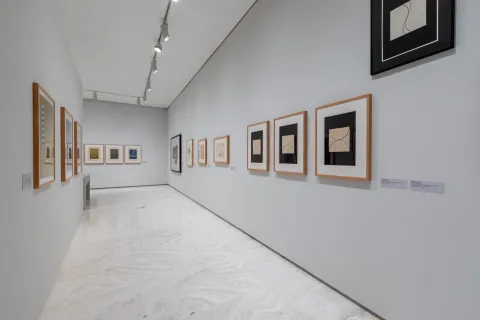
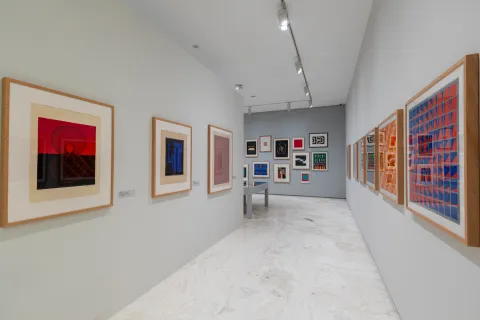
Eusebio Sempere and his partner Abel Martín learned the silkscreen printing technique in Paris. Upon their return to Spain in 1960, they introduced this printing technique by creating beautiful silkscreens of themselves and their artist friends, thus spreading abstract art which was unknown until that moment. At first, Sempere and Abel worked together and later, in the mid-1960s, Abel alone took charge of the technical process. And thus he became a key figure in the reproduction and dissemination of contemporary art in our country.

The profound conviction that graphic work deserved the status of an original work, that it brought contemporary art within reach of a large majority of the public, turning it into a mass phenomenon, and the respect and enthusiasm that both professionals profess for graphic work, has an impact on the Art of the 20th Century Collection itself. An impressive display of drawings, engravings, lithographs and silkscreens completes the extensive list of essential artists, thus exploring the suggestive territories of the artistic framework of the 20th century. This exhibition shows the works created in a specific context, from the kinetic artists of Paris to the Spanish geometric artists.

The work of Eusebio Sempere printed in silkscreen by Abel Martín is well known and a display of technique and craftsmanship. However, the printed work that Abel Martín creates as an artist is very little known. It develops in just four years, from 1968 to 1972 and comprises very few pieces, some of which are shown here.

EXPO-0050
Imagen
042A0918.jpg
/sites/default/files/inline-images/resources/exposiciones/EXPO-0050/Folleto-Abel-v02-ESP_7.pdf
Auguste Herbin, Wilfredo Arcay , Manuel Barbadillo , Waldo Díaz-Balart, José Luis Gómez Perales, Hans Hiterreiter, Joaquín Barceló
Rosa María Castells

Text [No Text]

Submitted by brandcode_deweloper on
Books and Artist Publications Collection Universitat Politècnica de València


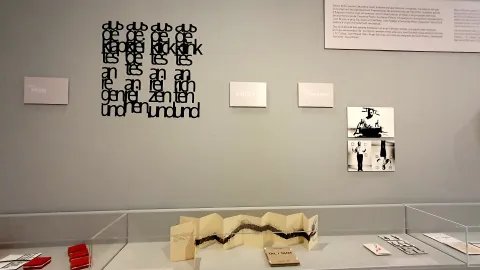
When reviewing history from the perspective of the present, specifically the contributions and importance of books produced by artists from the sixties and seventies onwards, when viewed from the current situation, a surprising updating occurs of the emergence and recognition of Fluxus, conceptual or minimalist artistic practices, but, above all, of the production of artist books and publications during that period.

It was in the early 1960s, the same decade in which conceptual art was formulated, when a truly different approach emerged regarding the conception of artist books, as well as their realization and the form of distribution. During that period, the book occupied a central place in the production of relevant contemporary artists, while also being the subject of critical theories about authorship (or, rather, the lack of authorship), the elimination of text or image in the book and, no less importantly, about the impact of new technologies on the mass production of works of art.

The artists who decided to work with the book as a plastic medium, assumed that their publications, in addition to functioning as an artistic product, would work as purely communicative instruments produced through more economical systems and would be easy to obtain. They set out to work with the techniques and printing processes that were most advanced at the time, the reproduction of black and white photography through offset or Xerox, which allowed them to produce numerous editions quickly and at low cost. And, according to these criteria, they radically distanced themselves from previous productions, the so-called livres d'artiste or illustrated books, as well as from any of the other commitments of artists who used the book in the first half of the twentieth century.


EXPO-0049
Imagen
20201008_115729.jpg
/sites/default/files/inline-images/resources/exposiciones/EXPO-0049/MACA_TEXTNOTEXT_HOJADESALA_DIGITAL_7.pdf
Dick Higgins, Edward Ruscha, Bruno Munari, Richard Hamilton
Antonio Alcaraz

Look at Me! Portraits and Other Fictions in the "la Caixa" Collection of Contemporary Art

Submitted by brandcode_deweloper on

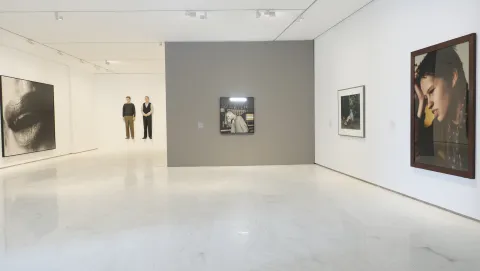
When we meet someone, the first thing we look at is their face in search of the signs that distinguish it. We follow their gaze, their gestures, and we pay attention to each of their expressions. We do the same when we look at a portrait, whether in painting, photography, sculpture or film, even though we know it is a representation, an image composed by someone with a specific intention.

Traditionally, the portrait has been a means to create the image of a character and distinguish it from the rest of society. Fidelity and resemblance to the subject portrayed have been essential conditions, although the ultimate goal has always been to reflect their identity. And this is where art poses questions to us: painting, photographing, drawing... is not reproducing or revealing a "self" but creating an image. Nowadays we all portray ourselves continuously but, as Roland Barthes said, when we look at the lens of a camera we act as if we were "another." Popularly we say that the camera does not lie, but we all know that in the portrait there is something of fiction, that in reality it is a re-presentation.

The portrait has reached our days by expanding its definition. With new concepts, techniques and languages, the most recent art deploys multiple possibilities for producing images of the human condition and exploring the complex notion of identity, as well as the social implications that it entails. The works exhibited come from the "la Caixa" Collection of Contemporary Art and gathered here they return our gaze to us as a social mirror in which we ask ourselves those eternally human questions: who are they? how do I see them? who am I? how do they see me?.

EXPO-0048
Imagen
1047637.jpg
/sites/default/files/inline-images/resources/exposiciones/EXPO-0048/Folleto-v04-A4-AF_7.pdf
George Maciunas, John Cage, David Degener, Walter de María, Henry Flynt, Yoko Ono, Dick Higgins, Nam June Paik, Dieter Roth, La Monte Young, Emmet Williams, Daniel Spoerri, Robert Filliou, Ken Friedman y Mike Weaver, Felipe Ehrenberg, Ulises Carrion, Edward Ruscha, Andy Warhol, Bruno Munari, Sol LeWitt, Carl Andre, Robert Barry, Douglas Huebler, Joseph Kosuth, Robert Morris, Laurence Weiner, Hans Peter Feldman, Richard Hamilton, Bernd & Hilla Becher, Christian Boltanski, John Baldesari, Annette Mesager, Matt Mullican, Richard Prince, Peter Piller, Lawrence Weiner, Sophie Calle, Jenny Holzer, Barbara Kruger, Antoni Muntadas, Ignasi Aballí, Isidoro Valcárcel Medina, Clemente Padín, Edgardo Antonio Vigo, Guillermo Deisler, Franz Mon, Joan Brossa, Frederic Amat, Fernando Millán, Jiri Kolar, Bartolomé Ferrando, David Pérez, Manuel Costa, Carmen Navarro, Vicente Plá, Jiri Valoch, Antonio Gómez y Eduardo Scala.
Nimfa Bisbe

Automatic Garden. Olga Diego

Submitted by brandcode_deweloper on

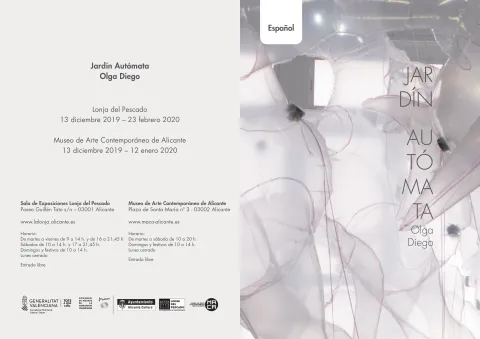
Automated Garden is a gigantic installation made up of almost a hundred inflatable and electronic sculptures inspired by the beautiful, extravagant and suggestive characters from Bosch's Garden of Earthly Delights, which is exhibited mostly in the Exhibition Hall of the Lonja, and which has a small representation in the MACA.

Attracted by the Procession of Desire painted on the central panel of the triptych, Olga Diego discovers naked human beings who enjoy, together with animals of all species, a world of unlimited pleasure. Lust represented in multiple and unimaginable forms. A suggestive world where we also find beautiful birds, fish and exotic fruits. Olga Diego builds that imaginary world in Automated Garden, a visual and creative orgy, a labyrinth of large translucent and transparent bodies that suggest a magical existence. The characters, in continuous movement and endowed with heart, mark with their rhythms an indecipherable electric symphony. Humanoids of all genders, simple and mixed quadrupeds, hybrid beings, women with large breast-antennas, globe-headed animals, the mutant giraffe, bird-boy with tortilla-wings, eggs and fish with legs, flying hermaphrodites, fruits with tentacles, two-headed dogs, strange birds with adapted wings, and a long etcetera.

Automated Garden has been a constructive challenge, but also an insinuating paradise in terms of the forms to be created. A lust converted into sin, religious in its time and profane now, due to the terrible consequences that continuous waste, unlimited consumerism and excessive use of plastic already have for humanity.

EXPO-0047
Imagen
Olga-Diego_Alicante-ESP_page-0001.jpg
/sites/default/files/inline-images/resources/exposiciones/EXPO-0047/Olga-Diego_Alicante-ESP_7.pdf

Grayscale

Submitted by brandcode_deweloper on
Mediterranean Foundation Collection

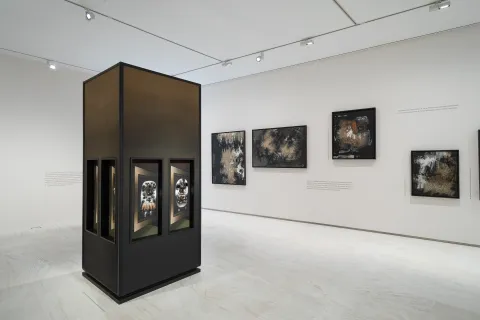
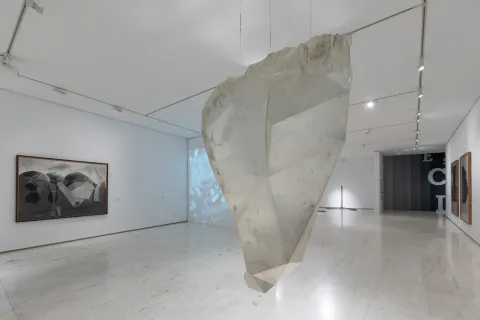
Grayscale brings together a series of works from the Fundación Caja Mediterráneo Collection, deposited in this Museum of Contemporary Art in Alicante, which share a common reflection on matter and its physical presence while consciously abandoning color and sometimes, form. Color in art history is as important as its negation, and the conscious declaration of its absence has been equally revolutionary thought. Although the choice of color is always a chemical process, its meaning has varied according to the era. Black and white. The negation of color or the sum of all. Two chromatic values that give rise between them to an infinite scale of degrees of luminosity. From light to darkness: the Grayscale. An ordered and gradual system of percentage of black over white that leads to light, medium, and dark gray, and to an endless range of intermediate grays.

From different perspectives and through various techniques, the exhibited artists have given material a substantial role in the aesthetic and conceptual debate of their works. They have chosen highly varied textures: Steel, lead, titanium, glass, iron, aluminum, asbestos cement, mirror or ceramic and graphite, paper, linen or wood. Matter becomes conscious and its presence is reclaimed. In the same way as sound. The physical properties of each element turn sculptures, photographs, films, paintings and drawings into complex works that reflect the intense relationship that has been produced between the artist and matter. 

A display of subtle chromatic balances, of cracks of clarity through which time escapes while the echoes of our presence sound in the room, literally.

EXPO-0046
Imagen
042A9973.jpg
/sites/default/files/inline-images/resources/exposiciones/EXPO-0046/folleto-escala-de-grises-CAST_7.pdf
Sergi Aguilar, Jordi Alcaraz, Rosa Brun, Carmen Calvo, Joan Cardells, Hannah Collins, Jon Mikel Euba, Rafael Lozano-Hemmer, Íñigo Manglano-Ovalle, Enric Mestre, José Antonio Orts y Amparo Tormo.

Rosa María Castells