Exiled Thought. Ana Teresa Ortega
Ana Teresa Ortega is the 2020 National Photography Prize winner. The jury has recognized one of the artists who has most contributed to making photography a form of contemporary art. Her work is guided by an investigative will regarding the limits and possibilities of photography as a hybrid language, which dialogues with three-dimensionality and is in constant reflection.
Her work freed photography from the documentary function that dominated the medium until the seventies. Her early works experimented with visual rhetoric using the medium and montage techniques, especially with her photosculptures from the 1990s. In the early decades of the 2000s, Ortega understands photography as a tool for constructing collective memory and history, and her images invoke another time in which forgotten past and history that never was can appear.
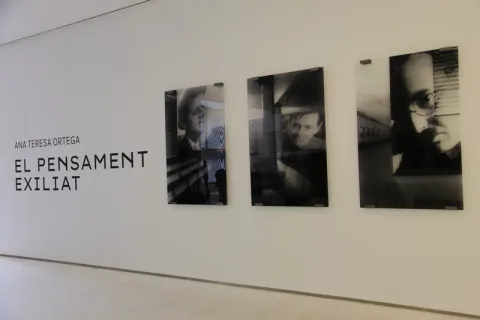
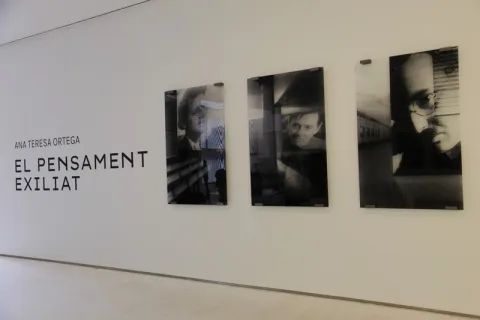
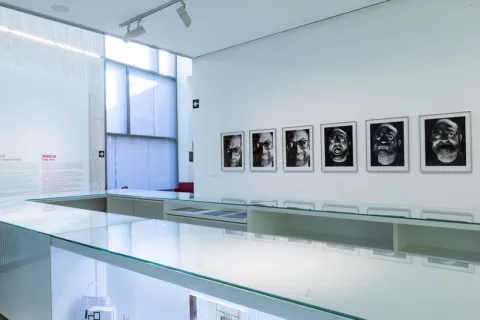
This is what happens in Thinkers (2002), where reflection on the intellectual heritage of the twentieth century and its transmission become image. Through a play between installation and photomontage, projections of writers' faces are photographed on empty architectural spaces. The images show these portraits, extracted from encyclopedias, on facades, interior walls, hallways or in doorways and stairwells: the enlarged face of Walter Benjamin is cut off at the corner of a factory; the gaze of Ángel Valente is framed between cement pillars; Joyce seems to sigh, pensive, long like a venetian blind.
The series consists of 24 images of projected portraits, from Zambrano's Z to Arendt's A, and forms an inverted alphabet of the century's intellectual legacy, with one peculiarity: all the portraits belong to exiled thinkers. Writers reluctant to the social, political and cultural environment of their time, who saw in writing the place and refuge to express their discontent with the world. Their committed writings reflect freedom, intelligence and hope, and their different conceptions of the world remain alive in our memory today.
The photographs were taken in suburban spaces, because they speak of thought in the margins, a metaphor for the physical or psychological confinement that all of them suffered. It is about thinking exile. Not about bringing back those who left—perhaps they were never present—but about invoking them as lost. And doing so through photographs of projected photographs of a third photograph that is the encyclopedic portrait, with a reflection on the trace: photographs, as imprints of light, are the trace and form the trail of that which is exiled in memory: an exile of light. To look at the gaze of Valente, Joyce and Benjamin and think about their trace. As if the past were not dead. As if it were not even past.
This work belongs to the Art Contemporani Collection of the Generalitat Valenciana. Since 2017, the Ministry of Education, Culture and Sport has maintained a line of acquisition of artworks with the dual purpose of stimulating the contemporary art market, while also gathering a collection of works representative of the artistic present in our Community. Different generations and sensibilities that approach the artistic creation process, offering new perspectives on your closest world.