The Invited Piece. Vulnerability(ies). Henri Cartier Bresson

Submitted by brandcode_deweloper on
Collection For the Love of Art, Bombas Gens, Valencia

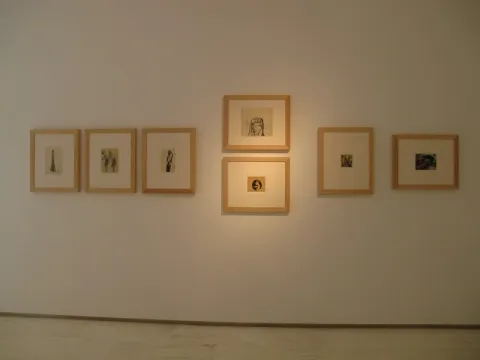
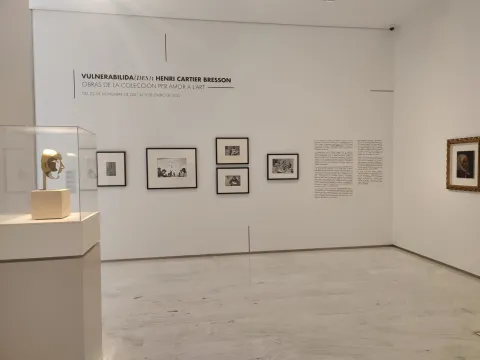
The five photographs by Henri Cartier Bresson shown here belong to the Per Amor a l'Art Collection – Per Amor a l'Art Foundation of Valencia. These works invited to the MACA are part of the exhibition project Vulnerability(ies), carried out in collaboration with Bombas Gens Centre d'Art and the Museum of the University of Alicante.

Vulnerability is a complex reality that has acquired notable prominence in recent times as a result of phenomena such as social inequality, the effects of climate change, gender-based violence, migratory movements, and the recent Covid pandemic. Theoretical reflection on human vulnerability is not recent; however, the urgency of responses to the moment we are living in, so compromised in many aspects, has validated its relevance.
We immediately associate the concept of vulnerability with that of fragility. To be vulnerable is to be a fragile subject. We often transfer this condition onto others based on their gender, their body, or their social position, but we avoid the thought that this state is constitutive of our own experience and, therefore, inherent to human nature. Feminist thinker Judith Butler has proposed rethinking vulnerability as a means to illuminate other models of living together, based on the recognition of interdependence between subjects and the need for care. Therefore, vulnerability is not a reason for inaction or submission but an opportunity for social emancipation and political resistance.
With this spirit, the exhibition Vulnerability(ies) emerges: as an approach to experiences of fragility from artistic practices that encourages us to understand ourselves as vulnerable beings – both in social and individual aspects – but capable of acting collectively to build new forms of relationship between us and between us and nature.

Henri Cartier Bresson (1908-2004) is one of the fundamental names in the history of photography of the last century. He was a pioneer of modern photojournalism, promoter of the Magnum Photos agency, and creator of the concept of the decisive moment: the sensation of making the eye, the head, and the heart coincide in a concentrated gesture that allows capturing reality by surprise.
Born in France, he wanted to dedicate himself to painting and began to frequent artists, especially surrealists, who decisively marked his almost pictorial gaze that he would express in images far from the anecdotal and as close as possible to the intimate truth of people. He always used black and white and was an enemy of color and the use of flash.
A man of strong political convictions, anticolonialist and republican, his commitment placed him in the most iconic revolutionary scenarios, making him an inveterate traveler. In the 1930s he traveled through several Spanish cities, including Alicante, where he captured with his lucid camera these famous images.

Works:

Henri Cartier Bresson
Alicante, Spain, 1933
Silver gelatin print
Per Amor a l'Art Collection, Valencia.

Henri Cartier Bresson
Alicante, Spain, 1934
Silver gelatin print
Per Amor a l'Art Collection, Valencia.

Henri Cartier Bresson
Madrid, Spain, 1933
Silver gelatin print
Per Amor a l'Art Collection, Valencia.

Henri Cartier Bresson
Madrid, Spain, 1933
Silver gelatin print
Per Amor a l'Art Collection, Valencia.

Henri Cartier Bresson
Flooding, Spain, 1933
Silver gelatin print
Per Amor a l'Art Collection, Valencia.
EXPO-0077
Imagen
WhatsApp-Image-2021-11-25-at-11.00.33.jpeg
Henri Cartier Bresson
Rosa María Castells
Obras de la Colección Per Amor a l’Art

The Invited Piece. Juan Genovés: Narrative

Submitted by brandcode_deweloper on
Martínez Guerricabeitia Collection of the University of Valencia

Through this exhibition program "The Invited Piece," MACA aims to bring to the public works temporarily loaned by other institutions that acquire a new meaning in the Museum when presented as an exhibition of a single work in relation to the context of the permanent collection. The Twentieth Century Art Collection allows for an enriching program of invitations. Specific works that, in dialogue, discussion, contiguity or contradiction, are shown immersed within the museum's exhibition context. On this occasion we have invited the Martínez Guerricabeitia Collection to share space with a splendid work by Valencian artist Juan Genovés. JUAN GENOVÉS

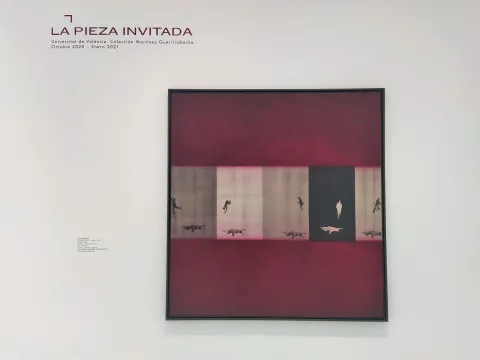
Relato, 1968
Acrylic and oil on canvas
180 x 170 cm.
Signed and dated on the back
MARTÍNEZ GUERRICABEITIA COLLECTION
Universitat de València

Relato won one of the prestigious Marzotto awards in 1968. It clearly presents the discoveries that sparked international interest in his painting: figuration as a way to transmit unambiguously a fact. The incorporation of flat space and, finally, the eminent narrative, sequential and modular character of the representation. The central motif of the painting is framed by two broad horizontal red stripes created with an airbrush as a screen that marks a distance between the viewer and the scene. A vibration in murky red reinforces awareness of the drama that unfolds. The central area is occupied by a sequence divided into five reiterated images, like cinematographic frames that appear poorly defined, in the grisaille in which beings are perceived from a great distance. The resources employed by Genovés: the reduced size of the figures, the point of view, the chromatic contrast, the dramatic effects of photography provoke the emotional involvement of the viewer in an empathetic identification with the victim.
The narration, something that happens and disappears leaving barely any traces, is captured as if being observed through a telephoto lens or viewfinder, not of the artist or the viewer, but of power, of the coercive apparatus of terror. Imbued with cinematic and literary culture, Genovés's gaze accounts for the human condition in the face of the oppressive presence of power.
The Martínez Guerricabeitia Collection is a peculiar and atypical collection. Composed of a total of 520 pieces, it is centered on artists whose mode of artistic expression is figuration and realism and whose intention, whose ideological content is always criticism, dissidence and commitment. Formed by Jesús Martínez Guerricabeitia, it was donated to the University of Valencia in 1999.

EXPO-0076
Imagen
La-pieza-invitada_Genoves-scaled.jpg
/sites/default/files/inline-images/resources/exposiciones/EXPO-0076/hoja-sala-pieza-genoves-cast_5.pdf
Rosa María Castells
Universitat de València. Colección Martínez Guerricabeitia

The Invited Piece. 7 Drawings by Julio González

Submitted by brandcode_deweloper on
Deposit at the MACA

MACA - Museum of Contemporary Art of Alicante presents the
works by Julio González deposited at MACA by Florencio
Martín, heir of Eusebio Sempere.
These are significant works that demonstrate the importance of
the collections that the Alicante artist gathered with the intention of
increasing the 20th Century Art Collection but which unfortunately
never reached this museum. Now, with this deposit, it is an
unparalleled opportunity to fulfill his intention.
These drawings by Julio González accompany the splendid works
that the 20th Century Art Collection possesses: "Montserrat criant nº 2";
"Nature morte"; "Petit masque aéré" and "Petite maternité assise",
expanding the Museum's vision of this artist. Julio González (1876-1942)
Julio González is considered one of the great names in modern
sculpture. He trained as a craftsman in artistic metalwork that
his father had in Barcelona. His work with iron, with which he created his own
language, has been valued as one of the most valuable contributions
of the avant-garde movements of the thirties, although he only dedicated one decade of his
life to creation with this metal. González began working with iron at
the end of the twenties, when he was already over fifty years old, and
although he had already worked with metal to create jewelry and various decorative objects,
it was then when he began to create small reliefs in
embossed copper and, later, to experiment with small sheets,
creating heads and female figures. It was contact with Picasso, with whom
he collaborated between 1928 and 1932, that allowed him to recognize the possibilities
that iron had for sculpture. The artist from Málaga asked him in 1928
for technical collaboration in the creation of a series of iron works, among
them a sculpture for a monument in homage to Apollinaire and Femme
au jardin.
His artisan origins, the knowledge of the possibilities that iron offered him,
together with great imaginative freedom and the sensitivity of a
great artist, allowed him to create a new, very personal language. He
joined the avant-garde with new and powerful sculptural forms and a
personal language, described as abstract, which had as its essential objective the
marriage between forms and space. In his sculptures, space is part of
the work itself, initiating a path that many other
sculptors such as David Smith or Eduardo Chillida would later follow. González himself applied the
term "drawing in space" to a part of his work, the one he created with
iron bars or rods.
The filiform or linear sculptures –what he himself called drawing in
space–, the volumetric heads or the biomorphic figures are the result of
work of great technical and conceptual rigor that would open the doors to
recognition as one of the great sculptors of the 20th century.

EXPO-0075
Imagen
IMG_4300.jpg
/sites/default/files/inline-images/resources/exposiciones/EXPO-0075/Hoja-de-sala-JULIO-GONZALEZ_5.pdf
Rosa María Castells
Colección Florencio Martín

The Invited Piece. Pablo Picasso, Luis Fernández and Julio González: Piece of Syrup, Head and Mask

Submitted by brandcode_deweloper on
Deposit at the MACA

The MACA - Museum of Contemporary Art of Alicante presents works by Pablo Picasso, Luis Fernández and Julio González, deposited at the MACA by Florencio Martín, heir of Eusebio Sempere, which can be enjoyed from July 25, 2017.

These are significant works that demonstrate the importance of the collections that the Alicante artist gathered with the intention of expanding the 20th Century Art Collection, but which unfortunately never reached this museum. Now, with this deposit, it is an unparalleled opportunity to fulfill his intention.

These pieces accompany in the space the splendid works of Julio González, Juan Gris and Pablo Gargallo that the 20th Century Art Collection possesses. Pablo Ruiz Picasso (Málaga, 1881 – Mougins (France), 1973)
One of the greatest artists of the 20th century, who participated in numerous artistic movements.
Picasso frequently resorts to El Greco, one of his favorite painters, in a return to his Spanish roots. Picasso admired "The Burial of the Count of Orgaz" by El Greco, a painting to which he dedicated a book that he composed between 1957 and 1959. A monumental book that Picasso illustrates with his own poetry based on his life and his Andalusia.
This is a book illustrated by Pablo Picasso, one of the most important within his production. The publication consists of a prologue and text by Rafael Alberti and 12 etchings and one engraving. The text of the volume is dated 1939, handwritten by Picasso himself in color lithography and is accompanied by etchings and dry point. The book demonstrates the knowledge Picasso had of the techniques of André Breton's group and proof of this is the automatic writing that is published in facsimile accompanying the series of engravings, a surrealist experience of the Count of Orgaz where eroticism and pornography are recurring themes: exotic scenes, circus scenes or allegorical scenes imbued with eroticism.
"Included in The Burial of the Count of Orgaz is this engraving that dates from 1939, and which, in accordance with the technique, but also with Picasso's feeling of that time, shows a rigidity and linear intensity very characteristic. The idea of including this print in the book came to Picasso from the text that he engraved in harmony with letter and drawing. It is a brief fragment, but its stylistic characteristics already foreshadow those that distinguish the unbridled paragraphs of the Burial, with its disdain for logic and even for spelling, if it is not a taste for openly violating it. Therefore, this engraving that unites text and drawing, and which emerged as pure expression of a lyrical moment, indeterminate perhaps, comes to enrich the copies of the ninth volume of La Cometa Editions."
Explanatory text about the engraving included in The Burial of the Count of Orgaz, edited and printed by Editorial Gustavo Gili, S.A. of Barcelona in 1969. Luis Fernández (Oviedo, 1900-Paris, 1973)
He studied at the School of Fine Arts in Barcelona. He moved to Paris where he came into contact with avant-garde artistic movements. There he met artists such as Lipchitzi, Braque, Ozenfant, among others and the Spanish artists Joaquín Peinado, Francisco Bores, Julio González and Picasso. These artists gave him the opportunity to know and work with the different artistic isms of the avant-gardes: cubism, purism, neoplasticism followed later by surrealism. His work evolved progressively toward a more personal and hermetic world.
This preparatory drawing confirms the architectural and geometric features that the artist has studied carefully, examining the different relationships between the parts, using geometric resources to create figures of strong intensity.
Like the original, the image is based on the number three: three necks, three chins, three noses, ... three heads, in this way the central one partially uses the elements of the two lateral ones. Three heads constituted rhythmically, architecturally: the ciliary arches appear supported by the columns that are the nose, and these rest on the lips of the mouth, are adorned with the arches of the nasal lobes and stand out with the spheres of the three chins. The rhythm is established in the verticality of all these motifs but also in the horizontal superposition of arches, circles and straight lines.

Julio González (Barcelona, 1876 – Arcueil (France), 1942)
Julio González is considered one of the great names in modern sculpture. He trained as a craftsman in artistic metalwork that his father had in Barcelona. In Paris, the city to which he moved with his family, he came into contact with Spanish artists such as Gargallo, Sabartés, Hugué and Picasso. But it was the contact with Picasso, with whom he collaborated between 1928 and 1932, that allowed him to recognize the possibilities that iron had for sculpture. His work with iron, with which he created his own language, has been valued as one of the most valuable contributions of the avant-gardes of the thirties, although he only dedicated a decade of his life to creation with this metal.
In his sculptures his antecedents are found in the works of Pablo Gargallo, space is part of the work itself, initiating a path that many other sculptors later followed such as David Smith or Eduardo Chillida. González himself applied the term "drawing in space" to a part of his work, the one he created with iron bars or rods.
Filiform or linear sculptures –what he himself called drawing in space–, volumetric heads or biomorphic figures are the result of work of great technical and conceptual rigor that would open the doors to recognition as one of the great sculptors of the 20th century.
Mask is a watercolor made by Julio González in 1940 that belongs to a series of studies for masks of geometric character. The artist takes his own portrait as a model to work and modify the proportions and features of his face, taking them to an abstract reorganization.
This is a silkscreen print of the watercolor made by González, printed by Eusebio Sempere and Abel Martin for the exhibition that took place at the Ateneo of Madrid in 1960 about Julio González.

EXPO-0074
Imagen
descarga.jpg
/sites/default/files/inline-images/resources/exposiciones/EXPO-0074/Hoja-sala-dep-Florencio_5.pdf
Luis Fernández
Rosa María Castells
Colección Florencio Martín

The Invited Piece. René Magritte: The Beautiful Society

Submitted by brandcode_deweloper on
Telefónica Foundation Collection

This original and avant-garde work accompanies the exhibition of works from the Twentieth Century Art Collection; it is displayed alongside very relevant pieces from the MACA, such as Kiki of Montparnasse by Pablo Gargallo, canvases and sculptures by Julio González or sharing the avant-garde space among Miró, Juan Gris, Alexander Calder or Ángel Ferrant.

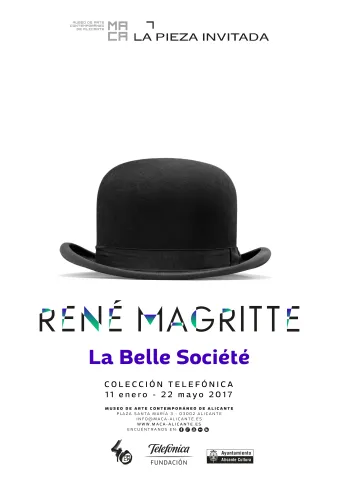
In 1927 René Magritte [Lessines, Hainaut, (Belgium), 1898–Brussels, (Belgium), 1967] moved to Paris, where he befriended André Breton and became one of the most prominent members of the surrealist group. His compositions are characterized by the juxtaposition of everyday objects in unusual contexts, represented with refined painting in clear colors and flat backgrounds. This work captures one of his most celebrated motifs, the man wearing a bowler hat and faceless, which has often been interpreted as Magritte's own alter ego. Here, the figure appears duplicated and silhouetted to contain, respectively, dense foliage and a landscape with sky and clouds as protagonists. This peculiar mixture between reality and fiction produces a disconcerting image, characteristic of the Belgian master's style.

In La Belle Société, painted by the artist shortly before his death, he superimposes two silhouettes of the same character, but replaces the image of a man with contours that contain natural and landscape motifs; dense vegetation, and in front, an identical profile of beach and horizon. The silhouettes act as if they were two windows onto external reality; perhaps they observe each other, perhaps there is a perpetual conversation between two different types of nature that fail to intertwine. Far from succumbing to the automatism of the freest current of surrealism and yet without abandoning the taste for the dreamlike or psychoanalytic, Magritte draws with a sure, clean, almost simple line, with simple forms in pursuit of freedom and expressiveness of thought.

Magritte explained his conception of painting thus: "The painted image is, on one hand, the description of the visible world modified by a way of thinking, or on the other hand, the painted image is the description of the visible world understood in a spontaneous way".

EXPO-0073
Imagen
Magritte_page-0001.jpg
/sites/default/files/inline-images/resources/exposiciones/EXPO-0073/hoja-sala-magritte-castellano-valenciano_5.pdf
René Magritte
Rosa María Castells
Colección Fundación Telefónica

Avant-garde Context 6. Frantisek Kupka

Submitted by brandcode_deweloper on
IVAM Collection of Valencia

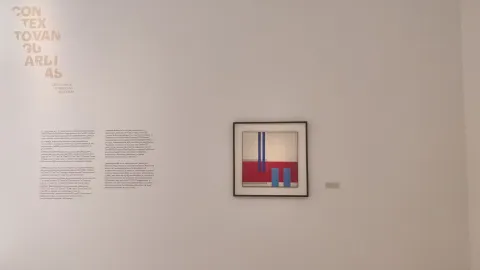
The MACA presents a work by artist Frantisek KUPKA from the collections of the Valencian Institute of Modern Art (IVAM), within the dialogue between collections established since 2021 in the "Contexto Vanguardia" program. The work can be viewed until September 2025.

This is the sixth exhibition within "Contexto Vanguardia" which seeks to maintain a permanent dialogue between the works from the IVAM collection belonging to the avant-gardes of the first decades of the twentieth century and the works from the MACA's Twentieth Century Art Collection, so that complementary readings are established, providing support and context for some pieces that, in communication with others, strengthen their language, thus allowing visitors to enjoy artists not represented in the MACA while completing the vision of the avant-gardes. The objective is to create content and share knowledge.

Proportions / Proporciones, 1934. Oil on canvas is the work that can be seen.

The artist
Frantisek KUPKA is one of the pioneers of abstraction. Trained in Prague and Vienna, he first settled in Paris where he embraced neo-impressionism, symbolism and modernism and later, in Puteaux, relating to the cubism of the Villon brothers. His work, abstract since 1912, is full of philosophical meanings, approaches music and theories of the emergence of energy while experimenting with both forms and colors suggested by the machine, as well as with geometric, circular or reticular structures, close to Van Doesburg and Mondrian and to the Abstraction-Création group to which he belongs.

EXPO-0072
Imagen
3ec9759f-502c-2669-fbf3-a33635e9f985.jpeg
Frantisek Kupka
Rosa María Castells
Obras del Instituto Valenciano de Arte Moderno (IVAM)

The Invited Piece. Julio Le Parc: Fractioned Circles

Submitted by brandcode_deweloper on
Deposit at the MACA

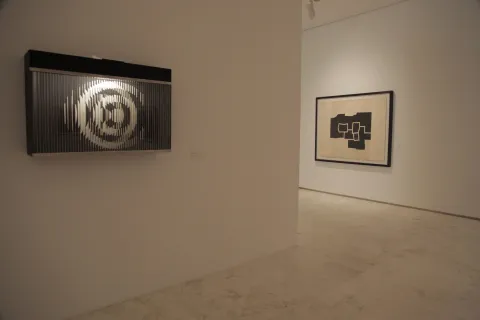
Le Parc develops different investigations with light; small boxes with light and movement that produce changes in images and colors. To achieve this, he uses artificial lighting, mirror effects, reflections and movements, manual or mechanical, the flow of phosphorescent liquids or the movement of nylon threads.

He studied in Buenos Aires, but in 1958 thanks to a scholarship from the French government he settled in Paris. In 1960, he founded the GRAV (Groupe de Recherche d'Art Visuel, Group for Research in Visual Art) together with Hugo Demarco, García Rossi, Hugo Demarco, Francois Morellet, Francisco Sobrino, J. Stein, Yvaral. This group, active until 1969, promoted collective texts, meetings, debates, presentation of experiences… that would have great influence on geometric art of the twentieth century.

Cercles fractionnés belongs to a series of works titled Displacements. Here, the image is in close relationship with the displacement of the spectator and its change undergoes an acceleration linked to the movement of the latter. The use of lumaline, a plastic and flexible product, metallized and with optical properties of mirrors, allowed the artist to carry out the first investigations with curved reflective plates that distorted images. In this work, the panel of sheets fractionates and multiplies the geometric forms (concentric circles) that are found on the opposite side to the spectator.

EXPO-0071
Imagen
IMG_6398-scaled.jpg
/sites/default/files/inline-images/resources/exposiciones/EXPO-0071/Hoja-de-sala_5.pdf
Rosa María Castells
Colección Florencio Martín

The Invited Piece. Eusebio Sempere: Division of Blue Circles, Virtual Rotatory Movement and Mobile Luminous

Submitted by brandcode_deweloper on
Alicante Provincial Council Collection

Eusebio Sempere (Onil 1923-1985) sculptor, painter and graphic artist, is the most international artist in the Alicante artistic panorama and one of the most genuine representatives of geometric abstraction and optical and kinetic tendencies. After studying at the San Carlos School of Fine Arts, he moved to Paris in 1949, where he became acquainted with the work of authors such as Mondrian, Kandinsky, Vasarely, Arp, Klee and Picasso and where he interacted with the most important artists of the time. During that period, he would abandon figuration and begin his journey through geometric art, developing two very important series: the "gouaches on cardboard" and the "luminous reliefs". In the gouaches he sought the creation of his own artistic alphabet and established the foundations of his plastic language and all his subsequent concerns. They are simple, emotional and naive works that become increasingly complex in a growing interest in volume, depth and movement. The "luminous reliefs" are resolved in three-dimensional version through a wooden box with different planes illuminated by means of a small electric motor and became the main contribution to the optical and kinetic movement of the Alicante artist.

To this series of experimental works belongs the Mobile Luminous Relief of 1959, Alicante Provincial Council collection, a complex work where painted wooden and plastic planes are assembled, which is illuminated alternately through a basic electrical system, and which emerges as a response to a growing interest in three-dimensional work, in volume and depth, developed throughout the 1950s. Sempere uses the three dimensions to capture light, but not a poetic light that until now emerged from the painting itself, but electric light, that which is installed through light bulbs, cables, sockets, resistors, rheostats and alternations. Light was the inescapable excuse for volume.

Eusebio Sempere and Abel Martín returned to Spain in 1960, settling in Madrid where they had friends who promised them help, collaborations and projects. Sempere found himself in an artistic environment dominated by the most material informalism and realistic figuration. And in his own creation he introduced a change in the support of his work: cardboard was replaced by wood, a hard and resistant surface that, properly prepared by Abel Martín, would be the best support for the gouache lines drawn with ruling pens. Above that background, gestural, thick and impasto, the mathematical regularity of some lines recalls the chosen path: geometric abstraction.

Virtual Rotatory Movement, 1969 and Division of Blue Circles, 1976, Alicante Provincial Council collection, both executed using the gouache on panel technique belong to this period and to these aesthetic concerns, although more refined. The material backgrounds have disappeared and in vibrant almost black blue colors or in pinkish and almost violet blues, Sempere manages to establish a suggestive geometric composition structured in squares. The works of this period will be increasingly perfected in execution, with the lines becoming finer and cleaner, of mathematical regularity, and the color degrading, his painting becoming more spiritual, almost mystical, with subtle and ethereal light effects.

EXPO-0070
Imagen
banner
/sites/default/files/inline-images/resources/exposiciones/EXPO-0070/hojasala_5.pdf
Rosa María Castells
Colección Diputación de Alicante.

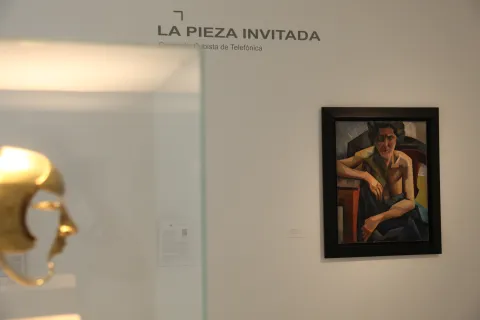
The Invited Piece. Auguste Herbin: Portrait of Madame H…

Submitted by brandcode_deweloper on
Telefónica Foundation Collection

Madame Herbin competes and dialogues with two other women represented by Julio González and Pablo Gargallo: La Montserrat and Alice Prim, Kikí of Montparnasse, thus joining the compositional modernity of the early avant-gardes.

Auguste Herbin (Quiévy (France), 1882 – Paris, 1960)

Son of a family of textile workers, Auguste Herbin was born in Quiévy, a small town near Cateau Cambrésis, on April 29, 1882. Thanks to great family economic efforts, young Herbin was able to enter the Academy of Fine Arts of Lille in 1899, but his early and keen interest in the wake of impressionist painting led him into conflict with teachers and classmates.

In 1901 he settles in Paris. The initial influence of impressionism and post-impressionism gave way to his involvement in cubism. In 1909 he moves to the Bateau-Lavoir studios, where he meets Picasso, Gris and Braque and participates in the birth and early development of the cubist movement. Herbin's cubism very soon disarticulated the differences between analytical cubism and synthetic cubism, fostering variable formulas that oscillated between the geometric translation of motifs and the encounter between cubism and the abstract, an aspect in which Herbin was truly a pioneer. In 1916, while mobilized due to the war, he signs an exclusive contract with Léonce Rosemberg. In 1921 Herbin's cubist work was valued higher than that of Léger or Braque and, nevertheless, the artist, to overcome certain moments of impasse, decided to change direction in his work. Between 1922 and 1926 he produced one of the most original formulas of the new European realism. After this period, the artist resumed, around 1925 or 1926, abstraction and in 1931 he becomes one of the creators of the Abstraction-Création group. In the post-war period, young creators of Concrete Art claimed Herbin's influence and in this field, and bearing an unusual recognition, the painter would develop his work, even overcoming serious health problems, until his death in 1960, at the age of 78. Between 1911 and 1912, Auguste Herbin painted four portraits of Madame H… In them, he took as his model his then companion and later wife, Louise Bailleux. But despite the fact that a certain resemblance can be appreciated between them, the physiognomic differences confirm that the painter is treating the female portrait as a genre and not so much as the embodiment of a concrete personality.

The Portrait of Madame H. possesses the quality of being a synthesis of the diversity shown by the painter in his female portraits of these years. Herbin appears indifferent both to the identification between background and figure characteristic of so-called analytical cubism and to the random concurrence of colored planes characteristic of so-called synthetic cubism and, despite this, the work participates in both registers. By fostering a powerful gesturality of the represented model, which communicates eagerly with the viewer, Herbin homogenizes the relationship between background and figure through similar plastic treatment. The entire composition is governed by the same register that makes geometric form coexist with brushstrokes rich in chromaticism, traced with the same gesture of the brush and with similar intensity in all its applications. Through this procedure, Herbin does not geometricize a natural model, but rather through the conjunction of syncopated prismatic forms brings forth the female figure and all the elements that accompany it.

Herbin apparently maintained the traditional vision that reproduces the figure of a woman in an interior leaning on a table. Apparently because, in reality, the entire figurative motif appears constructed through the articulation of acute triangular forms and irregular parallelograms in which the intensity of color, in flat tints, plays a special role in the definition of space. The work, therefore, beyond its figurative evidence, possesses a clear abstract conception, appearing, overall, very close to what Gris also elaborated in 1912, especially through the construction of the canvas through the systematic articulation of diagonal planes that converge with other vertical and horizontal planes.

The painter thus anticipates another of the paths of cubist aesthetics, posed in some of the foundational theoretical texts of the movement, but in truth not realized in painting until the historical circumstances of modernity changed substantially. In two Portraits of Madame H. made in 1911 and 1912, Herbin clearly posed the way in which cubist aesthetics could lead to the achievement of a new classicism. Herbin deduces from the reduction into abstract planes of the figurative a new figurative architecture based on norm, concentration and densification of compositional structure. And color. An intense presence of color in the work, a characteristic that equally defines the represented figure.

EXPO-0068
Imagen
IMG_5749.jpg
/sites/default/files/inline-images/resources/exposiciones/EXPO-0068/Hoja-de-sala-Herbin-MACA-ilovepdf-compressed_5.pdf
Auguste Herbin
Rosa María Castells
Colección Cubista de Telefónica

Kara Walker. Burning Village

Submitted by brandcode_deweloper on
Michael Jenkins and Javier Romero Collection from MACA

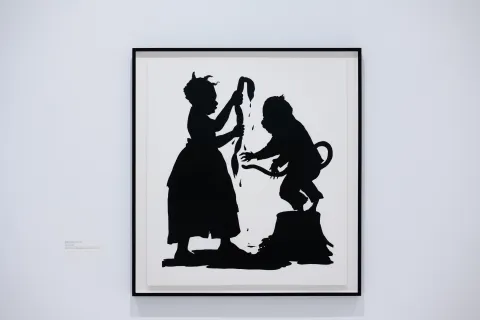
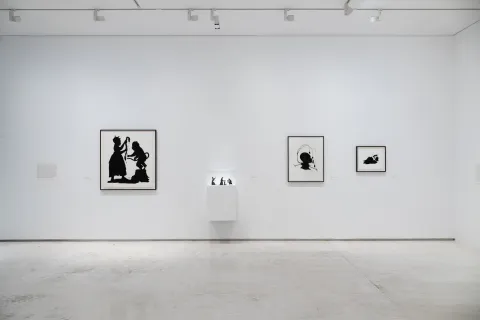
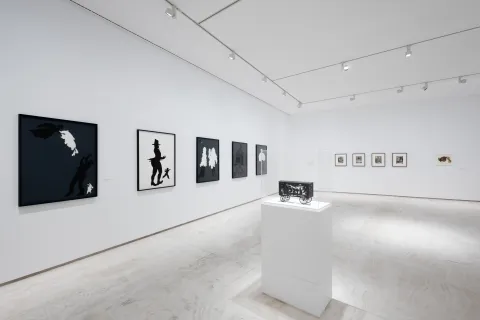
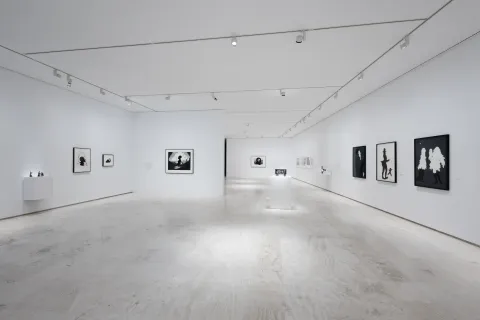
The MACA presents the largest Kara Walker exhibition held to date in Spain. The exhibition, which can be visited until September 7, is curated by Rosa Castells, and offers a journey through her trajectory over the last four decades. Kara Walker is one of the most prominent artists of her generation and one of the most interesting figures in the international art scene, with a complex body of work that analyzes, in sometimes chaotic scenes, issues of race, identity, power and desire used always as systems of oppression and subjugation, across centuries and continents.

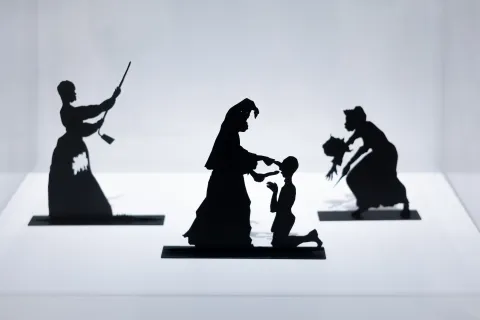
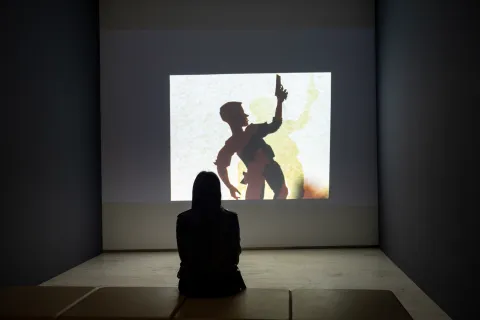
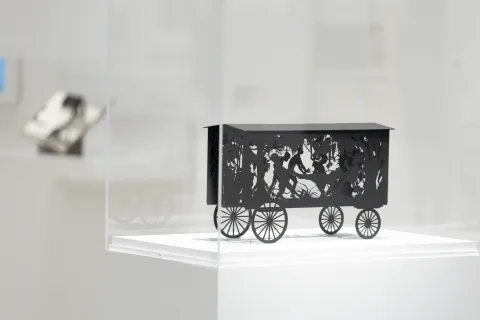
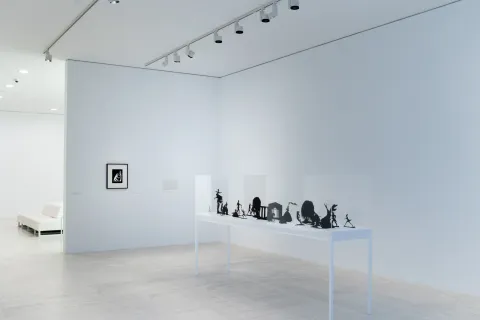
The exhibition brings together the numerous works by Kara Walker present in the Michael Jenkins and Javier Romero collection at the MACA. It consists of 44 pieces that cover part of her trajectory and constitute one of the most complete sets of the artist's work existing in European institutions. Here are displayed drawings, prints, sculptures, artist books and one of her most recent videos, a total of 31 works donated in ownership to the MACA in 2021 and 13 pieces deposited in 2024 for this exhibition that have traveled from New York. 

Her work addresses themes of violence, identity, race and sexuality in the context of the still-present psychological wound caused by the tragic legacy of slavery, presenting a critical vision of the historical past and examining racial and gender stereotypes in our current society.

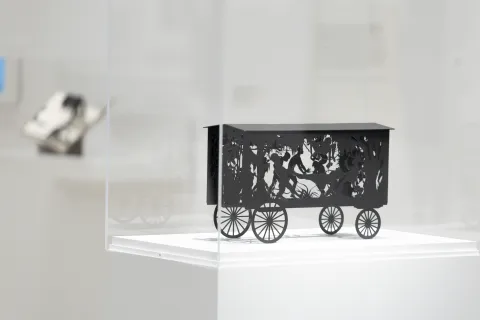
Known for her work of paper-cut silhouettes, inspired by the historical tradition of Victorian shadow portraits, shadow theater or magic lanterns, Walker uses, in works of great formal beauty, the language of satire and archetypes to reveal the contradictions of the concept a nation has of itself, while casting a very lucid subversive gaze on the historical-artistic allusions that influence her works.

Through drawing, printmaking, sculpture, video and installation, the artist explores the representation of the notion of race in modern and contemporary art, as well as the need to establish new narratives that challenge the way we look at and understand history. The images in Walker's work, drawn from both historical realism and the fantastical space of the imagined, seduce through their emotional rawness, the intellectual force they contain and their extraordinary visual beauty.

EXPO-0067
Imagen
10.jpg
Rosa María Castells
El MACA presenta la mayor exposición de Kara Walker realizada hasta la fecha en España. Colección Michael Jenkins y Javier Romero del MACA