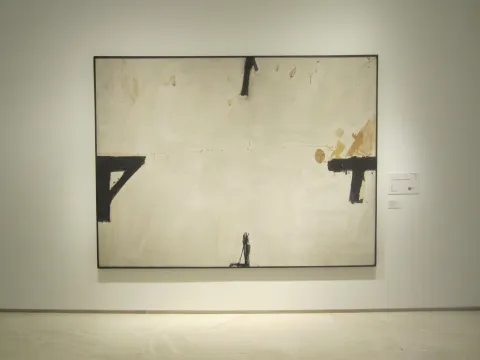
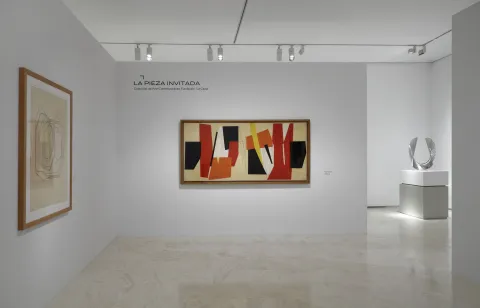
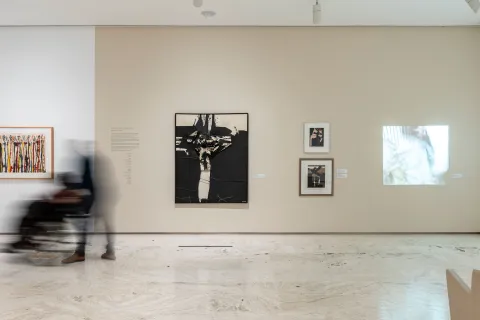
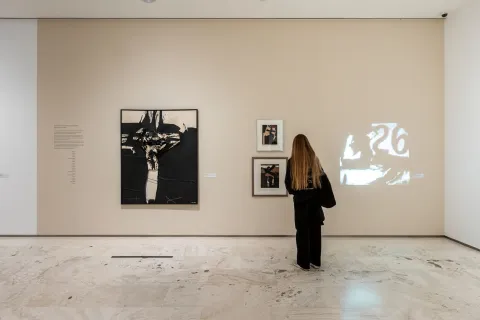
The MACA - Museum of Contemporary Art of Alicante has invited on this occasion the work by Antoni Tàpies titled "White with Four Black Signs" from 1964-1965, belonging to the Caja Mediterráneo Collection of the Social Work of Caja Mediterráneo deposited at the MACA and which can be enjoyed from October 2013 to February 2014.
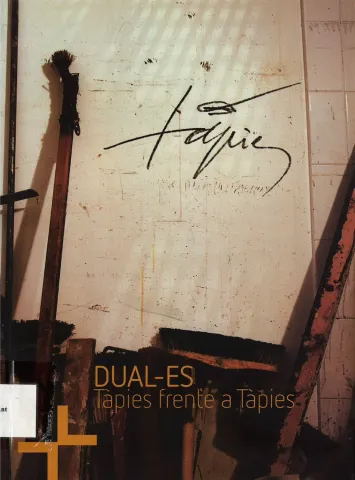
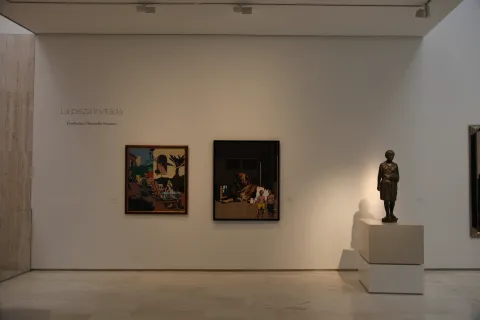
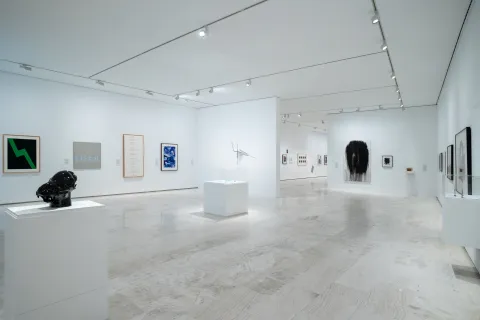
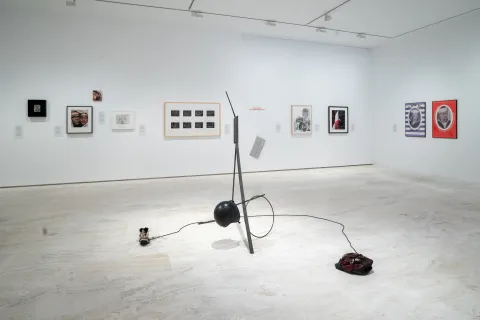
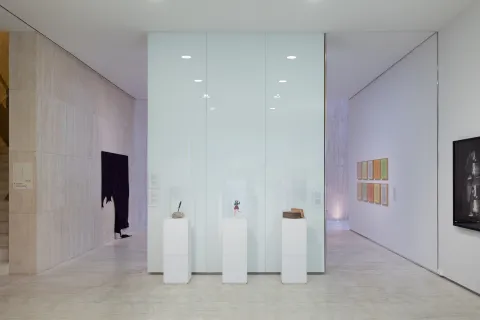
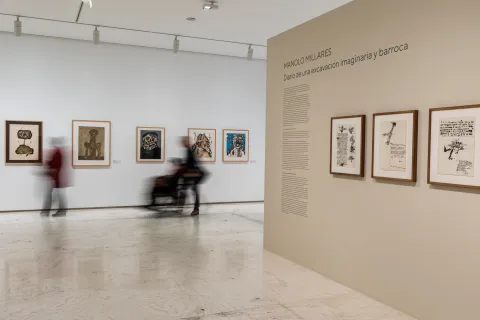
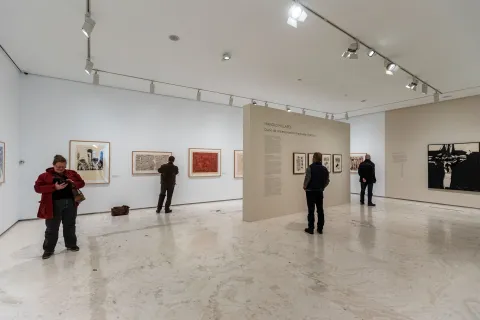
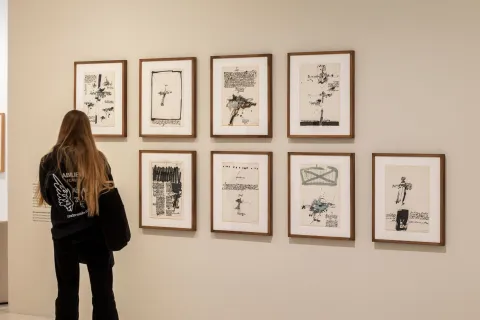
The invited piece is, on this occasion, a major work by artist Antoni Tàpies. It is the canvas White with 4 Black Signs, 1964-65, mixed media on canvas, 195 x 260 cm, belonging to the Caja Mediterráneo Collection deposited at the MACA. A great work by the Catalan artist that establishes dialogue with the group of works from the 20th Century Art Collection that addresses the Spanish generation of the 60s, including in the same room a small Tàpies titled Two Eyelids. The piece was installed for a specific temporary period between the months of September 2013 and January 2014 on the First Floor of the MACA, alongside works by Millares, Chillida, Torner, Rivera, Zóbel and Tàpies himself. White with 4 Black Signs is an impactful work not only because of the character of its iconography, but also because of the authentic struggle that is established between darkness and light, a peculiar characteristic of Tàpies' work. If the black color connects in one way or another with the idea of death, the white color suggests the hope of light. A large-scale work where black elements stand out against the uniform whitish background of the canvas. Those positioned in the central part in vertical arrangement are simply black lines, while those found at the extremes of the horizontal central axis can be read as two letters, the "A" and the "T". The truth is that these letters appear with great frequency in Tàpies' work, as they are the initials of the artist's name and surname. They are therefore a clear allusion to the presence of the artist in the work; they could even be understood as a signature. At the same time, it is necessary to say that especially the "T" appears in many works by Tàpies: that letter is also the cross, an essential characteristic of Christian iconography. Of course, Antoni Tàpies would not only have inherited that iconographic tradition from Spanish Baroque, but from religious art of all periods. Generally, the titles of Antoni Tàpies' works offer little information to the viewer, in that they are sparse and only make reference to some specific aspect of the work or not even that, since they are synthetic. The artist, by offering so little information about his work, White with 4 Black Signs enhances the need of those who observe it to investigate what happens in it, what it is about. That is precisely the essential question: to be able to trigger in those who observe carefully and wish to know more about the work, a process of reflection that leads them to unveil the enigmas that the works propose, both individually and as a whole.
Antoni Tàpies (Barcelona, 1923-2012) Began his artistic experiments during the long convalescence of a serious illness. His growing dedication to drawing and painting led him to abandon his university studies. In the 1940s he was already exhibiting his works, of marked personality, which distinguished him in the artistic panorama of the time. He is a co-founder of the magazine Dau al Set (1948). Influenced by Miró and Klee, he then increased the iconographic factor and magical themes. Little by little he incorporates geometrizing elements and color studies that lead to an interest in matter, which translates into canvases of intense texture and great expressive and communicative possibilities. With these works, Tàpies achieved, by the mid-1950s, international recognition. From the 1960s onwards, he incorporates new iconographic elements (writing signs, anthropomorphic elements, footprints and signs that allude to the reality of Catalonia) and technical procedures (new surfaces, use of everyday objects and varnish). Tàpies' pictorial language has evolved since then and has resulted in a diversified and productive plastic creation admired around the world.
Parallel to his artistic activity, Antoni Tàpies has developed a career as a writer that has resulted in various publications: La pràctica de l'art (The Practice of Art, 1970), L'art contra l'estètica (Art Against Aesthetics, 1974), Memòria personal (Personal Memory, 1977), La realitat com a art (Reality as Art, 1982), Per un art modern i progressista (For a Modern and Progressive Art, 1985), Valor de l'art (Value of Art, 1993) and L'art i els seus llocs (Art and Its Places, 1999).
Antoni Tàpies is undoubtedly one of the most important artists in the artistic history of the 20th century and one of the most genuine representatives of the informalist tendency. Always in a direct way, his paintings penetrate the viewer to leave questions of meaning in the background, resolving through force, gesture and matter.
Despite Tàpies' classification as an "informalist," signs such as crosses, lines, numbers and letters that belong to the artist's symbolic and inner universe often appear in his paintings, with clear allusions to the universe, life, death or sexuality, as well as a strong presence of the human figure apparently veiled by the abstraction with which his work is conceived. His plastic work reveals a personal assimilation of Oriental cultures, and an extremely delicate perception of the reality of the problems that plague mankind, while at the same time exalting and spiritualizing that which, by tradition, Western culture has considered poor and disposable.
The artist elevates any element present in the painting or any object of everyday life to the condition of a sign. Picasso affirmed that "art is the language of signs" and Tàpies takes this statement to the limit with the common denominator of intensity, force, spirituality, integration with matter, and the arrangement of color. Signs that will appear and mix to provoke, not to give answers: "the symbols are there, but I do not develop or analyze them," Tàpies himself tells us.
The presence of writing in his works returns to the sign all its ideographic capacity and gives language a force with a magical-religious value, of clearly Romanesque roots. A language that he will not abandon with the passage of time, as it is his own. Despite the evolution of the years and his work, iconography will continue to be essential for the deepest expression of his feelings. The signs are present, tied to new connections and with new elements, but always present. And thus, his creativity always results in works of great plastic force.
/sites/default/files/inline-images/resources/exposiciones/EXPO-0065/hoja-de-sala-1_5.pdf