Context avant-gardes 3. Georges Vantongerloo

Submitted by brandcode_deweloper on
IVAM Collection of Valencia

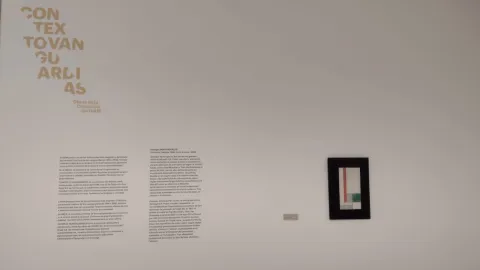
The MACA presents the third exhibition within the "Avant-garde Context" program with a work by Georges Vantongerloo. This program aims to maintain a permanent dialogue between the works from the IVAM collection belonging to the avant-garde movements of the first decades of the 20th century and the works from the 20th Century Art Collection, so that complementary readings are established, transversal perspectives, support and context for some pieces that, in communication with others, strengthen their language and message, while completing the vision of a fundamental era of modernity that travels paths between tradition and the new.

This third exhibition consists of a work from the IVAM collection by Belgian artist Georges Vantongerloo titled "Painted cement relief" from 1930, which is shown alongside other contemporary artists such as Julio González, Pablo Gargallo, and Juan Gris.

The Artist

Georges Vantongerloo (Antwerp, Belgium, 1886- Paris, France, 1965) was one of the great theorists of the 20th century. Painter, sculptor and architect, he reconceptualized the pictorial and sculptural space of abstract art in the early 20th century. In 1917 he founded the De Stijl group together with Piet Mondrian and Theo Van Doesburg, and in the 1930s he was part of the Abstraction-Création movement. His painting, based on the right angle and the relationship between lines and surfaces of flat colors, follows strictly geometric rules sustained by the idea of emptiness, silence and the absolute. Vantongerloo thus became the founder of mathematical thinking in modern art.
EXPO-0055
Imagen
WhatsApp-Image-2024-01-30-at-11.15.53.jpeg
Georges Vantongerloo
Rosa María Castells
Obras del Instituto Valenciano de Arte Moderno (IVAM)

Art in a Wasteland

Submitted by brandcode_deweloper on
IVAM Collection of Valencia

The endings of the Spanish Civil War and the Second World War propose antagonistic worlds, radically different scenarios, but both must be built upon barren ground; in pain, in the ruins and material and ethical debris that absolute destruction from war produces. And it does so under complex vital conditions: in exile, in emigration, in repression.

The two postwar periods represented a radical break for the history of culture. In Franco's Spain, the aesthetic project imagined from the Falange would attempt to reduce culture to state propaganda, break with the experimentalism of the avant-gardes and return to a certain academicism articulated from the idea of the national and the Catholic. In the nineteen fifties the need for international legitimation of the Regime would seek to continue instrumentalizing culture, but from an approach to more contemporary languages. That said, without losing the essences of "the Spanish and the Catholic." In the rest of the world, devastated after the war and its horrors, the break with the previous avant-gardes would come from the disturbing question about the relationship between civilization and barbarism. In both cases totalitarianisms, violence or cultural misery forced numerous artists to emigrate, to go into exile, and to work in the open. But their journey singularly enriched those territories that welcomed them.

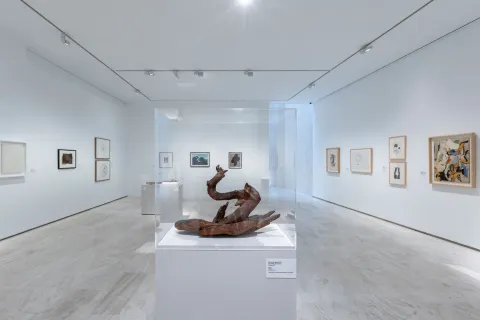
Constituted fundamentally by works belonging to the IVAM collection, this exhibition attempts a reading in which more than the differences in style, continuities are contemplated, similarities, mutual echoes, the shared effort, when the fabric of historical events is such that it becomes absolutely determining in poetic, discursive, formal or stylistic decisions; in humanity's gaze and thought about itself

EXPO-0054
Imagen
3F1A2020.jpg
/sites/default/files/inline-images/resources/exposiciones/EXPO-0054/FOLLETO-ARTE-BALDIA_7.pdf
Manuel Ángeles Ortiz, Francesc Catalá i Roca, Man Ray, Henri Michaux, László Moholy Nagy, Jorge Oteiza, Kurt Schwitters, Georges Vantongerloo, Mauricio Amster Cats, Karel Appel, Monika Buch, Vicente Castellano Giner, José Miguel de Miguel Ruiz, Marcel Duchamp, Lucio Fontana, Menchu Gal, Manolo Gil Pérez, Jacinta Gil Roncalés, Arshile Gorky, Adolph Gottlieb, George Grosz, Raoul Hausmann, Hermanos Mayo, Asger Jorn, Franz Kline, Lee Krasner, Lucebert (Lubertus Jacobus Swaanswijk), Marcel Mariën, André Masson, Fausto Melotti, Barnett Newman, Carlos Pascual de Lara, Ad Reinhardt, Josep Renau, Pierre Soulages, Friedrich Vordemberge, Gildewart, Herbert List, Óscar Domínguez, Ricard Giralt, Miracle, Maruja Mallo, Mathias Goeritz, Luis Felipe Vivanco, Ángel Gullón, José Gumbau, Matilde Salvador
Esteban Vicente
Rosa María Castells
Obras de la colección del IVAM. La muestra ha estado con anterioridad en el Museo de Bellas Artes de Castellón.