Automatic Garden. Olga Diego

Submitted by brandcode_deweloper on

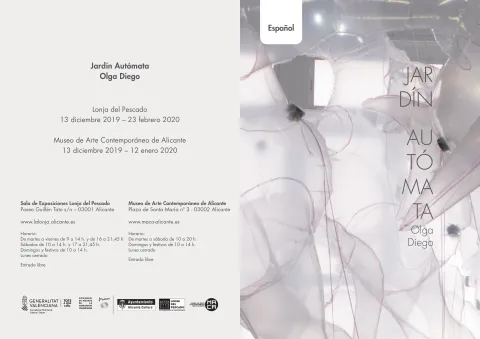
Automated Garden is a gigantic installation made up of almost a hundred inflatable and electronic sculptures inspired by the beautiful, extravagant and suggestive characters from Bosch's Garden of Earthly Delights, which is exhibited mostly in the Exhibition Hall of the Lonja, and which has a small representation in the MACA.

Attracted by the Procession of Desire painted on the central panel of the triptych, Olga Diego discovers naked human beings who enjoy, together with animals of all species, a world of unlimited pleasure. Lust represented in multiple and unimaginable forms. A suggestive world where we also find beautiful birds, fish and exotic fruits. Olga Diego builds that imaginary world in Automated Garden, a visual and creative orgy, a labyrinth of large translucent and transparent bodies that suggest a magical existence. The characters, in continuous movement and endowed with heart, mark with their rhythms an indecipherable electric symphony. Humanoids of all genders, simple and mixed quadrupeds, hybrid beings, women with large breast-antennas, globe-headed animals, the mutant giraffe, bird-boy with tortilla-wings, eggs and fish with legs, flying hermaphrodites, fruits with tentacles, two-headed dogs, strange birds with adapted wings, and a long etcetera.

Automated Garden has been a constructive challenge, but also an insinuating paradise in terms of the forms to be created. A lust converted into sin, religious in its time and profane now, due to the terrible consequences that continuous waste, unlimited consumerism and excessive use of plastic already have for humanity.
EXPO-0047
Imagen
Olga-Diego_Alicante-ESP_page-0001.jpg
/sites/default/files/inline-images/resources/exposiciones/EXPO-0047/Olga-Diego_Alicante-ESP_7.pdf

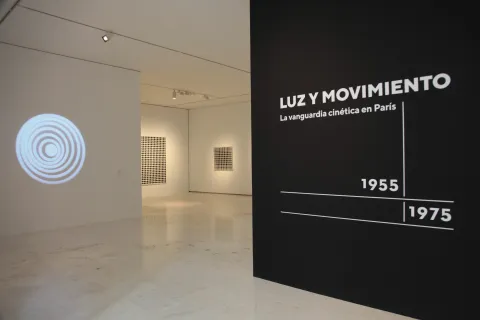
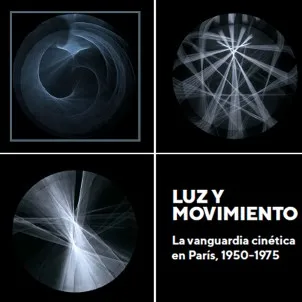
Light and Movement. The Kinetic Avant-Garde in Paris 1950-1975

Submitted by brandcode_deweloper on

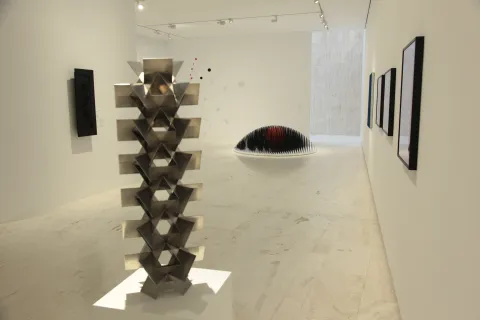
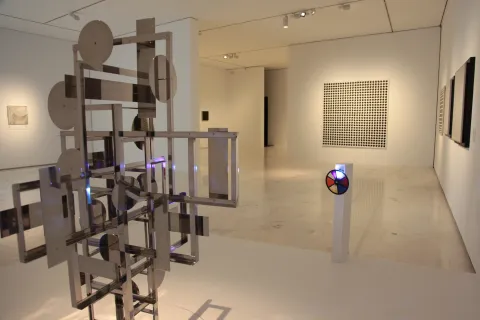
The question of movement, light and their representation runs through the history of art. From the 1950s onwards, following in the footsteps of pioneers such as Naum Gabo, Antoine Pevsner and László Moholy-Nagy, Marcel Duchamp and Alexander Calder, artists began to integrate these forces into their creations, shaping a new vision of reality in which nothing is fixed and definitive but rather unstable and indeterminate, in constant movement: the works live in the present, change, are never exhausted. Kinetic movement develops in Europe as an international constellation formed by a new generation of artists who want to radically transform art by opposing the myth of the work, a unique, defined and totemic object destined for an elite, personal expression of the artist, creative genius secluded in their ivory tower. These new breed of artists want to modernize the artistic object, open it to reality by integrating new materials and industrial techniques; from a social perspective, to produce art for a wider audience, participatory art, to propose an active role for both the artist and the spectator. 

Movement embodies the new mutual relationship, physical and emotional, that is established between spectator and work, it is a mouvement émouvant [moving movement], as Vasarely describes it in 1955: the works are living bodies that are reflected in the moving body of the spectator and enter into relationship with him, involving him in an exercise of conscious freedom. 

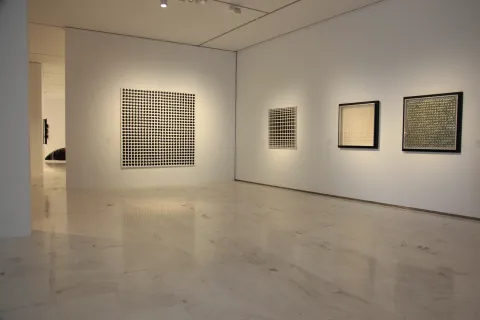
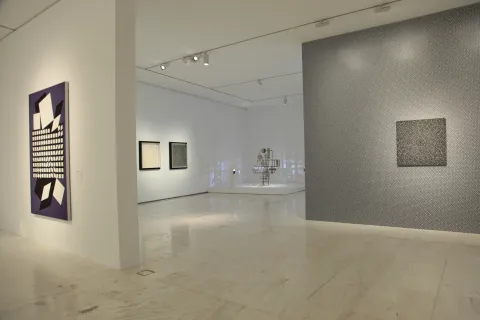
Light and Movement opens a perspective on the rich vitality of this international tendency in the active Parisian context, whose influence will also nourish Spanish artistic debate, focusing on the period of its fascinating creative development and maximum recognition between 1955, the year of the historic exhibition Le Mouvement at the Denise René gallery in Paris, and 1975. The works of the protagonists of this avant-garde, coming from private collections, galleries and Parisian institutions, will resonate and be enriched in dialogue with the exceptional collection of kinetic works at the MACA, a donation by Eusebio Sempere.
 

EXPO-0043
Imagen
Sin-título-6.jpg
/sites/default/files/inline-images/resources/exposiciones/EXPO-0043/MACA%E2%80%93VALN%E2%80%93CAST2_5.pdf
Takis (Panagiotis Vassilakis), Marina Apolonio, Pol Bury, Alexander Calder, Carlos Cruz-Diez, Ángel Duarte, Marcel Duchamp, Julio Le Parc, François Morellet, Jordi Pericot, Nicolas Schöffer, Francisco Sobrino, Jesús Rafael Soto, Víctor Vasarely, Eusebio Sempere, François Morellet, Horacio García, Joël Stein, Robert Breer y Brian de Palma.
Jordi Ballart, Marianna Gelussi
En colaboración con Fundación Catalunya La Pedrera