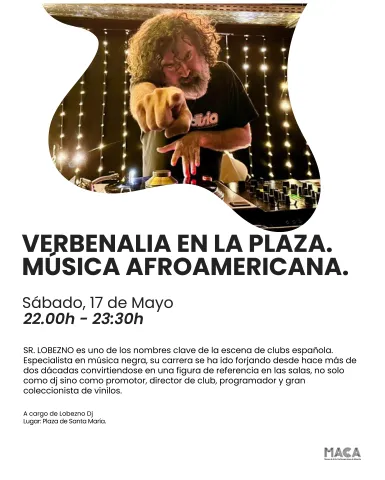
SR. LOBEZNO is one of the key names in the Spanish club scene. A specialist in black music, his career has been forged over more than two decades, becoming a reference figure in clubs, not only as a DJ but also as a promoter, club director, programmer, and avid vinyl collector. Founder of the Afrodisia Club in Granada, an internationally renowned venue for black sounds with over 20 years of history, he was also co-creator of the record label ENNEGRO DISCOS.
His sessions, always on vinyl, are a perfect combination of rhythm, quality, and innovation while keeping an eye on the references of the past.
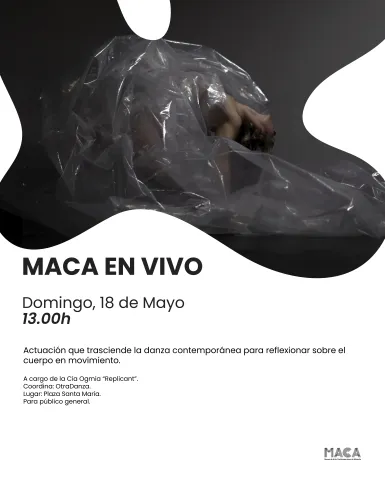
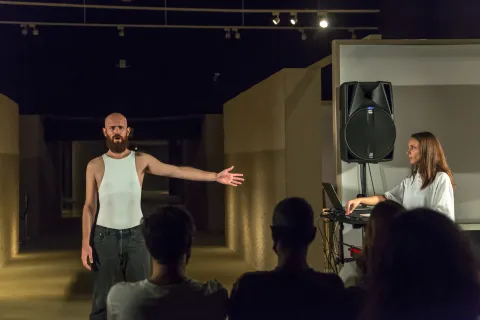
In charge of Ogmia Company "Replicant" Coordinated by: OtraDanza
A performance that transcends contemporary dance to reflect on the body in motion.
The world is governed by a tireless and incandescent will that turns us into machines of desire. We desire ceaselessly and, after the satisfaction of one longing, another emerges that demands to be fulfilled. This dynamic drags us relentlessly between two inevitable poles: suffering and boredom.
In this back-and-forth, the search for freedom presents itself as a challenge, since free will will always be conditioned by desire.
Replicant explores the intersection between dance, existentialism, and transhumanism. The work investigates the human condition, freedom, and self-determination, using the body in motion as a means of expression. It also seeks to offer a personal perspective on the spirit, life, and individual consciousness, as well as examine the moral conflict in the construction of being.
Are freedom and self-determination essential conditions for defining what is human?
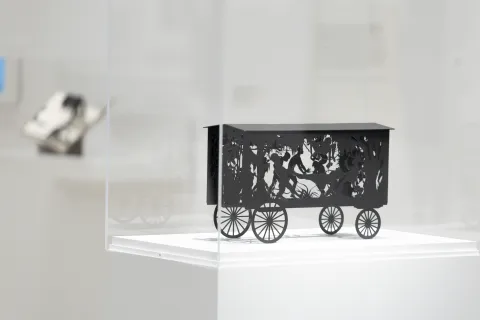
"Utopic Liberty". Installation by Elio Rodríguez on the facade.
This series by Elio Rodríguez invites the viewer to explore the relationship between the monumental and the organic, the real and the utopian, through a playful and critical dialogue with iconic monuments. This project, developed intensively over the last few years, has its roots in 2010, when Rodríguez created Ceiba Negra, a monumental inflatable sculpture for The Mattress Factory in Pittsburgh. That experience marked the beginning of an exploration into artistic interventions that challenge the rigidity of space and architecture.
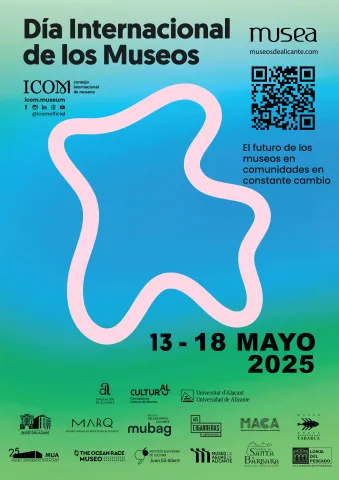
On May 18th, at the proposal of the International Council of Museums (ICOM), International Museum Day is celebrated, and, as has been the case since 2013, Alicante will join again. This year's theme is "The future of museums in communities in constant change," focusing on how museums can navigate and contribute to a world experiencing profound social, technological, and environmental changes.
The City Council (MACA, Las Cigarreras, and MUSA), the Provincial Council (MARQ, MUBAG, and the Juan Gil-Albert Alicante Institute of Culture), The Ocean Race Museum, the University of Alicante Museum, the University Headquarters City of Alicante, and the Alicante Water Museum, come together again to offer a carefully curated program for all audiences.
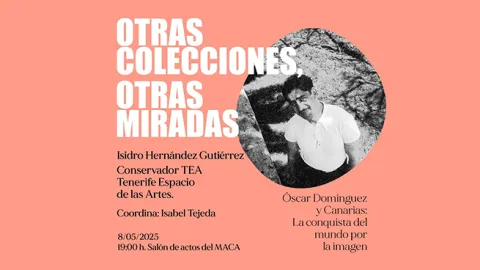
"Óscar Domínguez and the Canary Islands: The Conquest of the World through Image". Coordinated by: Isabel Tejeda
A new cycle of talks begins under the name "Other Collections, Other Perspectives". At this beginning, we will have the presence of the curator of TEA Tenerife Espacio de las Artes, Isidro Hernández Gutiérrez, with whom we will delve into the idea of "Óscar Domínguez and the Canary Islands: The Conquest of the World through Image".
Hernández will address some of the keys to the scope and significance of the Canarian avant-garde and the international culture magazine Gaceta de arte (1932 - 1936), dwelling especially on the work of painter Óscar Domínguez, who has been considered, along with Miró and Dalí, one of the great contributions of Spanish painting to international surrealism.
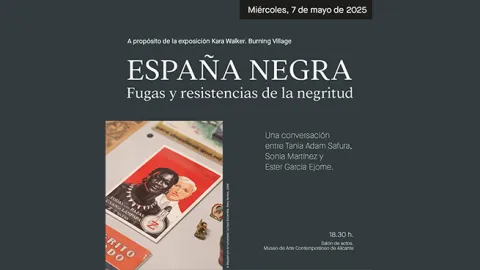
With Sonia Martínez, Esther García Ejome and Tania Safura Adam.
With Sonia Martínez, Esther García Ejome and Tania Safura Adam. "Black Spain: a journey towards blackness in space-time" is a collaborative and situated research project, proposed at a moment of awakening of Spanish blackness in which there is an imperative need to incorporate new histories and discourses into the public sphere. Initiated in 2021 by Diáspora LAB of Radio África, it has revealed the great need to deepen understanding of the relationship of blackness in Spanish territory. Its passage through different museographic institutions such as ARTIUM in the Basque Country, CCCB in Catalonia, MNCARS in Madrid and IVAM in Valencia and surrounding areas, has been a fundamental pillar in bringing forth from the archive and from public and domestic territory, a new collective black subject.
During this session we will be able to delve into the vicissitudes of this unprecedented project in the Spanish context. On one hand, Sonia Martínez as director of IVAM, will tell us how the institution, which had been conducting explorations around blackness for some time, incorporates the research within the museographic framework; Tania Safura Adam, coordinator of "Black Spain", will share its methodological limits, challenges and crossroads; and, finally, Esther García Ejome, as a researcher of the Valencian territory, will share some findings from the area.
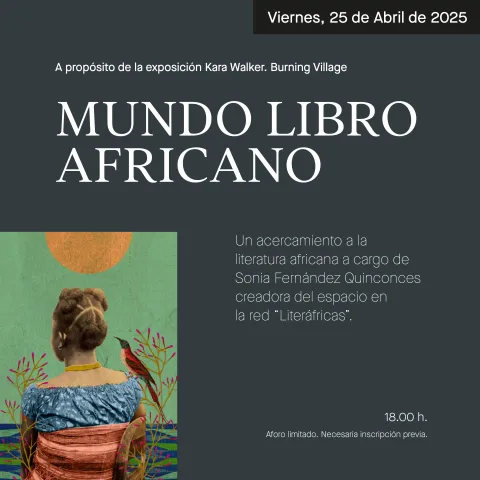
We are starting a new book club: African Book World, through Sonia Fernández Quinconces; a graduate in Law (UPV-EHU) and specialist in Human Rights in a global world from the same University.
Sonia Fernández collaborates with various media outlets as a columnist for the newspaper El País, and with initiatives always related to African literatures and the African Letters award granted by the Blue Bird Foundation. Her space on the web, "Literáfricas," which she calls "Simply Literature," revolves around these letters and their universe. Literáfrica is a project led by Sonia Fernández Quinconces and created to promote African Literature and Orality.
The history of women's presence in African literatures has been a story of strength, resistance and, above all, of great talent. They had to face multiple obstacles and fight against prejudices and undervaluation. Sidelined, set aside and cornered, their voices, despite all this, managed to be heard. And they grew in number, filling spaces that were previously empty, writing about issues that directly concerned them, as women, as Africans.
The representation of African women has been woven from false or distorted images. Many, incomplete. For this reason it was so necessary that women recover the word that, since ancestral times, has belonged to them. And write. In doing so they have returned to us countless visions, helping us understand multiple situations and inviting us to accompany them through their thoughts and experiences both intimate and collective.
In the previous session of Arborescentes we were left wanting to talk about the small plants that emerge freely from cracks and hard-to-clean corners. So much monumental ficus and so little brave weeds drove us to dedicate the following session to them, to the VIP plants! (very important plants). We tell you how we went about it.
Why are plants that grow in asphalt cracks important?
Plants that grow in asphalt cracks in cities are not only symbols of biological resistance, but also key agents within new approaches to urban biodiversity.
To rethink urban plants not as "green waste" but as living agents that claim their place, we must understand that preserving the wild is not just about protecting distant forests, but also respecting a crack where life springs forth.
They constitute spontaneous laboratories of life and evolution. They are "zones of freedom," where vegetation grows without direct human intervention.
They play an essential role as green micro-corridors. They act as connectors between fragments of dispersed urban habitats, allowing the flow of species—from pollinating insects to soil microorganisms.
Urban biodiversity depends on these unplanned spaces. The biodiversity that these plants provide increases ecological resilience.
"VIP Plants" as cultural and social mediators: A novel reading of these plants is to understand them as cultural and social mediators. Their presence challenges the traditional narrative of human control over urban nature and proposes an aesthetic of disorder that invites us to rethink city design. Rather than eradicating these spontaneous manifestations, we could integrate them into a new model of urbanism that accepts the unplanned, fostering a more flexible and ethical relationship between the built and the living. This approach can be connected with recent concepts such as the right to the wild in the city.
Within the Giroscopia event, the MACA hosts the screening of the short film "Insurrección" by Jorge Hinojosa and Daniel M. Caneiro and a subsequent roundtable discussion with director Jorge Hinojosa and some actors and crew members of the short film. As a closing, the making-of video of the shoot will be screened. Moderators: Enric Mira and Ingrid Granda
Creation and direction: Aurora Bauzà & Pere Jou Performance and musical composition: Aurora Bauzà & Pere Jou
External eye: Alessandro Sciarroni
Production: Ariadna Miquel and Management: Art Republic
Aurora Bauzà and Pere Jou are composers, creators and performers at the forefront of the performing arts. Their main research revolves around the human voice and its intricate connections with the body, movement, space, stage and light. Their compositions go beyond the traditional boundaries of artistic genres, treating music as a multidimensional entity with physical, scenic, visual, dramaturgical, expressive and poetic qualities. Their unique artistic approach involves a physical and movement practice that decomposes the resonant movement of sound (singing) from visual movement, creating a distinctive interaction. Choreography, viewed through an acoustic lens, merges fluidly with musical composition, shaping the essence and dramaturgical structure of their interdisciplinary work.
I AM (T)HERE is a scenic and musical work that explores the relationship between body and voice. Through the obstinate repetition of a vocal melody, and accompanied by an electronic atmosphere, the performer/singer moves in search of a body emancipated from the voice, breaking with the classical musical tradition in which the body is silenced and subordinated to vocal discourse. I AM (T)HERE seeks a physical and vocal language that proposes new forms of interaction between body and voice. An interdisciplinary, hybrid and transversal language that constructs its own semantics within the body/voice relationship and that does not hierarchize between disciplines of the living arts such as movement and sound. The piece embodies a body trapped between two different dynamics, voice and movement, that evolve in opposite directions, creating a body in tension, a subject in conflict with its own identity.