Avant-garde Context 6. Frantisek Kupka

Submitted by brandcode_deweloper on
IVAM Collection of Valencia

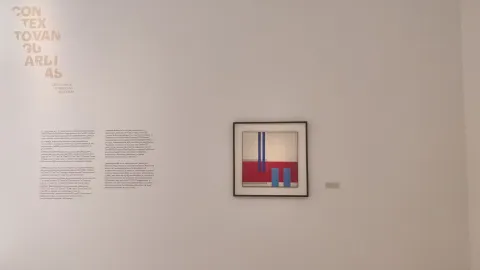
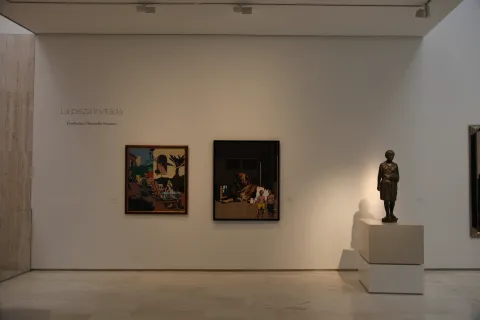
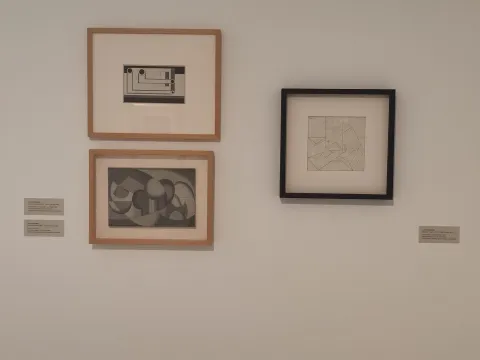
The MACA presents a work by artist Frantisek KUPKA from the collections of the Valencian Institute of Modern Art (IVAM), within the dialogue between collections established since 2021 in the "Contexto Vanguardia" program. The work can be viewed until September 2025.

This is the sixth exhibition within "Contexto Vanguardia" which seeks to maintain a permanent dialogue between the works from the IVAM collection belonging to the avant-gardes of the first decades of the twentieth century and the works from the MACA's Twentieth Century Art Collection, so that complementary readings are established, providing support and context for some pieces that, in communication with others, strengthen their language, thus allowing visitors to enjoy artists not represented in the MACA while completing the vision of the avant-gardes. The objective is to create content and share knowledge.

Proportions / Proporciones, 1934. Oil on canvas is the work that can be seen.

The artist
Frantisek KUPKA is one of the pioneers of abstraction. Trained in Prague and Vienna, he first settled in Paris where he embraced neo-impressionism, symbolism and modernism and later, in Puteaux, relating to the cubism of the Villon brothers. His work, abstract since 1912, is full of philosophical meanings, approaches music and theories of the emergence of energy while experimenting with both forms and colors suggested by the machine, as well as with geometric, circular or reticular structures, close to Van Doesburg and Mondrian and to the Abstraction-Création group to which he belongs.

EXPO-0072
Imagen
3ec9759f-502c-2669-fbf3-a33635e9f985.jpeg
Frantisek Kupka
Rosa María Castells
Obras del Instituto Valenciano de Arte Moderno (IVAM)

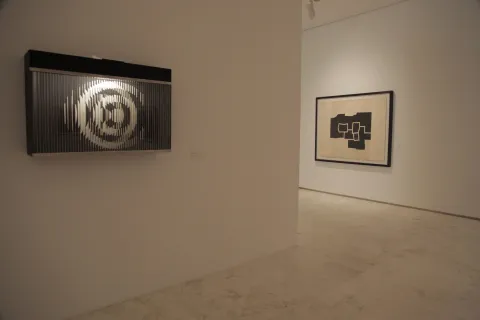
The Invited Piece. Julio Le Parc: Fractioned Circles

Submitted by brandcode_deweloper on
Deposit at the MACA

Le Parc develops different investigations with light; small boxes with light and movement that produce changes in images and colors. To achieve this, he uses artificial lighting, mirror effects, reflections and movements, manual or mechanical, the flow of phosphorescent liquids or the movement of nylon threads.

He studied in Buenos Aires, but in 1958 thanks to a scholarship from the French government he settled in Paris. In 1960, he founded the GRAV (Groupe de Recherche d'Art Visuel, Group for Research in Visual Art) together with Hugo Demarco, García Rossi, Hugo Demarco, Francois Morellet, Francisco Sobrino, J. Stein, Yvaral. This group, active until 1969, promoted collective texts, meetings, debates, presentation of experiences… that would have great influence on geometric art of the twentieth century.

Cercles fractionnés belongs to a series of works titled Displacements. Here, the image is in close relationship with the displacement of the spectator and its change undergoes an acceleration linked to the movement of the latter. The use of lumaline, a plastic and flexible product, metallized and with optical properties of mirrors, allowed the artist to carry out the first investigations with curved reflective plates that distorted images. In this work, the panel of sheets fractionates and multiplies the geometric forms (concentric circles) that are found on the opposite side to the spectator.

EXPO-0071
Imagen
IMG_6398-scaled.jpg
/sites/default/files/inline-images/resources/exposiciones/EXPO-0071/Hoja-de-sala_5.pdf
Rosa María Castells
Colección Florencio Martín

The Invited Piece. Eusebio Sempere: Division of Blue Circles, Virtual Rotatory Movement and Mobile Luminous

Submitted by brandcode_deweloper on
Alicante Provincial Council Collection

Eusebio Sempere (Onil 1923-1985) sculptor, painter and graphic artist, is the most international artist in the Alicante artistic panorama and one of the most genuine representatives of geometric abstraction and optical and kinetic tendencies. After studying at the San Carlos School of Fine Arts, he moved to Paris in 1949, where he became acquainted with the work of authors such as Mondrian, Kandinsky, Vasarely, Arp, Klee and Picasso and where he interacted with the most important artists of the time. During that period, he would abandon figuration and begin his journey through geometric art, developing two very important series: the "gouaches on cardboard" and the "luminous reliefs". In the gouaches he sought the creation of his own artistic alphabet and established the foundations of his plastic language and all his subsequent concerns. They are simple, emotional and naive works that become increasingly complex in a growing interest in volume, depth and movement. The "luminous reliefs" are resolved in three-dimensional version through a wooden box with different planes illuminated by means of a small electric motor and became the main contribution to the optical and kinetic movement of the Alicante artist.

To this series of experimental works belongs the Mobile Luminous Relief of 1959, Alicante Provincial Council collection, a complex work where painted wooden and plastic planes are assembled, which is illuminated alternately through a basic electrical system, and which emerges as a response to a growing interest in three-dimensional work, in volume and depth, developed throughout the 1950s. Sempere uses the three dimensions to capture light, but not a poetic light that until now emerged from the painting itself, but electric light, that which is installed through light bulbs, cables, sockets, resistors, rheostats and alternations. Light was the inescapable excuse for volume.

Eusebio Sempere and Abel Martín returned to Spain in 1960, settling in Madrid where they had friends who promised them help, collaborations and projects. Sempere found himself in an artistic environment dominated by the most material informalism and realistic figuration. And in his own creation he introduced a change in the support of his work: cardboard was replaced by wood, a hard and resistant surface that, properly prepared by Abel Martín, would be the best support for the gouache lines drawn with ruling pens. Above that background, gestural, thick and impasto, the mathematical regularity of some lines recalls the chosen path: geometric abstraction.

Virtual Rotatory Movement, 1969 and Division of Blue Circles, 1976, Alicante Provincial Council collection, both executed using the gouache on panel technique belong to this period and to these aesthetic concerns, although more refined. The material backgrounds have disappeared and in vibrant almost black blue colors or in pinkish and almost violet blues, Sempere manages to establish a suggestive geometric composition structured in squares. The works of this period will be increasingly perfected in execution, with the lines becoming finer and cleaner, of mathematical regularity, and the color degrading, his painting becoming more spiritual, almost mystical, with subtle and ethereal light effects.

EXPO-0070
Imagen
banner
/sites/default/files/inline-images/resources/exposiciones/EXPO-0070/hojasala_5.pdf
Rosa María Castells
Colección Diputación de Alicante.

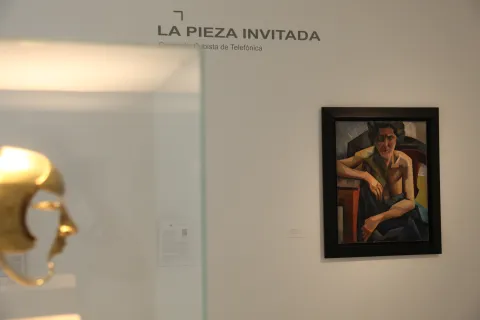
The Invited Piece. Auguste Herbin: Portrait of Madame H…

Submitted by brandcode_deweloper on
Telefónica Foundation Collection

Madame Herbin competes and dialogues with two other women represented by Julio González and Pablo Gargallo: La Montserrat and Alice Prim, Kikí of Montparnasse, thus joining the compositional modernity of the early avant-gardes.

Auguste Herbin (Quiévy (France), 1882 – Paris, 1960)

Son of a family of textile workers, Auguste Herbin was born in Quiévy, a small town near Cateau Cambrésis, on April 29, 1882. Thanks to great family economic efforts, young Herbin was able to enter the Academy of Fine Arts of Lille in 1899, but his early and keen interest in the wake of impressionist painting led him into conflict with teachers and classmates.

In 1901 he settles in Paris. The initial influence of impressionism and post-impressionism gave way to his involvement in cubism. In 1909 he moves to the Bateau-Lavoir studios, where he meets Picasso, Gris and Braque and participates in the birth and early development of the cubist movement. Herbin's cubism very soon disarticulated the differences between analytical cubism and synthetic cubism, fostering variable formulas that oscillated between the geometric translation of motifs and the encounter between cubism and the abstract, an aspect in which Herbin was truly a pioneer. In 1916, while mobilized due to the war, he signs an exclusive contract with Léonce Rosemberg. In 1921 Herbin's cubist work was valued higher than that of Léger or Braque and, nevertheless, the artist, to overcome certain moments of impasse, decided to change direction in his work. Between 1922 and 1926 he produced one of the most original formulas of the new European realism. After this period, the artist resumed, around 1925 or 1926, abstraction and in 1931 he becomes one of the creators of the Abstraction-Création group. In the post-war period, young creators of Concrete Art claimed Herbin's influence and in this field, and bearing an unusual recognition, the painter would develop his work, even overcoming serious health problems, until his death in 1960, at the age of 78. Between 1911 and 1912, Auguste Herbin painted four portraits of Madame H… In them, he took as his model his then companion and later wife, Louise Bailleux. But despite the fact that a certain resemblance can be appreciated between them, the physiognomic differences confirm that the painter is treating the female portrait as a genre and not so much as the embodiment of a concrete personality.

The Portrait of Madame H. possesses the quality of being a synthesis of the diversity shown by the painter in his female portraits of these years. Herbin appears indifferent both to the identification between background and figure characteristic of so-called analytical cubism and to the random concurrence of colored planes characteristic of so-called synthetic cubism and, despite this, the work participates in both registers. By fostering a powerful gesturality of the represented model, which communicates eagerly with the viewer, Herbin homogenizes the relationship between background and figure through similar plastic treatment. The entire composition is governed by the same register that makes geometric form coexist with brushstrokes rich in chromaticism, traced with the same gesture of the brush and with similar intensity in all its applications. Through this procedure, Herbin does not geometricize a natural model, but rather through the conjunction of syncopated prismatic forms brings forth the female figure and all the elements that accompany it.

Herbin apparently maintained the traditional vision that reproduces the figure of a woman in an interior leaning on a table. Apparently because, in reality, the entire figurative motif appears constructed through the articulation of acute triangular forms and irregular parallelograms in which the intensity of color, in flat tints, plays a special role in the definition of space. The work, therefore, beyond its figurative evidence, possesses a clear abstract conception, appearing, overall, very close to what Gris also elaborated in 1912, especially through the construction of the canvas through the systematic articulation of diagonal planes that converge with other vertical and horizontal planes.

The painter thus anticipates another of the paths of cubist aesthetics, posed in some of the foundational theoretical texts of the movement, but in truth not realized in painting until the historical circumstances of modernity changed substantially. In two Portraits of Madame H. made in 1911 and 1912, Herbin clearly posed the way in which cubist aesthetics could lead to the achievement of a new classicism. Herbin deduces from the reduction into abstract planes of the figurative a new figurative architecture based on norm, concentration and densification of compositional structure. And color. An intense presence of color in the work, a characteristic that equally defines the represented figure.

EXPO-0068
Imagen
IMG_5749.jpg
/sites/default/files/inline-images/resources/exposiciones/EXPO-0068/Hoja-de-sala-Herbin-MACA-ilovepdf-compressed_5.pdf
Auguste Herbin
Rosa María Castells
Colección Cubista de Telefónica

Kara Walker. Burning Village

Submitted by brandcode_deweloper on
Michael Jenkins and Javier Romero Collection from MACA

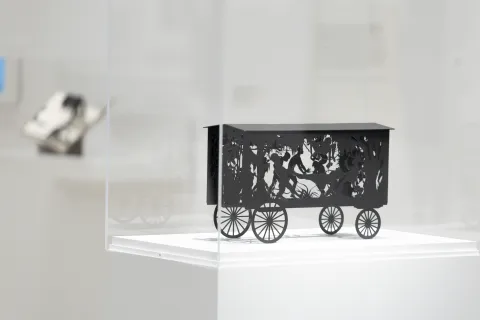
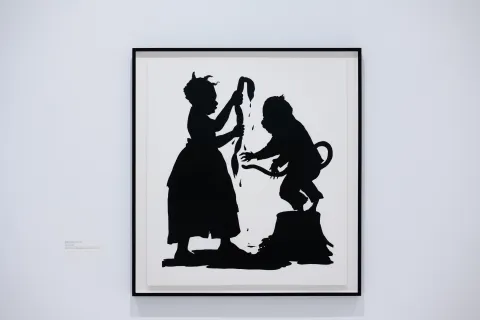
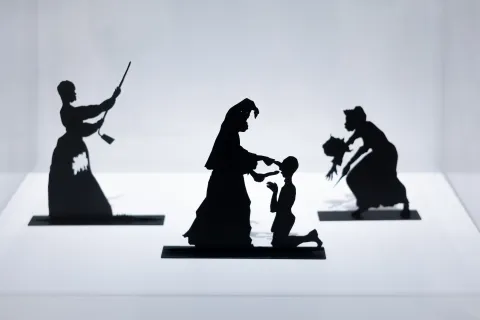
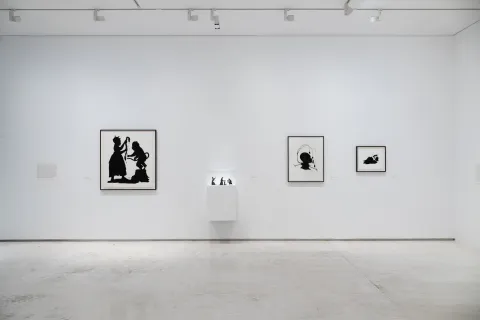
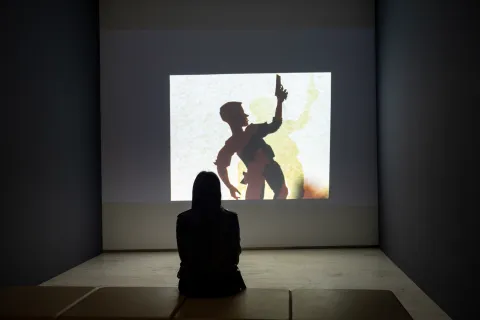
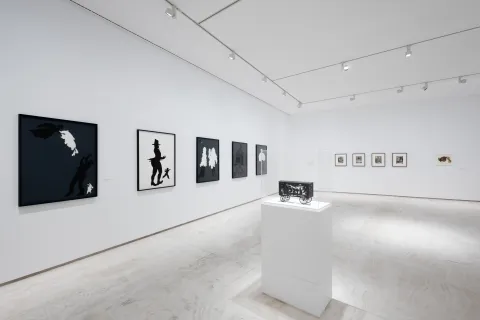
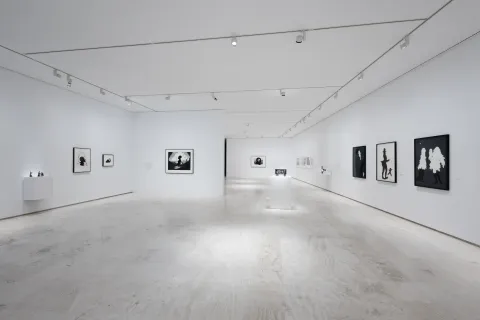
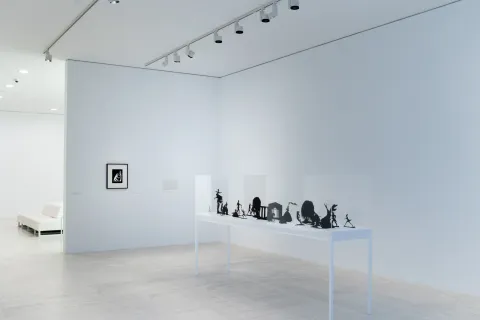
The MACA presents the largest Kara Walker exhibition held to date in Spain. The exhibition, which can be visited until September 7, is curated by Rosa Castells, and offers a journey through her trajectory over the last four decades. Kara Walker is one of the most prominent artists of her generation and one of the most interesting figures in the international art scene, with a complex body of work that analyzes, in sometimes chaotic scenes, issues of race, identity, power and desire used always as systems of oppression and subjugation, across centuries and continents.

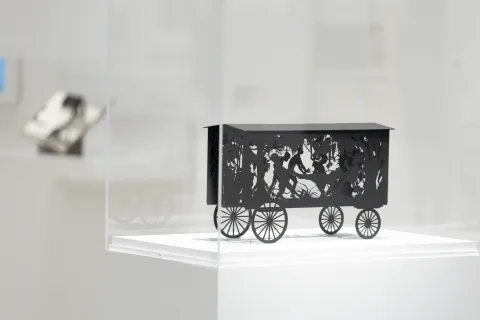
The exhibition brings together the numerous works by Kara Walker present in the Michael Jenkins and Javier Romero collection at the MACA. It consists of 44 pieces that cover part of her trajectory and constitute one of the most complete sets of the artist's work existing in European institutions. Here are displayed drawings, prints, sculptures, artist books and one of her most recent videos, a total of 31 works donated in ownership to the MACA in 2021 and 13 pieces deposited in 2024 for this exhibition that have traveled from New York. 

Her work addresses themes of violence, identity, race and sexuality in the context of the still-present psychological wound caused by the tragic legacy of slavery, presenting a critical vision of the historical past and examining racial and gender stereotypes in our current society.

Known for her work of paper-cut silhouettes, inspired by the historical tradition of Victorian shadow portraits, shadow theater or magic lanterns, Walker uses, in works of great formal beauty, the language of satire and archetypes to reveal the contradictions of the concept a nation has of itself, while casting a very lucid subversive gaze on the historical-artistic allusions that influence her works.

Through drawing, printmaking, sculpture, video and installation, the artist explores the representation of the notion of race in modern and contemporary art, as well as the need to establish new narratives that challenge the way we look at and understand history. The images in Walker's work, drawn from both historical realism and the fantastical space of the imagined, seduce through their emotional rawness, the intellectual force they contain and their extraordinary visual beauty.

EXPO-0067
Imagen
10.jpg
Rosa María Castells
El MACA presenta la mayor exposición de Kara Walker realizada hasta la fecha en España. Colección Michael Jenkins y Javier Romero del MACA

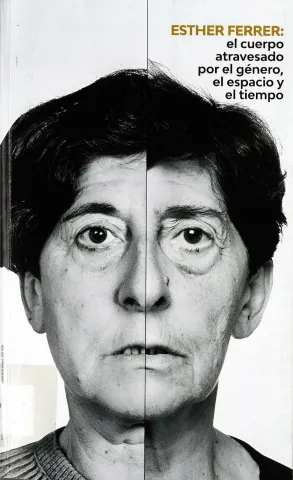
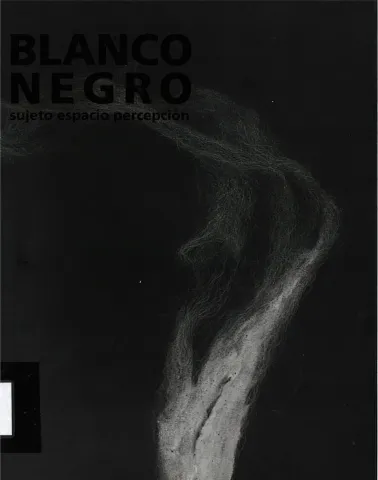
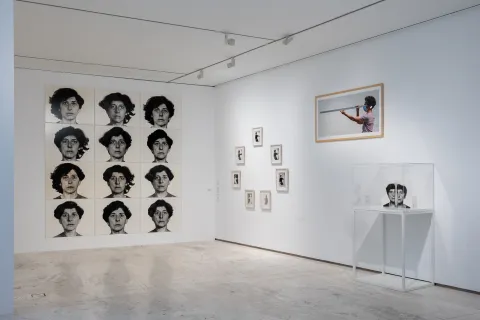
Esther Ferrer: the body traversed by gender, space and time

Submitted by brandcode_deweloper on

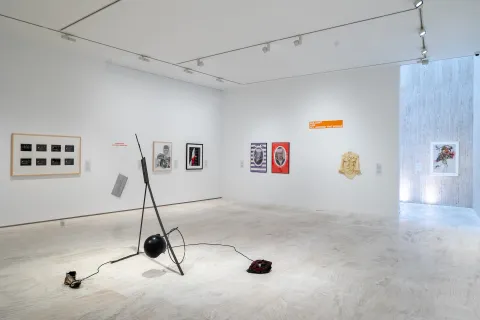
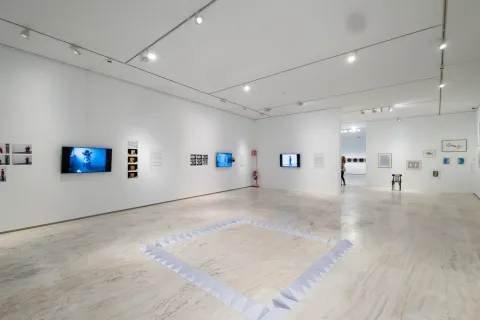
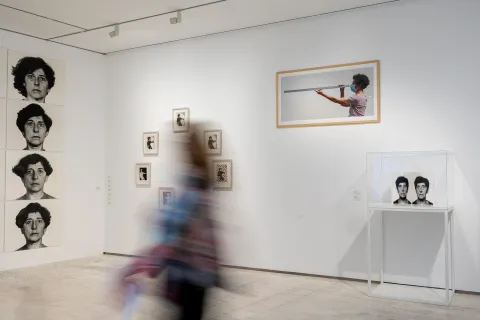
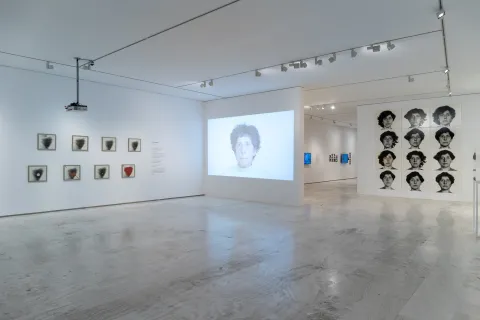
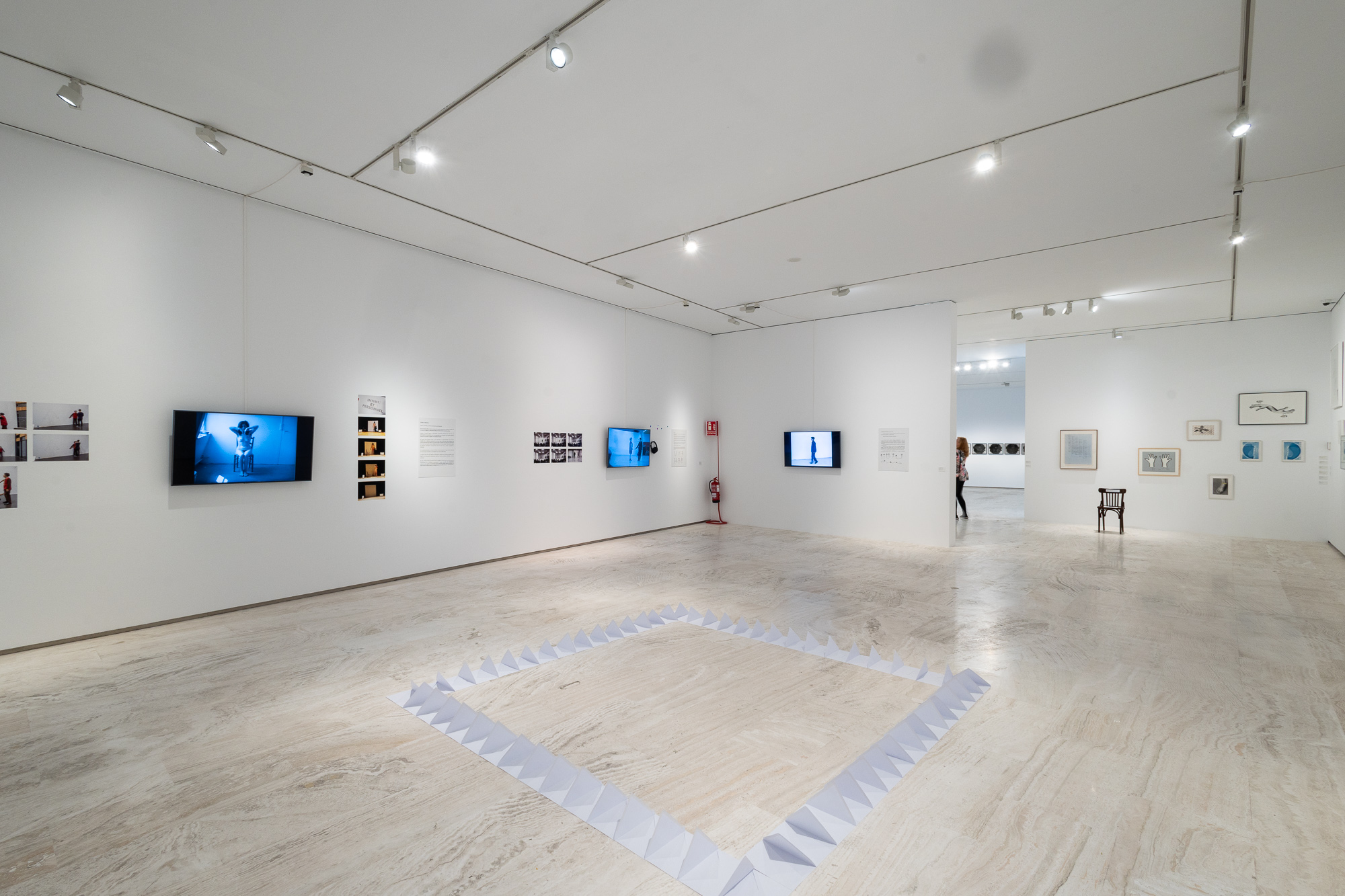
The exhibition focuses on the idea of woman and her body in interrelation with time and space. A body, that of the artist herself, from which she produces actions and creative works. And, from which, she traverses and measures space and, in turn, is crossed by time, even showing the aging of a woman, confronted with the idea and promotion of eternal feminine youth fostered by the patriarchal system.
 

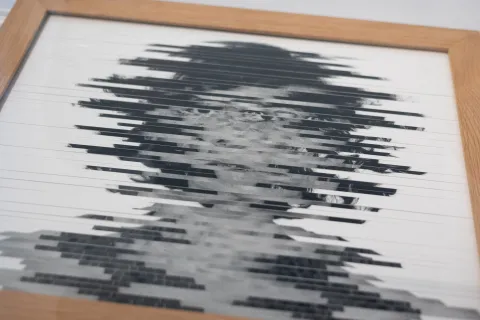
And that body is also transferred to photography, installations, drawings and even video, through self-portraits of her face and body fragments, in performative attitudes. Furthermore, a bodily action, shown through a series of images and audiovisuals that, as documentation of a selection of performances, are offered as visual and sound narrative media, alongside "the scores" or scripts that she constructs to continue in the execution of her performances.
 

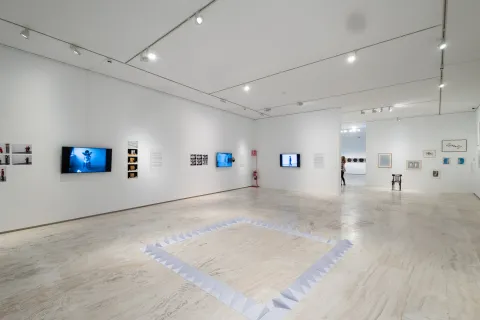
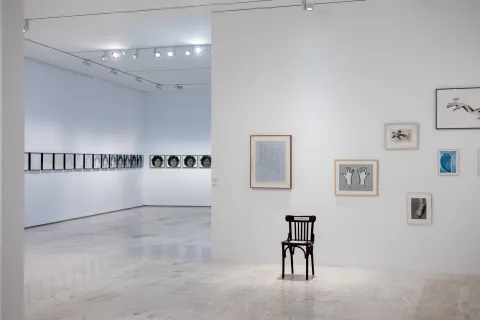
In short, an entire multi and interdisciplinary performative exhibition route expanded from action to plastic works and vice versa, its incitement to the realization of actions by the public or its mere evocation, or else the visual pieces as traces or remains of performances. While showing us her own body set in motion in time and space, seen and read as a meaning of symbolic layers and deconstructive representations of the patriarchal gaze on the female body. And, all of this, bathed in a certain sense of acerbic humor, the conjugation of the absurd and chance encounters with objects, words and signs.
 

EXPO-0066
Imagen
3F1A9868.jpg
/sites/default/files/inline-images/resources/exposiciones/EXPO-0066/esther-ferre-folleto-desplegable-72x34-cm-Alicante-1_5.pdf
Margarita de Aizpuru

The Invited Piece. Antoni Tàpies: White with Four Black Signs

Submitted by brandcode_deweloper on
Mediterranean Foundation Collection

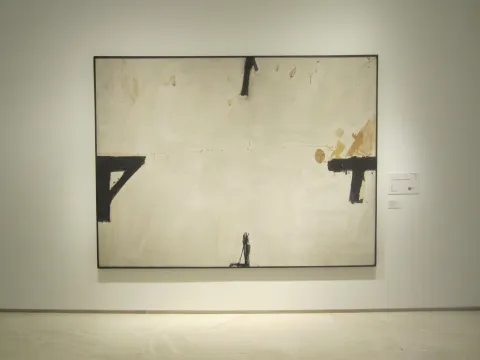
The MACA - Museum of Contemporary Art of Alicante has invited on this occasion the work by Antoni Tàpies titled "White with Four Black Signs" from 1964-1965, belonging to the Caja Mediterráneo Collection of the Social Work of Caja Mediterráneo deposited at the MACA and which can be enjoyed from October 2013 to February 2014.

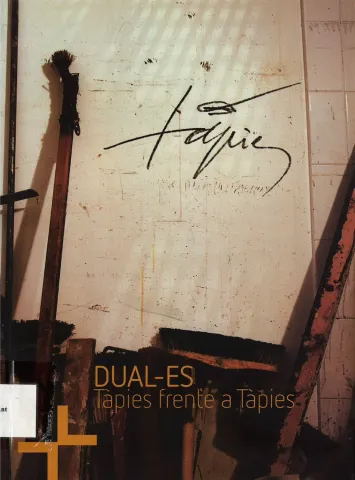
The invited piece is, on this occasion, a major work by artist Antoni Tàpies. It is the canvas White with 4 Black Signs, 1964-65, mixed media on canvas, 195 x 260 cm, belonging to the Caja Mediterráneo Collection deposited at the MACA. A great work by the Catalan artist that establishes dialogue with the group of works from the 20th Century Art Collection that addresses the Spanish generation of the 60s, including in the same room a small Tàpies titled Two Eyelids. The piece was installed for a specific temporary period between the months of September 2013 and January 2014 on the First Floor of the MACA, alongside works by Millares, Chillida, Torner, Rivera, Zóbel and Tàpies himself. White with 4 Black Signs is an impactful work not only because of the character of its iconography, but also because of the authentic struggle that is established between darkness and light, a peculiar characteristic of Tàpies' work. If the black color connects in one way or another with the idea of death, the white color suggests the hope of light. A large-scale work where black elements stand out against the uniform whitish background of the canvas. Those positioned in the central part in vertical arrangement are simply black lines, while those found at the extremes of the horizontal central axis can be read as two letters, the "A" and the "T". The truth is that these letters appear with great frequency in Tàpies' work, as they are the initials of the artist's name and surname. They are therefore a clear allusion to the presence of the artist in the work; they could even be understood as a signature. At the same time, it is necessary to say that especially the "T" appears in many works by Tàpies: that letter is also the cross, an essential characteristic of Christian iconography. Of course, Antoni Tàpies would not only have inherited that iconographic tradition from Spanish Baroque, but from religious art of all periods. Generally, the titles of Antoni Tàpies' works offer little information to the viewer, in that they are sparse and only make reference to some specific aspect of the work or not even that, since they are synthetic. The artist, by offering so little information about his work, White with 4 Black Signs enhances the need of those who observe it to investigate what happens in it, what it is about. That is precisely the essential question: to be able to trigger in those who observe carefully and wish to know more about the work, a process of reflection that leads them to unveil the enigmas that the works propose, both individually and as a whole.

Antoni Tàpies (Barcelona, 1923-2012) Began his artistic experiments during the long convalescence of a serious illness. His growing dedication to drawing and painting led him to abandon his university studies. In the 1940s he was already exhibiting his works, of marked personality, which distinguished him in the artistic panorama of the time. He is a co-founder of the magazine Dau al Set (1948). Influenced by Miró and Klee, he then increased the iconographic factor and magical themes. Little by little he incorporates geometrizing elements and color studies that lead to an interest in matter, which translates into canvases of intense texture and great expressive and communicative possibilities. With these works, Tàpies achieved, by the mid-1950s, international recognition. From the 1960s onwards, he incorporates new iconographic elements (writing signs, anthropomorphic elements, footprints and signs that allude to the reality of Catalonia) and technical procedures (new surfaces, use of everyday objects and varnish). Tàpies' pictorial language has evolved since then and has resulted in a diversified and productive plastic creation admired around the world.

Parallel to his artistic activity, Antoni Tàpies has developed a career as a writer that has resulted in various publications: La pràctica de l'art (The Practice of Art, 1970), L'art contra l'estètica (Art Against Aesthetics, 1974), Memòria personal (Personal Memory, 1977), La realitat com a art (Reality as Art, 1982), Per un art modern i progressista (For a Modern and Progressive Art, 1985), Valor de l'art (Value of Art, 1993) and L'art i els seus llocs (Art and Its Places, 1999).

Antoni Tàpies is undoubtedly one of the most important artists in the artistic history of the 20th century and one of the most genuine representatives of the informalist tendency. Always in a direct way, his paintings penetrate the viewer to leave questions of meaning in the background, resolving through force, gesture and matter.

Despite Tàpies' classification as an "informalist," signs such as crosses, lines, numbers and letters that belong to the artist's symbolic and inner universe often appear in his paintings, with clear allusions to the universe, life, death or sexuality, as well as a strong presence of the human figure apparently veiled by the abstraction with which his work is conceived. His plastic work reveals a personal assimilation of Oriental cultures, and an extremely delicate perception of the reality of the problems that plague mankind, while at the same time exalting and spiritualizing that which, by tradition, Western culture has considered poor and disposable.

The artist elevates any element present in the painting or any object of everyday life to the condition of a sign. Picasso affirmed that "art is the language of signs" and Tàpies takes this statement to the limit with the common denominator of intensity, force, spirituality, integration with matter, and the arrangement of color. Signs that will appear and mix to provoke, not to give answers: "the symbols are there, but I do not develop or analyze them," Tàpies himself tells us.

The presence of writing in his works returns to the sign all its ideographic capacity and gives language a force with a magical-religious value, of clearly Romanesque roots. A language that he will not abandon with the passage of time, as it is his own. Despite the evolution of the years and his work, iconography will continue to be essential for the deepest expression of his feelings. The signs are present, tied to new connections and with new elements, but always present. And thus, his creativity always results in works of great plastic force.

EXPO-0065
Imagen
img_2748-1.jpg
/sites/default/files/inline-images/resources/exposiciones/EXPO-0065/hoja-de-sala-1_5.pdf
Rosa María Castells
Colección Caja Mediterráneo

Avant-garde Context 5. Sophie Taeuber-Arp and Jean Arp

Submitted by brandcode_deweloper on
IVAM Collection of Valencia

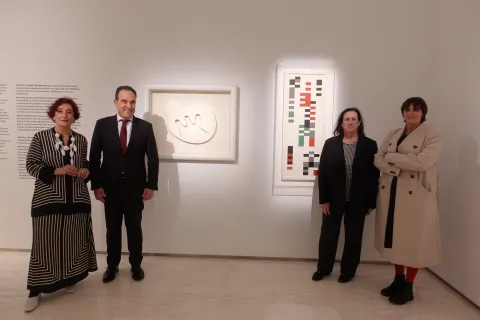
The MACA exhibits a work by artist Sophie Taeuber-Arp and another piece by Jean Arp belonging to the collections of the Valencian Institute of Modern Art (IVAM), within the dialogue between collections established since 2021 in the "Contexto Vanguardia" program.

This is the fifth exhibition within "Contexto Vanguardia" which seeks to maintain a permanent dialogue between the works in the IVAM collection belonging to the avant-gardes of the first decades of the twentieth century and the works of the MACA's Twentieth Century Art Collection, so that complementary readings are established, support and context for some pieces that, in communication with others, strengthen their language, thus allowing visitors to enjoy artists not represented in the MACA while completing the vision of the avant-gardes. The objective is to create content and share knowledge.

Composition Aubette, 1927 by Sophie Taeuber-Arp and Coquille Nuage I, 1932 by Jean Arp, are the two works that can be visited in the museum.

The Artists
Jean Arp and Sophie Taeuber-Arp are essential artists in the European avant-gardes of the first third of the twentieth century: Dadaism, Neoplasticism, Constructivism… always around abstraction.

Jean Arp freely adapts forms extracted from nature transformed into elementary poetry in a constant recognition of nature as the ideal of art. Cloud Shell is a work that takes root in water, sun, clouds, or stone, and introduces the idea of metamorphosis, of continuous movement, in the ancestral time of an origin.

Sophie Taeuber-Arp is a multifaceted artist largely unknown, a convinced activist of modernity, who bases her formal language on geometric forms. In this piece that was created for the rehabilitation of the Café Aubette in Strasbourg, she uses the primary colors she had experimented with in her textile work, synthesizing the Neoplasticist aesthetic.

EXPO-0064
Imagen
alt
Sophie Taeuber-Arp
Rosa María Castells
Obras del Instituto Valenciano de Arte Moderno (IVAM)

The Invited Piece. Equipo Crónica: Meninas in the Chalet

Submitted by brandcode_deweloper on
Chirivella Soriano Foundation

The MACA - Museum of Contemporary Art of Alicante has invited on this occasion the work of Equipo Crónica titled Las Meninas in the Chalet from 1969 belonging to the Chirivella Soriano Foundation of Valencia, which can be enjoyed from February 1st to April 28th, 2013. This splendid work from the Chirivella Soriano Foundation Las Meninas in the Chalet from 1969 fits perfectly alongside the work of Equipo Crónica belonging to the 20th Century Art Collection titled Self-portrait in Palace painted just one year later, in 1970.

A reflection on the theme of classical painting that serves to place Velázquez's characters—in the case of Las Meninas in the Chalet—the Infanta Margarita of Austria, the lady-in-waiting of the Infanta Isabel de Velasco, the dwarf Mari Bárbola, the royal chamberlain José Nieto and the dog, in a chalet from the 50s-60s, a time when the tourist phenomenon emerged and the chalet became fashionable for summer vacations. The exterior space of this representation corresponds to an advertisement from the Valencian store "Hogar completo"—specialized in armchairs, rocking chairs and folding summer loungers.

Self-portrait in Palace places the scene in the original space of the Las Meninas painting, preserving the characters of the royal chamberlain José Nieto and the Dog decorated with the Cross of Santiago, but in this case distorted, to occupy a gigantic volume. The two artists Manolo Valdés and Rafael Solbes, portray themselves in the foreground as in the original work the main characters of Las Meninas are placed. The painting is not finished, as there appears a blank area, empty and thousands of paint drips, and they appear characterized as two house painters who, during a break from their work, stop to look at us because we have placed ourselves in the scene and they invite us to reflect on the work they are carrying out.

The collaboration between institutions such as the MACA and the Chirivella Soriano Foundation, in this case coordinated through the Consortium of Museums of the Valencian Regional Government and the Culture Department of the Alicante City Council, has made possible the arrival of this work by Equipo Crónica. An exhibition program that will continue throughout the year.

Equipo Crónica. (1964-1981)

Formed by the artists Manolo Valdés, Rafael Solbes and Juan Antonio Toledo (although the latter soon distanced himself from the group), the group reacted against the dominant informalist current in the Spanish artistic panorama of the time. Their collective work developed during the last ten years of Francoism and the democratic transition, until 1981.

Equipo Crónica creates decidedly figurative work very close to the pop art aesthetic. Taking advantage of resources from journalistic chronicles, the language of mass media, comics, advertising or art history itself, their painting critically analyzes the social and political situation of Spain and casts an ironic look at myths by placing well-known situations and characters in different contexts, thus contributing to the demystification of images and questioning the very function of art.

The MACA - Museum of Contemporary Art of Alicante has invited on this occasion the work of Equipo Crónica titled Las Meninas in the Chalet from 1969 belonging to the Chirivella Soriano Foundation of Valencia, which can be enjoyed from February 1st to April 28th, 2013.

The collaboration between institutions such as the MACA and the Chirivella Soriano Foundation, in this case coordinated through the Consortium of Museums of the Valencian Regional Government and the Culture Department of the Alicante City Council, has made possible the arrival of this work by Equipo Crónica. An exhibition program that will continue throughout the year.

EXPO-0062
Imagen
PIEZA-INVITADA-008.jpg
/sites/default/files/inline-images/resources/exposiciones/EXPO-0062/HOJA-MANO-EQUIP-CRONICA-ALTA-ilovepdf-compressed_5.pdf
Rosa María Castells
Fundación Chirivella Soriano

Avant-garde Context 4. Luis Fernández

Submitted by brandcode_deweloper on
IVAM Collection of Valencia
This is the fourth exhibition within "Contexto Vanguardia" that seeks to maintain a permanent dialogue between the works of the IVAM collection belonging to the avant-gardes of the first decades of the twentieth century and the works of the MACA's Twentieth Century Art Collection, so that complementary readings are established, support and context for some pieces that, in communication with others, strengthen their language, thus allowing the visitor to enjoy artists not represented in the MACA while completing the vision of the avant-gardes. The objective is to create content and share knowledge. «Abstraction or Still Life», «Abstraction» (1933) and «Abstraction in longitude» (1926-1928) are the three oil paintings on canvas by artist Luis Fernández that are shown alongside works by Julio González, Pablo Gargallo and Juan Gris, among others. Luis Fernández (Oviedo, Spain, 1900- Paris, France, 1973) was one of the Spanish artists of the so-called School of Paris. He arrived there in 1924 and struck up friendships with Picasso and Julio González, as well as with geometric abstraction that would lead him to join the Abstraction-Création movement. A painter concerned with craftsmanship and the artisanal concept of the work, he formulated his thinking in various texts written in the 1930s, his most analytical and experimental period. He reflected on color and its function in painting, on composition, format and the profound meaning of abstraction which for him possessed metaphysical and symbolic resonances. His painting—he said—was an "unconscious representation of the order that man observes in the universe".

EXPO-0061
Imagen
WhatsApp-Image-2024-10-16-at-11.35.00.jpeg
Luis Fernández
Rosa María Castells
Obras del Instituto Valenciano de Arte Moderno (IVAM)