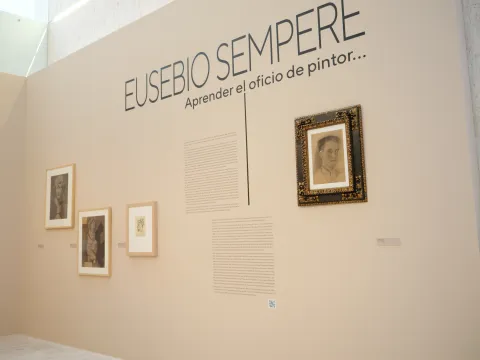
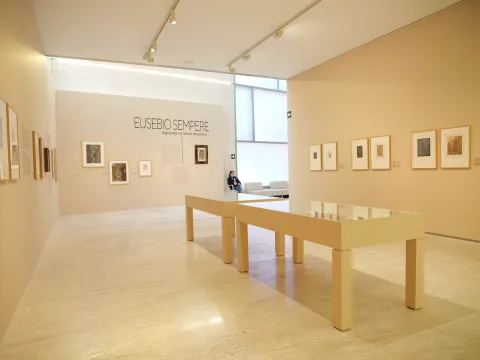
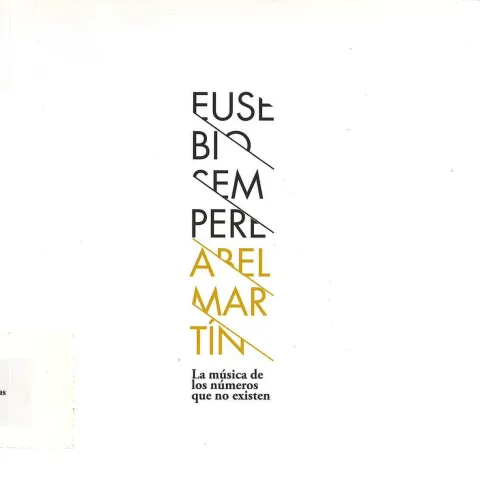
Eusebio Sempere. Learning the Painter's Trade

Submitted by brandcode_deweloper on

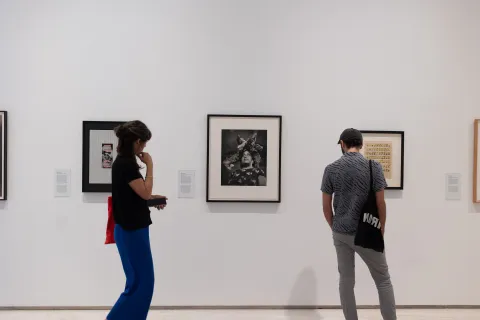
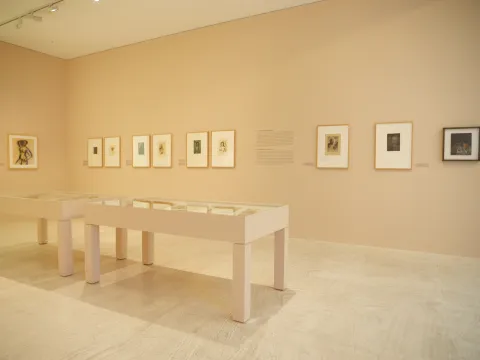
Thanks to an early vocation for painting, Sempere began in 1941 his training period at the School of Fine Arts of San Carlos in Valencia, the city where his family moved after the civil war, after having lost his toy factory in Onil. 
 

Sempere had finished his high school studies a few months earlier and attended evening classes at the School of Arts and Crafts, which had given him some knowledge and practice in drawing. His six years of academic training were tedious and frustrating. Artistic education in Spain during those postwar years was depressing; to the poor teachers, mediocre as artists, authoritarian and despotic in their classes, was added an extreme conservatism in the content and continuous "Sorolla-like" references as the only valid example to follow, just as the artist recalls time and again. 
 

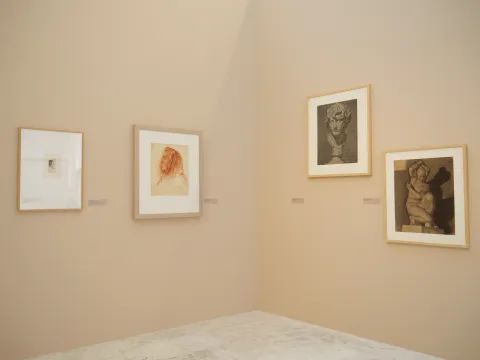
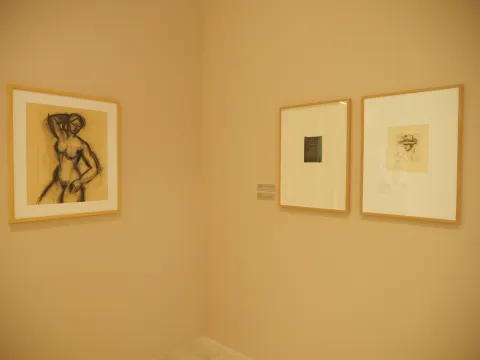
At the School he met Father Alfons Roig, professor of the subject Liturgy and Christian Culture, who spoke to the San Carlos students about Kandinsky and was perhaps the only person knowledgeable about and an enthusiastic defender of modernity and avant-garde movements. Eusebio finished his studies in 1946 but remained at San Carlos until 1948 in order to study the specialty of intaglio engraving with professor Ernesto Furió, one of the few teachers who managed to earn the respect of his students. Sempere learned the technique of etching and dry point, and his engravings show an exceptional mastery of graphic art, working texture and volume and skillfully balancing light and darkness. 
 

Sempere studied modeling, drawing, anatomy, perspective and painting procedures, acquiring solid training in the artistic craft that is demonstrated in the preserved works from those training years. At the end of 1948, the SEU (University Students' Union) grants him a scholarship to pursue further studies in Paris. There he will become an artist-
EXPO-0060
Imagen
P1060957
/sites/default/files/inline-images/resources/exposiciones/EXPO-0060/TEXTO-EXPO-SEMPERE-LECTURA-FACIL_5.pdf
Rosa María Castells

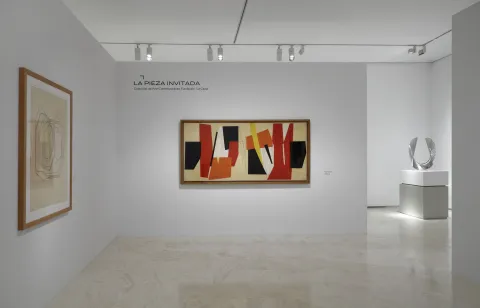
The Invited Piece. Pablo Palazuelo: Alborada

Submitted by brandcode_deweloper on
Contemporary Art Collection of the "La Caixa" Foundation

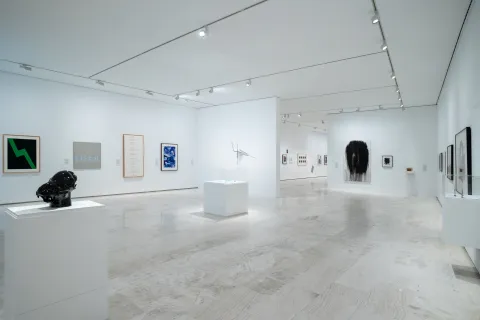
Alborada by Pablo Palazuelo came to share the space alongside the constructivists from the 20th Century Art Collection and established a dialogue with Palazuelo's work held in the Collection, Sub-rosa XII.

In Palazuelo's painting, one observes an attempt, sometimes unattainable, to represent the logic of chance. This—this structural, architectural, scientific will, falsely impersonal—makes his paintings appear as authentic manifestos about how abstract language materializes. Thus, the alborada to which the title refers, a musical composition that celebrates the dawn, unites two significant aspects in the artist's work: light, understood as a succession of chromatic planes, an optical variation, and the idea of serialization, represented through forms that configure a kind of rhythmic sequence, a movement that vibrates and shifts horizontally across the surface of the painting.

EXPO-0059
Imagen
303011.jpg
Rosa María Castells

Moving Forward, Looking Back

Submitted by brandcode_deweloper on
Colección Michael Jenkins y Javier Romero del MACA

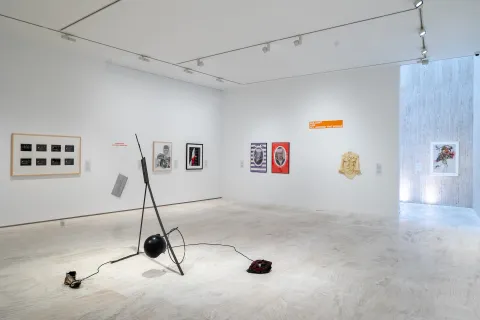
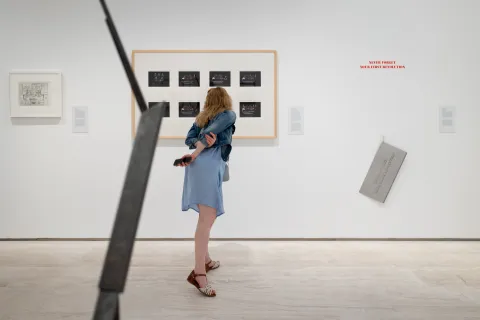
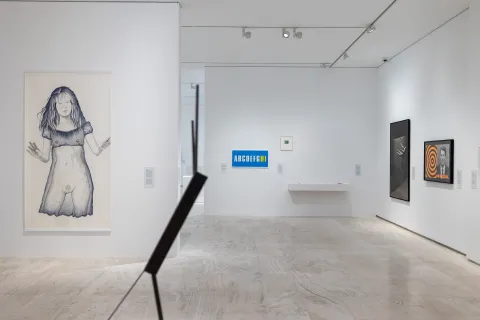
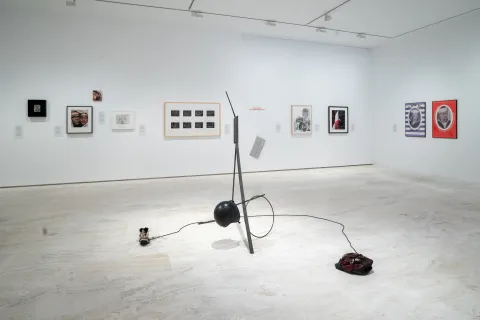
Moving forward, Looking back, Avanzando, mirando atrás, es la segunda exposición organizada a partir de la extensa colección donada por Michael Jenkins y Javier Romero al MACA, reuniendo en esta ocasión el trabajo de cincuenta y seis artistas de diferentes nacionalidades, trabajando en muy diversos medios artísticos, y trazando un equilibrio igualitario entre mujeres y hombres artistas. 

Esta muestra aborda planteamientos que pueden aplicarse por igual al trabajo artístico, a la labor de las instituciones dedicadas al arte contemporáneo y también, a la tarea como coleccionistas de Michael y Javier, quienes consideran la relevancia de testimoniar el presente, pero entendiendo la necesidad de mantener la vista en el pasado para construir y comprender el momento actual y también para vislumbrar el futuro. Conocer el pasado artístico es fundamental para contar lo que sucede hoy en arte. Ese conocimiento permite contar la historia del arte no como episodios aislados, sino interconectados, siguiendo el rastro de lo que acontece, buscando las semillas iniciales y los entrelazados con el fin de completar una lectura más precisa de la compleja y extensísima producción artística contemporánea.

Para muchos artistas, el trabajo en el estudio es una tarea que viene acompañada de forma continua por revisiones y análisis del trabajo previo, de lo hecho antes, como un impulso a su vez de nuevas ideas. Una mirada atrás que, a menudo, no se limita al trabajo propio, sino también al trabajo de otros artistas como fuente de inspiración.  En esta exposición conviven obras de artistas consagrados o de generaciones distintas buscando así los inicios de unas prácticas o ideas que no siempre surgen de forma nueva y sin sustento, ya que el trabajo de numerosos artistas actuales se enraíza a menudo en la obra de los predecesores, que a su vez también miraron atrás (para entenderlo, copiarlo, seguirlo, transformarlo o atacarlo y negarlo). Y esa mirada hacia atrás no impide sino que impulsa el registro de lo rabiosamente presente y permite imaginar algunas de las propuestas futuras o de los caminos que el propio arte y los artistas abren. 

La selección de trabajos mostrados aquí nos permite también ampliar nuestro conocimiento sobre las múltiples investigaciones estéticas y formales que existen en el arte contemporáneo, así como hacia las investigaciones que se adentran y reflexionan sobre muy diversos asuntos urgentes de nuestra realidad, en lo social y lo político.

EXPO-0058
Imagen
3F1A5586.jpg
/sites/default/files/inline-images/resources/exposiciones/EXPO-0058/Folleto-Cast_Val-OK_7.pdf
Josef Albers, Rosana Antolí, Lutz Bacher, Burt Barr, Pablo Bellot, Mira Bernabeu, Mark Bradford, Tania Bruguera, Bureau, Pepe Calvo, Vija Celmins, Eugenio Dittborn, Harold Eugene Edgerton, Steven Evans, Cayetano Ferrández, Nuria Fuster, Ellen Gallagher, Iluminada García Torres, John Giorno, Group Material, Susana Guerrero, Josephine Halvorson, Mary Heilmann, Kribi Heral, Arturo Herrera, Carmen Herrera, Leslie Hewitt, Jenny Holzer, Graciela Iturbide, Imi Knoebel, Barbara Kruger, Sol Lewitt, John Lindell, Richard Long, Agnes Martín, Marlene McCarty, Josiah McElheny, Rosell Meseguer, Donald Moffet, Mariko Mori, Steve Morrison, Olivier Mosset, Vik Muniz, Óscar Muñoz, Takashi Murakami, Wangechi Mutu, Bruce Nauman, Gabriel Orozco, Massimo Pisani, Sylvia Plimack Mangold, Kay Rosen, Aura Rosenberg, Matt Saunders, Dana Schutz, Richard Serra, Andrés Serrano, Nancy Shaver, Shahzia Sikander, Amy Sillman, Haim Steinbach, Thomas Struth, Yuken Teruya, Hank Willis Thomas,MAnn Toebbe, Cecilia Vicuña Y Kara Walker.
Rosa María Castells

Elena Asins. The murmur of the wind is an tireless whistle

Submitted by brandcode_deweloper on

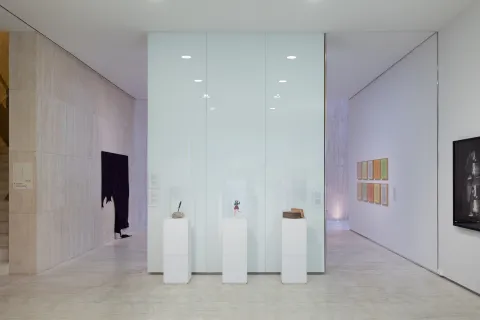
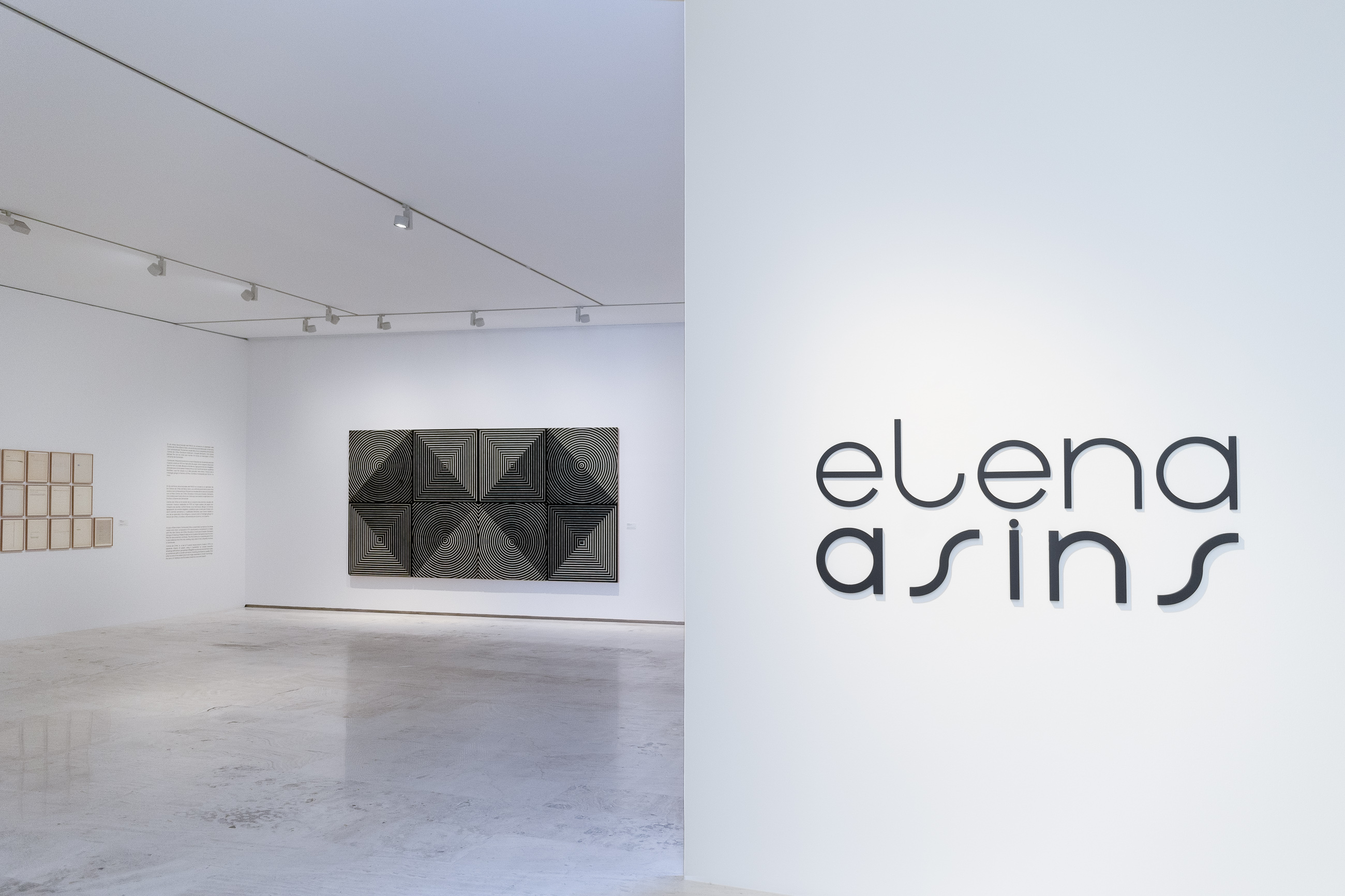
Elena Asins (Madrid, 1940 - Azpíroz, Navarra, 2015) is one of the most radical and rigorous artists in the Spanish art scene. A renovator of plastic language, Asins combines the constructive tradition of twentieth-century avant-garde with computation and information theory, being considered one of the pioneers of computer-assisted art in Spain. A brilliant artist, provocative in silence, who builds from structure, from mathematical norm and logic, a work that generates itself to become, at times, almost invisible.
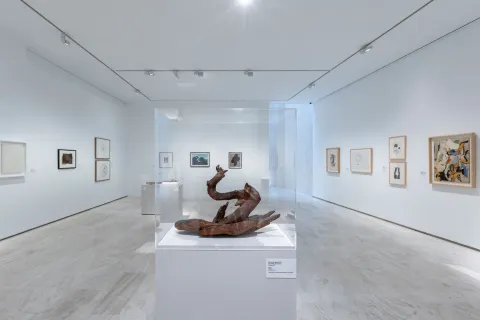
Through, fundamentally, the works bequeathed by the artist to the Museo Nacional Centro de Arte Reina Sofía, this exhibition proposes a journey through the persistent investigations carried out by the artist and their plastic results: a final work of apparent simplicity in its calculations, but linguistically hermetic. True to herself and the result of her renunciation of color, Elena Asins's works are read first through the word and then through structure and line. Never forgetting the tempo: an internal music that runs through all her artistic production, sequencing it. Asins has resorted in her works to a wide range of formats and media from concrete poetry to video, passing through drawing, sculpture or installation, always characterized by compositional rigor and formal refinement.

Linked to some of the most innovative projects in the recent history of Spanish art, such as the Cooperative of Artistic and Craft Production or the Computing Center of the Complutense University of Madrid, we highlight the encounter there with Eusebio Sempere and Abel Martín, their friendship and the coincidence of their investigations. And we will show for the first time a fundamental work by Elena Asins: the Songs of Orpheus, a series of visual poems dated 1970 and preserved by Eusebio Sempere that have become one of the most important pieces in the history of Spanish experimental poetry.

EXPO-0057
Imagen
3F1A9604-Editar.jpg
/sites/default/files/inline-images/resources/exposiciones/EXPO-0057/poliptico-definitivo_7.pdf
Rosa María Castells
Obras han sido prestadas por el Museo Nacional Centro de Arte Reina Sofía, el MACVAC de Villafamés, el Museo de la Universidad de Alicante, la Fundación Mediterráneo y la Colección espíritu-materia. Obras a las que se unen las piezas de Elena Asins pertenecientes a las colecciones del MACA así como las que se encuentran depositadas en el museo como las de Robledo-Palop Collection de Nueva York o la Colección Ars Citerior.

Now the rush stayed still

Submitted by brandcode_deweloper on
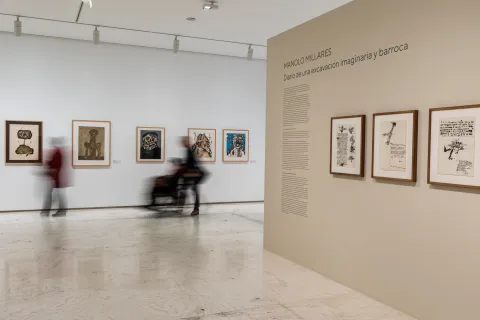
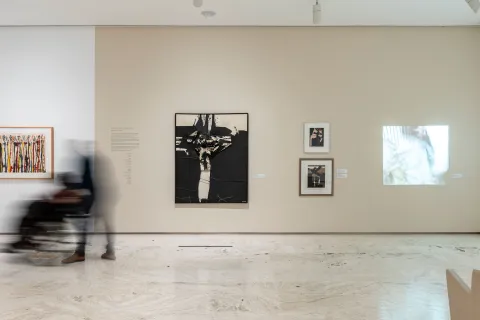
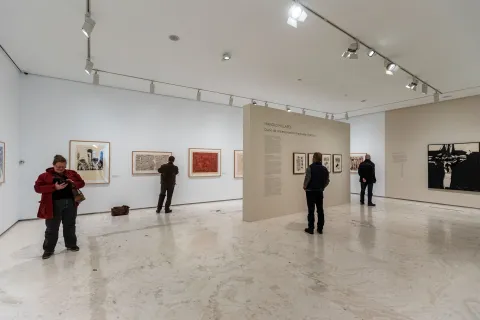
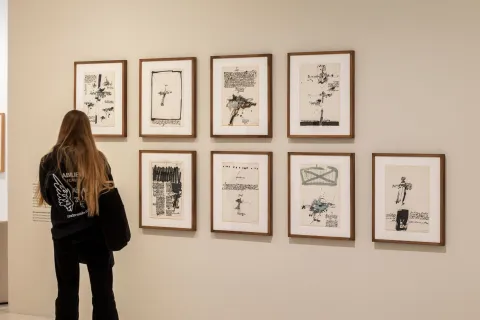
Abstract Experiences Around Manolo Millares

Eusebio Sempere and his partner Abel Martín learned the silkscreen printing technique in Paris, in the workshop of Cuban artist Wifredo Arcay. When they returned in 1960, they introduced this printing technique in Spain, creating beautiful silkscreens of themselves and their artist friends gathered around the Museum of Abstract Art in Cuenca. At first, Sempere and Martín worked together until, in the mid-1960s, Abel became a reference figure in the silkscreen printing trade, taking charge of the technical process with great quality in the prints and portfolios that came out of their workshops in Cuenca and Madrid. And thus he became a key figure in the reproduction and dissemination of contemporary art in our country.

Furthermore, the deep conviction that graphic work deserved the status of an original work, that it brought contemporary art within reach of a large majority of the public, turning it into a mass phenomenon, and the respect and enthusiasm that both (Eusebio and Abel) profess for graphic work, enriches the Art of the 20th Century Collection itself. An impressive display of drawings, engravings, lithographs and silkscreens completes the extensive roster of essential artists that traverse the most suggestive territories of the artistic framework of the twentieth century. 

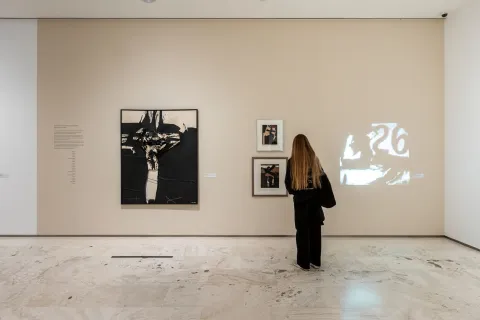
This exhibition showcases works created in the most abstract context, from the pioneers of the avant-garde in Paris to Spanish informalists, among whom stands out the work of Canary Islands artist Manolo Millares, to whom we pay tribute on the 50th anniversary of his death.

EXPO-0056
Imagen
3F1A2384-1.jpg
Rosa María Castells
Colabora: Colección
Fundación Mediterráneo y otras varias depositadas por la
Colección Ars Citerior.

Context avant-gardes 3. Georges Vantongerloo

Submitted by brandcode_deweloper on
IVAM Collection of Valencia

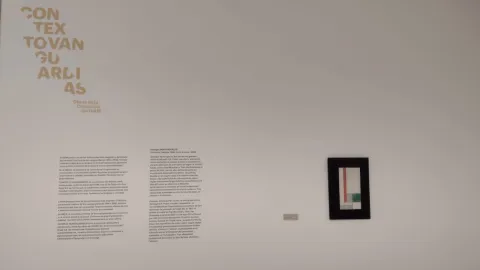
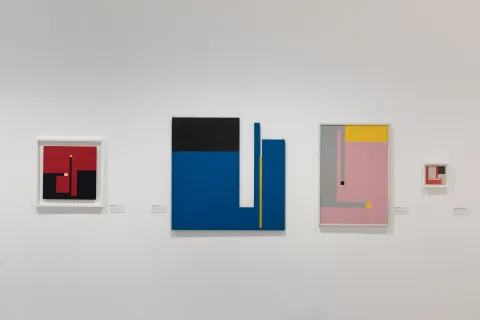
The MACA presents the third exhibition within the "Avant-garde Context" program with a work by Georges Vantongerloo. This program aims to maintain a permanent dialogue between the works from the IVAM collection belonging to the avant-garde movements of the first decades of the 20th century and the works from the 20th Century Art Collection, so that complementary readings are established, transversal perspectives, support and context for some pieces that, in communication with others, strengthen their language and message, while completing the vision of a fundamental era of modernity that travels paths between tradition and the new.

This third exhibition consists of a work from the IVAM collection by Belgian artist Georges Vantongerloo titled "Painted cement relief" from 1930, which is shown alongside other contemporary artists such as Julio González, Pablo Gargallo, and Juan Gris.

The Artist

Georges Vantongerloo (Antwerp, Belgium, 1886- Paris, France, 1965) was one of the great theorists of the 20th century. Painter, sculptor and architect, he reconceptualized the pictorial and sculptural space of abstract art in the early 20th century. In 1917 he founded the De Stijl group together with Piet Mondrian and Theo Van Doesburg, and in the 1930s he was part of the Abstraction-Création movement. His painting, based on the right angle and the relationship between lines and surfaces of flat colors, follows strictly geometric rules sustained by the idea of emptiness, silence and the absolute. Vantongerloo thus became the founder of mathematical thinking in modern art.

EXPO-0055
Imagen
WhatsApp-Image-2024-01-30-at-11.15.53.jpeg
Georges Vantongerloo
Rosa María Castells
Obras del Instituto Valenciano de Arte Moderno (IVAM)

Art in a Wasteland

Submitted by brandcode_deweloper on
IVAM Collection of Valencia

The endings of the Spanish Civil War and the Second World War propose antagonistic worlds, radically different scenarios, but both must be built upon barren ground; in pain, in the ruins and material and ethical debris that absolute destruction from war produces. And it does so under complex vital conditions: in exile, in emigration, in repression.

The two postwar periods represented a radical break for the history of culture. In Franco's Spain, the aesthetic project imagined from the Falange would attempt to reduce culture to state propaganda, break with the experimentalism of the avant-gardes and return to a certain academicism articulated from the idea of the national and the Catholic. In the nineteen fifties the need for international legitimation of the Regime would seek to continue instrumentalizing culture, but from an approach to more contemporary languages. That said, without losing the essences of "the Spanish and the Catholic." In the rest of the world, devastated after the war and its horrors, the break with the previous avant-gardes would come from the disturbing question about the relationship between civilization and barbarism. In both cases totalitarianisms, violence or cultural misery forced numerous artists to emigrate, to go into exile, and to work in the open. But their journey singularly enriched those territories that welcomed them.

Constituted fundamentally by works belonging to the IVAM collection, this exhibition attempts a reading in which more than the differences in style, continuities are contemplated, similarities, mutual echoes, the shared effort, when the fabric of historical events is such that it becomes absolutely determining in poetic, discursive, formal or stylistic decisions; in humanity's gaze and thought about itself

EXPO-0054
Imagen
3F1A2020.jpg
/sites/default/files/inline-images/resources/exposiciones/EXPO-0054/FOLLETO-ARTE-BALDIA_7.pdf
Manuel Ángeles Ortiz, Francesc Catalá i Roca, Man Ray, Henri Michaux, László Moholy Nagy, Jorge Oteiza, Kurt Schwitters, Georges Vantongerloo, Mauricio Amster Cats, Karel Appel, Monika Buch, Vicente Castellano Giner, José Miguel de Miguel Ruiz, Marcel Duchamp, Lucio Fontana, Menchu Gal, Manolo Gil Pérez, Jacinta Gil Roncalés, Arshile Gorky, Adolph Gottlieb, George Grosz, Raoul Hausmann, Hermanos Mayo, Asger Jorn, Franz Kline, Lee Krasner, Lucebert (Lubertus Jacobus Swaanswijk), Marcel Mariën, André Masson, Fausto Melotti, Barnett Newman, Carlos Pascual de Lara, Ad Reinhardt, Josep Renau, Pierre Soulages, Friedrich Vordemberge, Gildewart, Herbert List, Óscar Domínguez, Ricard Giralt, Miracle, Maruja Mallo, Mathias Goeritz, Luis Felipe Vivanco, Ángel Gullón, José Gumbau, Matilde Salvador
Esteban Vicente
Rosa María Castells
Obras de la colección del IVAM. La muestra ha estado con anterioridad en el Museo de Bellas Artes de Castellón.

Bruno Munari

Submitted by brandcode_deweloper on

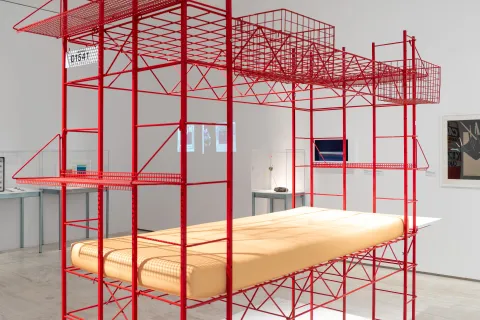
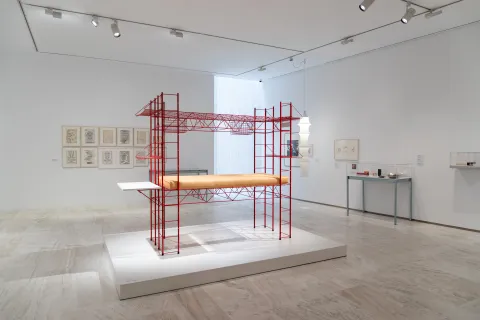
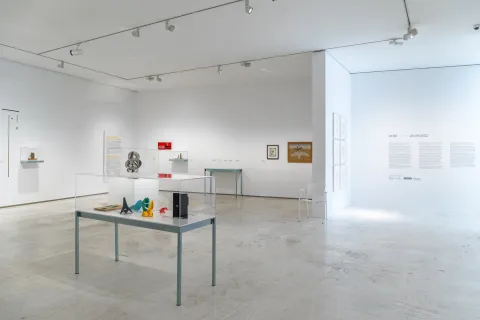
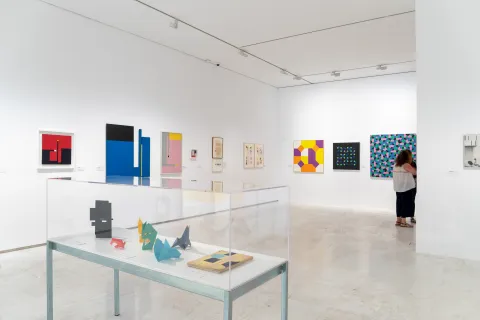
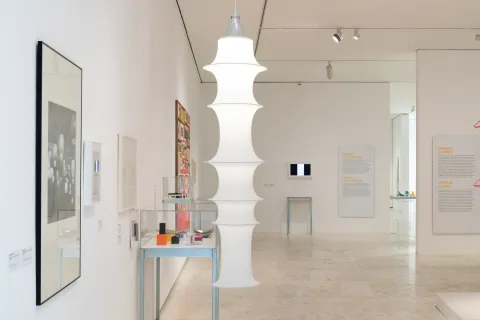
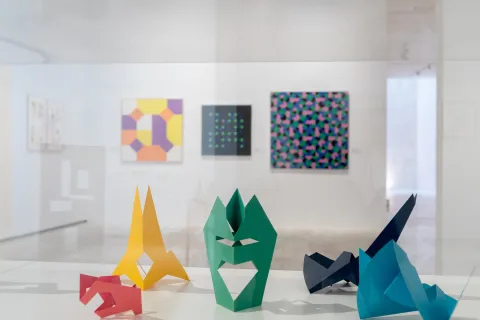
There are artists who have had a significant influence on twentieth-century culture and yet few people know them. Bruno Munari (Milan, 1907-1998), whom Picasso defined as "a Leonardo of our time", is one of those paradigmatic cases. This is the first retrospective exhibition dedicated in our country to Munari, conceived by the Juan March Foundation, which travels with a selection of works to the MACA, the Juan March Foundation Museum in Palma and the Spanish Museum of Abstract Art in Cuenca. Through approximately one hundred thirty pieces, it presents his plural activity in full and reveals the breadth of media that the author used in his plastic and visual research, always experimental and innovative. Indeed, in his work we find, as a pioneer, objects as works of art, graphic design as a profession, books as projects and games as investigations.

In 1927, at barely 20 years old, Munari exhibited his work for the first time, alongside that of second-generation Italian Futurist artists. Later he would distance himself from them to develop his own, extremely singular project. In 1930 he would make a turn towards abstraction, which culminated in his first "aerial machine". From that peculiar "machine" would be born his series of "useless machines", curious pieces based on the dynamism of forms. Munari's early interest in this subject would lead him later to investigate with technologies and processes that were then new, such as the photocopier or computer programming. His experiments with light would follow, and a type of works that overflowed with poetic ingenuity, such as the Fossils of 2000, the Travel Sculptures, the Speaking Forks, the Prebooks and the Illegible Books. Parallel to his work as an artist, Munari developed a very relevant activity as a graphic and editorial designer, in which he applied a rigorous method that purges the designed of the unnecessary, simplifies it and optimizes its function, thus making it enduring in taste and in time.

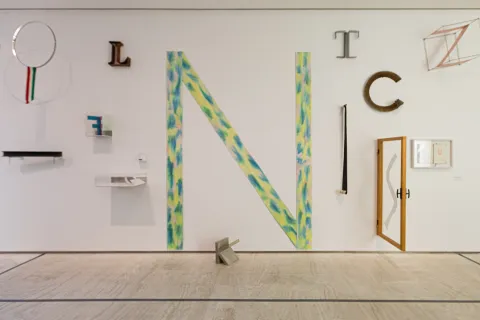
All of Munari's work seems animated by a strong pedagogical vocation. At the end of the 1970s he launched his "laboratories" for children at the Pinacoteca di Brera in Milan, workshops with active proposals to learn by doing, experimenting and playing. The present exhibition includes a "laboratory" specially designed for the occasion, to which a dedicated space is allocated within the rooms where children and young people will coexist with pieces from the great Lucini Alphabet, letters created by the artist from diverse materials. This monograph on the author has been conceived as if it were "a collective exhibition of Bruno Munari" (a subtitle that he himself gave to one of his exhibitions), because it presents a very varied set of processes and results that, with imagination and method, one person produced as if by magic: Bruno Munari.

EXPO-0053
Imagen
042A5538.jpg
/sites/default/files/inline-images/resources/exposiciones/EXPO-0053/IMPRENTA_BM_programa_de_mano_7.pdf
Bruno Munari
Rosa María Castells
En cooperación con la Fundación Juan March y cuenta con la colaboración del Consorci de Museus.

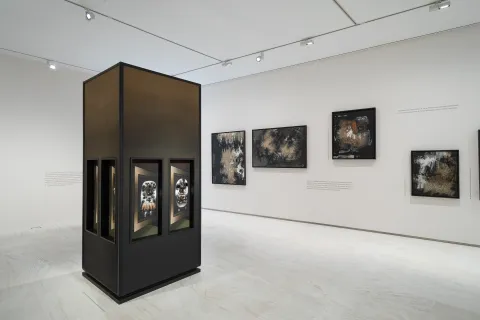
Exiled Thought. Ana Teresa Ortega

Submitted by brandcode_deweloper on
Contemporary Art Collection of the Valencian Generalitat

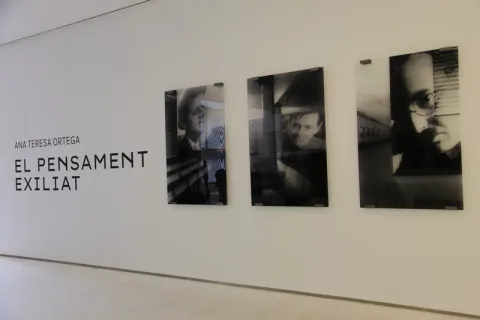
Ana Teresa Ortega is the 2020 National Photography Prize winner. The jury has recognized one of the artists who has most contributed to making photography a form of contemporary art. Her work is guided by an investigative will regarding the limits and possibilities of photography as a hybrid language, which dialogues with three-dimensionality and is in constant reflection.

Her work freed photography from the documentary function that dominated the medium until the seventies. Her early works experimented with visual rhetoric using the medium and montage techniques, especially with her photosculptures from the 1990s. In the early decades of the 2000s, Ortega understands photography as a tool for constructing collective memory and history, and her images invoke another time in which forgotten past and history that never was can appear.

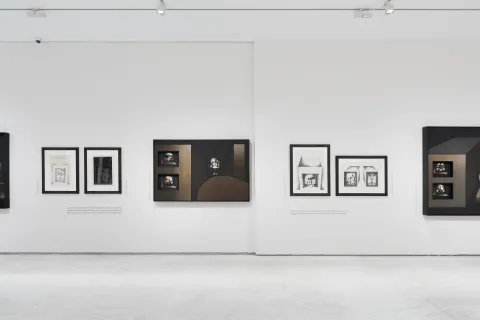
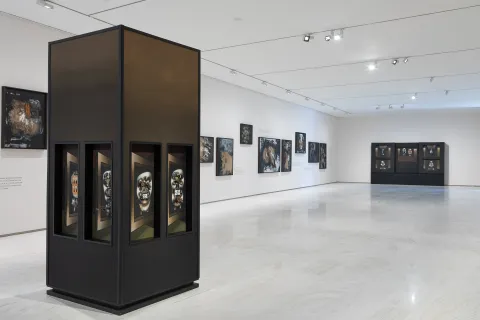
This is what happens in Thinkers (2002), where reflection on the intellectual heritage of the twentieth century and its transmission become image. Through a play between installation and photomontage, projections of writers' faces are photographed on empty architectural spaces. The images show these portraits, extracted from encyclopedias, on facades, interior walls, hallways or in doorways and stairwells: the enlarged face of Walter Benjamin is cut off at the corner of a factory; the gaze of Ángel Valente is framed between cement pillars; Joyce seems to sigh, pensive, long like a venetian blind.

The series consists of 24 images of projected portraits, from Zambrano's Z to Arendt's A, and forms an inverted alphabet of the century's intellectual legacy, with one peculiarity: all the portraits belong to exiled thinkers. Writers reluctant to the social, political and cultural environment of their time, who saw in writing the place and refuge to express their discontent with the world. Their committed writings reflect freedom, intelligence and hope, and their different conceptions of the world remain alive in our memory today.

The photographs were taken in suburban spaces, because they speak of thought in the margins, a metaphor for the physical or psychological confinement that all of them suffered. It is about thinking exile. Not about bringing back those who left—perhaps they were never present—but about invoking them as lost. And doing so through photographs of projected photographs of a third photograph that is the encyclopedic portrait, with a reflection on the trace: photographs, as imprints of light, are the trace and form the trail of that which is exiled in memory: an exile of light. To look at the gaze of Valente, Joyce and Benjamin and think about their trace. As if the past were not dead. As if it were not even past.

This work belongs to the Art Contemporani Collection of the Generalitat Valenciana. Since 2017, the Ministry of Education, Culture and Sport has maintained a line of acquisition of artworks with the dual purpose of stimulating the contemporary art market, while also gathering a collection of works representative of the artistic present in our Community. Different generations and sensibilities that approach the artistic creation process, offering new perspectives on your closest world.

EXPO-0052
Imagen
IMG_8790.jpg
Rosa María Castells
Col·lecció Art Contemporani de la Generalitat Valenciana

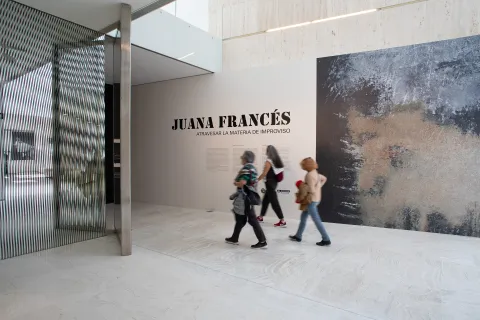
Juana Francés. Crossing Matter Unexpectedly

Submitted by brandcode_deweloper on
Juana Francés Collection of the MACA

Juana Francés de la Campa (Alicante, 1924 – Madrid, 1990) is one of the most powerful artists in the Spanish art scene of the second half of the twentieth century. There were very few women in the avant-garde front line, but she was always there, with her own personality, attentive to the artistic concerns of a generation of artists who revolutionized art, driven by a coercive political, social and cultural situation.

Juana's painting emanates a persistent murmur: a profound unease, an anguish that surfaces in all her works. Whether through subject matter, composition, gesture, material or color, Juana Francés' painting is wrapped in an unbreathable atmosphere. They are hard, complex, committed and suffocating works… but of great pictorial quality that stood out then in the most important biennials and international exhibitions of contemporary Spanish art. Juana enjoyed national and international recognition. Art history has forgotten her since. And it is necessary to recover her.

Juana Francés performed an act of generosity toward the city of Alicante in 1990. Upon her death, she donated her collection to the museums of four Spanish cities: Zaragoza, Madrid, Valencia and Alicante. Thus it was, and today, the Juana Francés Legacy belongs to the collections of the Museum of Contemporary Art in Alicante for the enjoyment of all.

EXPO-0051
Imagen
042A0228.jpg
/sites/default/files/inline-images/resources/exposiciones/EXPO-0051/HOJA-SALA-ESPANOL_7.pdf
Rosa María Castells