Fernando Sinaga, José Maldonado, Judith Egger, Máximo González, Pipo Hernández and Tamara Arroyo.
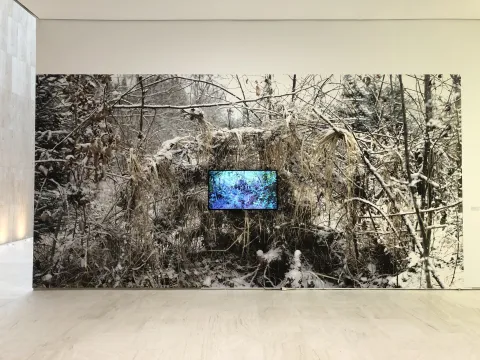
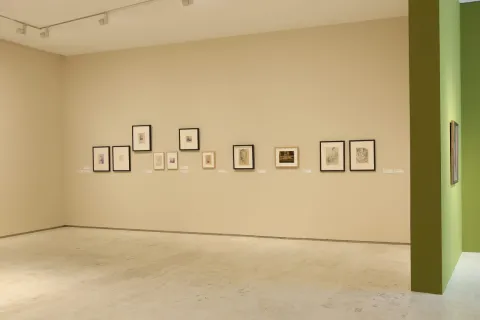
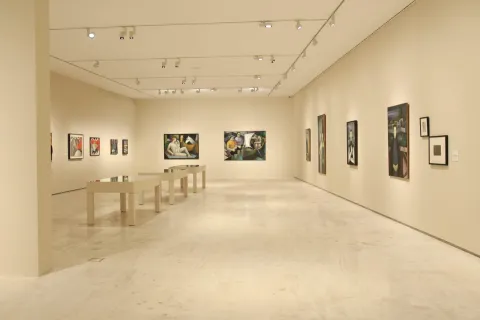
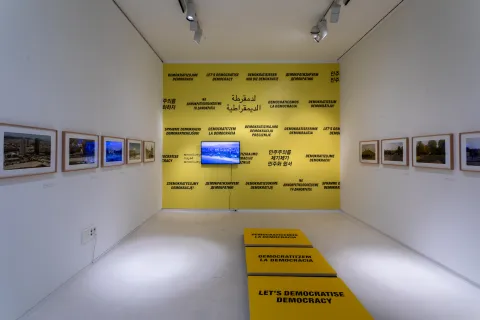
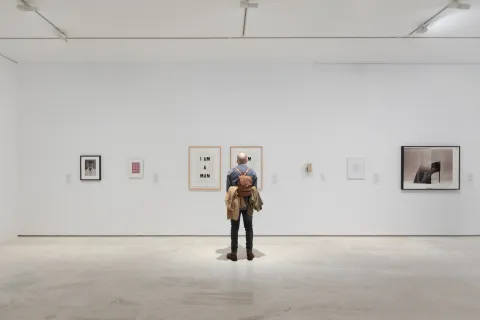
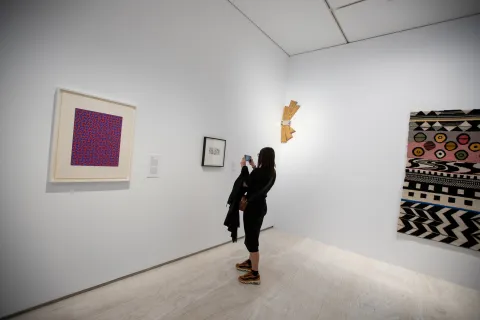
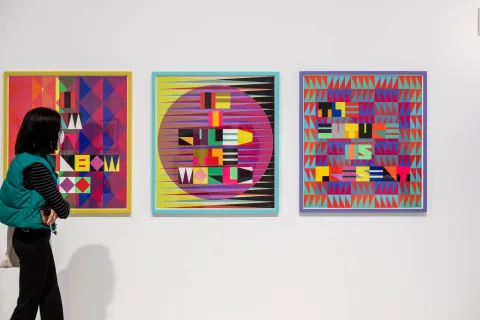
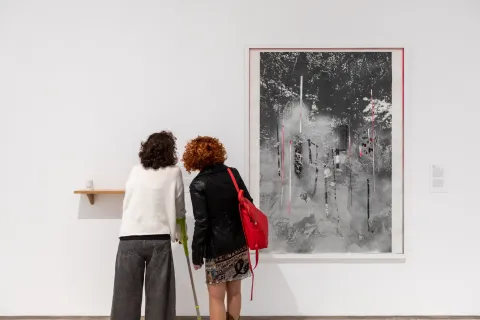
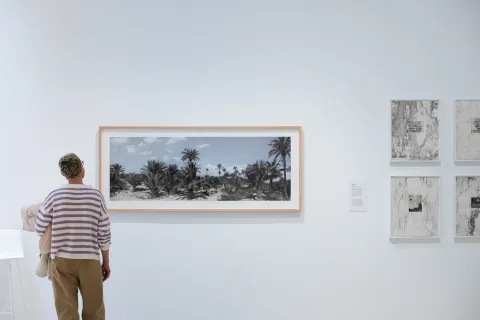
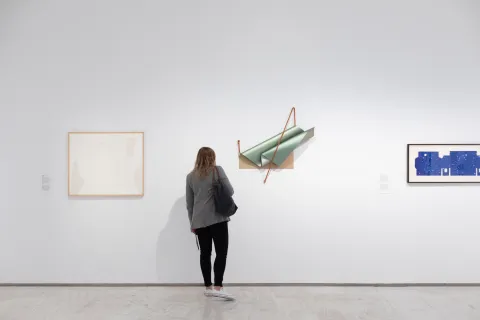
The Shortest Night is a collective exhibition that emerges as a collaborative proposal between both galleries and the museum, opening a dialogue around the idea of transformation in creative, artistic, and vital processes.
As an effort to promote new forms of art production and exhibition, the show is carried out in a transversal and concomitant manner across the three venues of the galleries in Madrid and Alicante and the MACA, with works displayed organically among them, taking conceptual and aesthetic criteria above the representation of the galleries as a real exercise in institutional synergy.
The Shortest Night delves into transformation as a process of resignification that promotes regeneration, transmutation, change, and renewal, considering the difficult times we are living in and making reference to the traditions of Saint John, a time in which a change of season takes place whose tradition consists of making way for the new, renewed, and transformed.
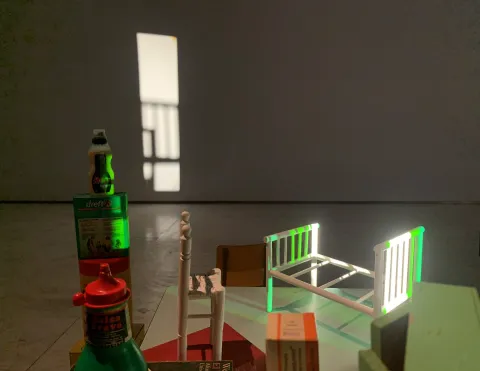
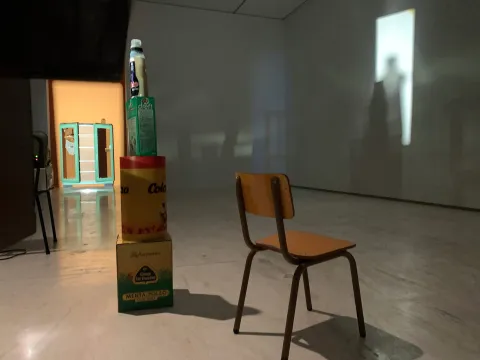
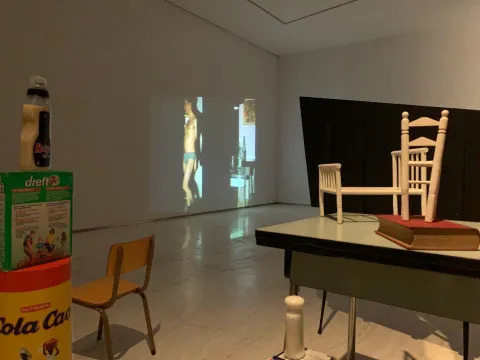
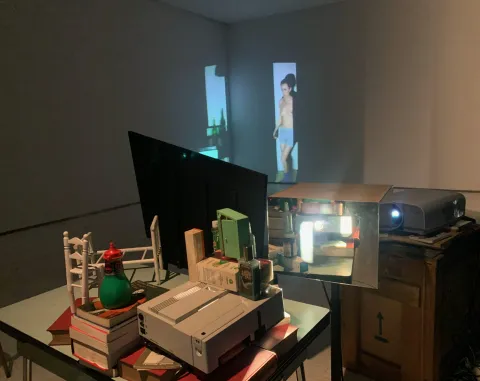
The Museum of Contemporary Art in Alicante presents in this exhibition two works by Eulàlia Valldosera: The Fall. Leaving the Flames to Fall into the Embers from 1996 and Family Ties from 2012.
The Fall is a fundamental work in the artist's trajectory, a complex and enigmatic installation that speaks of an emotional accident, a descent into the underworld, the impossibility of escaping a situation even when attempting different behaviors. The very questioning of a couple in their domestic environment, a story devoid of narration that unfolds in the space where the spectator finds themselves trapped as both witness and architect of the problem.
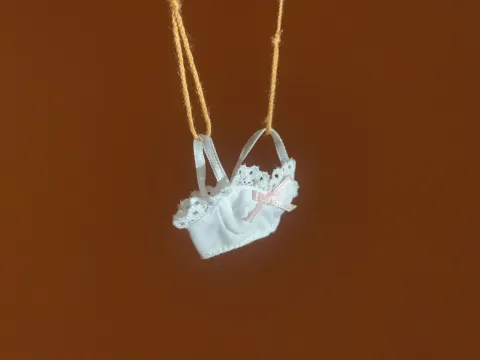
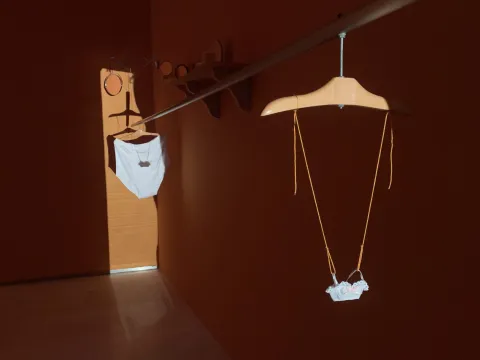
Family Ties is a series of photographs of intimacy and reveals the visible and hidden emotional relationships that family members experience, enjoy, or suffer. Complex and inevitable implications that redefine the very model of family in continuous transformation. Love, protection, or mutual care becomes tinged with hatred, absence, jealousy, or abuse in a highly fragmented emotional labyrinth.
In both works, the drama is in plain sight. Recovered. The facts are not narrated, but rather represented. Through reality and its shadow, through the projection of light and movement. With her own perspective, Valldosera recreates dramatized scenes that simultaneously reflect presence and absence, memory and desire, where the shadow evokes an inner search that refers to the world of the subconscious, not only as a specter of an unresolved past, but also as an authentic form of reality.
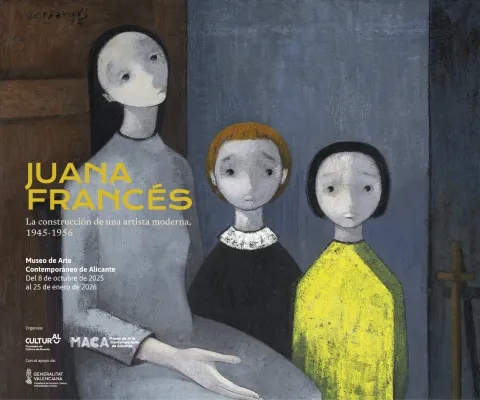
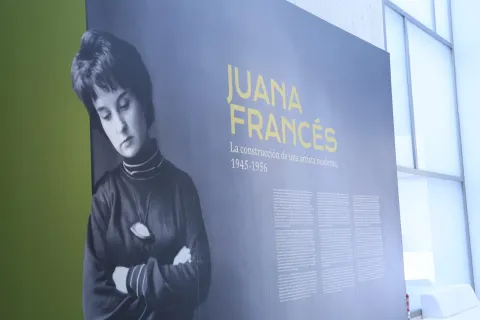
Juana Concepción Francés de la Campa (Alicante, 1924 - Madrid, 1990) is one of the most forceful artists in the Spanish artistic panorama of the second half of the twentieth century, a pioneer of abstract informalism and the only woman in the emblematic El Paso Group. She exhibited in important international artistic events such as three Hispano-American Biennials, the Venice Biennale, in as many as five editions, and the São Paulo Biennale. She exhibited in group shows alongside her generation's peers at the Guggenheim Museum in New York and at the Tate Gallery in London, and in notable solo exhibitions at institutions in Spain, France, and Portugal, among other places. She was recognized by critics from her early figurative period through the end of her career, but has been forgotten by art historiography. In recent years, her figure has been strongly reclaimed, affirming her quality and relevance, and at the MACA we have delved deeper into separate exhibitions on her abstract paintings.
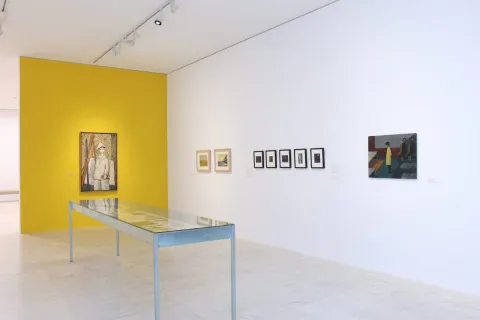
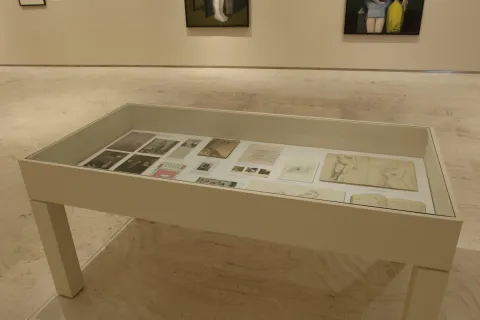
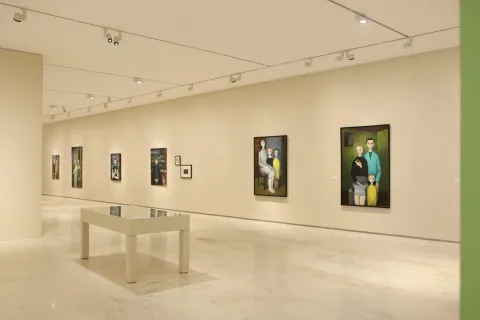
Now we propose to review the origins of her painting: the years of training, her more symbolist figurative period, and her personal transition before embarking on the generational adventure of abstract art. It is the least known period: paintings where figurative work of Italianate influence moves between restrained symbolism and surrealism with metaphysical roots, featuring rounded and voluminous figures of geometric character. Among the themes presented are maternities, portraits of children and women, families, and enigmatic still lifes as well as allegorical scenes that present an air of intriguing mysticism and that contain a spirituality that we will see emerge in later periods. On a technical level, Francés works innovatively to achieve certain textures and impastos using the encaustic technique, where she mixes wax, resin, and solvent on a rigid support, superimposing different layers of paint to "wound" them afterward with a nail. An experimental will that remains intact throughout her entire career, marking her strong plastic personality.
Juana Francés is the most prominent of a group of women artists who began exhibiting in the 1950s and whose professional determination defied the society of her time: an exclusionary system that relegated women to the domestic sphere or to decorative roles in culture. Facing a hostile, normative, and rigid environment created by the social ideology of Francoism, Juana Francés managed to remain attentive to plastic concerns and to be an active part of a generation of artists who revolutionized the art of their time. Her trajectory allows us today to rethink the role of women in art history, as well as the complex relationship between aesthetic modernity and social commitment.
Michael Jenkins and Javier Romero Collection from MACA
Opening. Beyond the Maps is the title of the first exhibition of the Michael Jenkins and Javier Romero Collection at MACA. It includes forty-nine artists from different generations and nationalities from among the one hundred sixty-two that make up the collection, with works spanning from the late sixties to the present day, seeking a balance between historical figures or artists with long careers and younger artists.
Opening because it initiates and serves as an introduction to a more extensive collection that seeks to eliminate not only geographical hierarchies, but also hierarchies of disciplines and artistic media, generational boundaries, gender or identity, individual or group work, or hierarchies that could be applied to the diversity of formal or conceptual approaches in art to offer a vision that goes beyond maps, beyond any kind of preestablished and hermetic artistic boundary. Opening our perspective.
The proposed selection reflects the variety of themes and narratives that artists have been exploring in the social and political context, in order to stimulate critical thinking and offer a clearer and more faithful image of reality. We also wanted to highlight the high presence of women artists in the collection and they constitute half of the artists included in this presentation. We have also selected several artists of color from the notable group whose works are represented in the collection. Finally, it was important to highlight the presence of artists from Alicante, for which we have included the work of ten of them in order to create a reading that, aspiring to the global, understands the local, the closest, as fundamental.
Thus, trying to eliminate chronological and territorial boundaries, we propose that in this first installation artists from different generations and geographical contexts coexist and that cross-dialogues be constructed between the selected works. Let this serve as an introduction.
Elena Aguilera, Richard Artschwager, Aurelio Ayela, Joseph Beuys, Nayland Blake, Louise Bourgeois, Mark Bradford, Trisha Brown, Fernando Bryce, Pepe Calvo, Olga Diego, Nicole Eisenman, Tony Feher, Inma Femenía, Katharina Fritsch, Nuria Fuster, Anna Bella Geiger, General Idea, Jeff
Gibson, Felix González-Torres, David Hammons, Mona Hatoum, Arturo Herrera, Sheila Hicks, Mike Kelley, Ellsworth Kelly, Corita Kent, Teresa Lanceta, Sherrie Levine, Glenn Ligon, Angel Masip, Josiah McElheny, Zanele Muholi, Vik Muniz, Claes Oldenburg, Ana Teresa Ortega, Cindy Sherman, Erin Shirreff, Amy Sillman, Hiroshi Sugimoto, Richard Tuttle, Danh Vo, Kara Walker, Andy Warhol, Ruth Wolf-Rehfeldt, Jesus Zuazo.
Vásárhelyi Győző, the artist's real name (Pécs, Hungary, April 9, 1906 – Annet-sur-Marne, France, March 15, 1997). He studied medicine in Hungary, but left the career after two years. He then became interested in abstract art and Bauhaus teaching in Budapest. He moved to Paris in the early 1930s and worked there as a graphic designer. In this city he developed his first major work, Zebra, which is considered today the first work of Op art.
He worked in advertising and decoration until 1940. He held his first exhibition at the Denise René gallery, to which he would always remain connected. His work is based on geometric abstraction and the interaction of colors to create a sense of movement and he was the greatest representative of op-art.
In 1955 he published his Yellow Manifesto, a theory about two-dimensional plastic art and kinetic art. Vasarely developed his own model of geometric abstract art, using various materials but using a minimum number of forms and colors. His work gave him international fame and he received several prestigious awards.
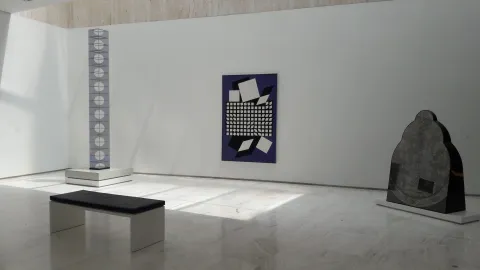
This piece, property of the Provincial Council of Alicante, extends its stay at the MACA as an invited piece, as part of the kinetic space of the 20th Century Art Collection, where another work by this Hungarian artist is exhibited: "Kroa B", 1971 (sculpture in anodized and polychrome metal).
The sensation of movement is the common element of the works that make up this Room. The mutual, physical and emotional relationship established between the viewer and the work is a mouvement émouvant [moving movement], as Vasarely describes it in 1955: the works are living bodies that are reflected in the moving body of the viewer and enter into relationship with him, making him a participant.
Vásárhelyi Győző, the artist's real name (Pécs, Hungary, April 9, 1906 – Annet-sur-Marne, France, March 15, 1997). He studied medicine in Hungary, but left the career after two years. He then became interested in abstract art and Bauhaus teaching in Budapest. He moved to Paris in the early 1930s and worked there as a graphic designer. In this city he developed his first major work, Zebra, which is considered today the first work of Op art.
Working in advertising and decoration until 1940, he held his first exhibition at the Denise René gallery, to which he would always remain associated. His work is based on geometric abstraction and the interaction of colors to create a sense of movement and he is the greatest representative of op-art. In 1955 he published his Yellow Manifesto, a theory about two-dimensional plastic art and kinetic art. Vasarely developed his own model of geometric abstract art, using various materials but using a minimum number of forms and colors. His work gave him international fame and he received several prestigious awards.
The Vasarely Museum in Hungary contains an important collection of his works, as well as many other artists of Hungarian origin who have worked abroad. He is the father of artist Yvaral, author of works in that same style.
If the idea of plastic art had so far resided in artisanal management and in the myth of the "unique work", it now lies in the conception of a possibility of RECREATION, of MULTIPLICATION and of EXPANSION. •
Does the immense dissemination of literary or musical work occur to the detriment of its uniqueness and quality? • The majestic chain of the fixed image in two dimensions goes from Lascaux to the abstract works… the future holds for us the happiness of a new plastic beauty, in movement and moving.
Collection For the Love of Art, Bombas Gens, Valencia
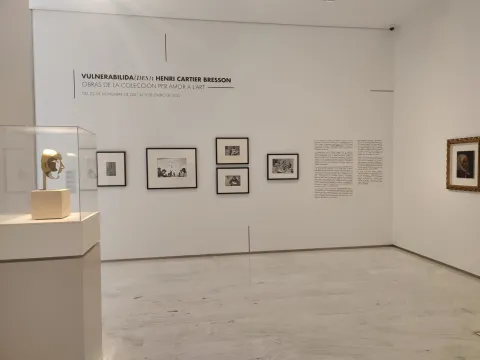
The five photographs by Henri Cartier Bresson shown here belong to the Per Amor a l'Art Collection – Per Amor a l'Art Foundation of Valencia. These works invited to the MACA are part of the exhibition project Vulnerability(ies), carried out in collaboration with Bombas Gens Centre d'Art and the Museum of the University of Alicante.
Vulnerability is a complex reality that has acquired notable prominence in recent times as a result of phenomena such as social inequality, the effects of climate change, gender-based violence, migratory movements, and the recent Covid pandemic. Theoretical reflection on human vulnerability is not recent; however, the urgency of responses to the moment we are living in, so compromised in many aspects, has validated its relevance. We immediately associate the concept of vulnerability with that of fragility. To be vulnerable is to be a fragile subject. We often transfer this condition onto others based on their gender, their body, or their social position, but we avoid the thought that this state is constitutive of our own experience and, therefore, inherent to human nature. Feminist thinker Judith Butler has proposed rethinking vulnerability as a means to illuminate other models of living together, based on the recognition of interdependence between subjects and the need for care. Therefore, vulnerability is not a reason for inaction or submission but an opportunity for social emancipation and political resistance. With this spirit, the exhibition Vulnerability(ies) emerges: as an approach to experiences of fragility from artistic practices that encourages us to understand ourselves as vulnerable beings – both in social and individual aspects – but capable of acting collectively to build new forms of relationship between us and between us and nature.
Henri Cartier Bresson (1908-2004) is one of the fundamental names in the history of photography of the last century. He was a pioneer of modern photojournalism, promoter of the Magnum Photos agency, and creator of the concept of the decisive moment: the sensation of making the eye, the head, and the heart coincide in a concentrated gesture that allows capturing reality by surprise. Born in France, he wanted to dedicate himself to painting and began to frequent artists, especially surrealists, who decisively marked his almost pictorial gaze that he would express in images far from the anecdotal and as close as possible to the intimate truth of people. He always used black and white and was an enemy of color and the use of flash. A man of strong political convictions, anticolonialist and republican, his commitment placed him in the most iconic revolutionary scenarios, making him an inveterate traveler. In the 1930s he traveled through several Spanish cities, including Alicante, where he captured with his lucid camera these famous images.
Works:
Henri Cartier Bresson Alicante, Spain, 1933 Silver gelatin print Per Amor a l'Art Collection, Valencia.
Henri Cartier Bresson Alicante, Spain, 1934 Silver gelatin print Per Amor a l'Art Collection, Valencia.
Henri Cartier Bresson Madrid, Spain, 1933 Silver gelatin print Per Amor a l'Art Collection, Valencia.
Henri Cartier Bresson Madrid, Spain, 1933 Silver gelatin print Per Amor a l'Art Collection, Valencia.
Henri Cartier Bresson Flooding, Spain, 1933 Silver gelatin print Per Amor a l'Art Collection, Valencia.
Martínez Guerricabeitia Collection of the University of Valencia
Through this exhibition program "The Invited Piece," MACA aims to bring to the public works temporarily loaned by other institutions that acquire a new meaning in the Museum when presented as an exhibition of a single work in relation to the context of the permanent collection. The Twentieth Century Art Collection allows for an enriching program of invitations. Specific works that, in dialogue, discussion, contiguity or contradiction, are shown immersed within the museum's exhibition context. On this occasion we have invited the Martínez Guerricabeitia Collection to share space with a splendid work by Valencian artist Juan Genovés. JUAN GENOVÉS
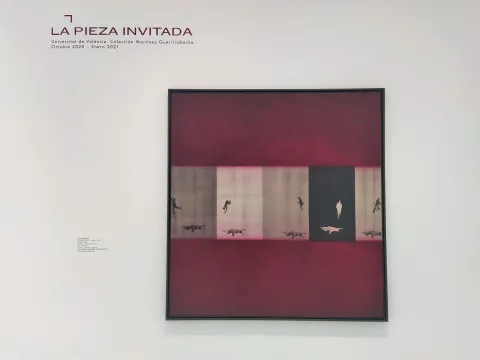
Relato, 1968 Acrylic and oil on canvas 180 x 170 cm. Signed and dated on the back MARTÍNEZ GUERRICABEITIA COLLECTION Universitat de València
Relato won one of the prestigious Marzotto awards in 1968. It clearly presents the discoveries that sparked international interest in his painting: figuration as a way to transmit unambiguously a fact. The incorporation of flat space and, finally, the eminent narrative, sequential and modular character of the representation. The central motif of the painting is framed by two broad horizontal red stripes created with an airbrush as a screen that marks a distance between the viewer and the scene. A vibration in murky red reinforces awareness of the drama that unfolds. The central area is occupied by a sequence divided into five reiterated images, like cinematographic frames that appear poorly defined, in the grisaille in which beings are perceived from a great distance. The resources employed by Genovés: the reduced size of the figures, the point of view, the chromatic contrast, the dramatic effects of photography provoke the emotional involvement of the viewer in an empathetic identification with the victim. The narration, something that happens and disappears leaving barely any traces, is captured as if being observed through a telephoto lens or viewfinder, not of the artist or the viewer, but of power, of the coercive apparatus of terror. Imbued with cinematic and literary culture, Genovés's gaze accounts for the human condition in the face of the oppressive presence of power. The Martínez Guerricabeitia Collection is a peculiar and atypical collection. Composed of a total of 520 pieces, it is centered on artists whose mode of artistic expression is figuration and realism and whose intention, whose ideological content is always criticism, dissidence and commitment. Formed by Jesús Martínez Guerricabeitia, it was donated to the University of Valencia in 1999.
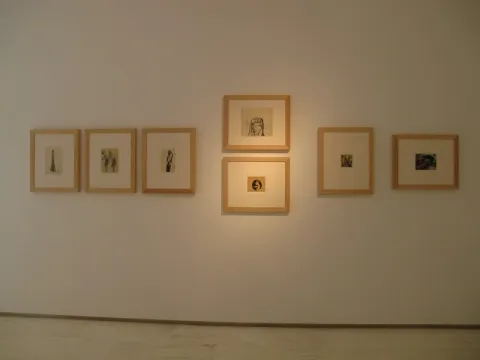
MACA - Museum of Contemporary Art of Alicante presents the works by Julio González deposited at MACA by Florencio Martín, heir of Eusebio Sempere. These are significant works that demonstrate the importance of the collections that the Alicante artist gathered with the intention of increasing the 20th Century Art Collection but which unfortunately never reached this museum. Now, with this deposit, it is an unparalleled opportunity to fulfill his intention. These drawings by Julio González accompany the splendid works that the 20th Century Art Collection possesses: "Montserrat criant nº 2"; "Nature morte"; "Petit masque aéré" and "Petite maternité assise", expanding the Museum's vision of this artist. Julio González (1876-1942) Julio González is considered one of the great names in modern sculpture. He trained as a craftsman in artistic metalwork that his father had in Barcelona. His work with iron, with which he created his own language, has been valued as one of the most valuable contributions of the avant-garde movements of the thirties, although he only dedicated one decade of his life to creation with this metal. González began working with iron at the end of the twenties, when he was already over fifty years old, and although he had already worked with metal to create jewelry and various decorative objects, it was then when he began to create small reliefs in embossed copper and, later, to experiment with small sheets, creating heads and female figures. It was contact with Picasso, with whom he collaborated between 1928 and 1932, that allowed him to recognize the possibilities that iron had for sculpture. The artist from Málaga asked him in 1928 for technical collaboration in the creation of a series of iron works, among them a sculpture for a monument in homage to Apollinaire and Femme au jardin. His artisan origins, the knowledge of the possibilities that iron offered him, together with great imaginative freedom and the sensitivity of a great artist, allowed him to create a new, very personal language. He joined the avant-garde with new and powerful sculptural forms and a personal language, described as abstract, which had as its essential objective the marriage between forms and space. In his sculptures, space is part of the work itself, initiating a path that many other sculptors such as David Smith or Eduardo Chillida would later follow. González himself applied the term "drawing in space" to a part of his work, the one he created with iron bars or rods. The filiform or linear sculptures –what he himself called drawing in space–, the volumetric heads or the biomorphic figures are the result of work of great technical and conceptual rigor that would open the doors to recognition as one of the great sculptors of the 20th century.
The MACA - Museum of Contemporary Art of Alicante presents works by Pablo Picasso, Luis Fernández and Julio González, deposited at the MACA by Florencio Martín, heir of Eusebio Sempere, which can be enjoyed from July 25, 2017.
These are significant works that demonstrate the importance of the collections that the Alicante artist gathered with the intention of expanding the 20th Century Art Collection, but which unfortunately never reached this museum. Now, with this deposit, it is an unparalleled opportunity to fulfill his intention.
These pieces accompany in the space the splendid works of Julio González, Juan Gris and Pablo Gargallo that the 20th Century Art Collection possesses. Pablo Ruiz Picasso (Málaga, 1881 – Mougins (France), 1973) One of the greatest artists of the 20th century, who participated in numerous artistic movements. Picasso frequently resorts to El Greco, one of his favorite painters, in a return to his Spanish roots. Picasso admired "The Burial of the Count of Orgaz" by El Greco, a painting to which he dedicated a book that he composed between 1957 and 1959. A monumental book that Picasso illustrates with his own poetry based on his life and his Andalusia. This is a book illustrated by Pablo Picasso, one of the most important within his production. The publication consists of a prologue and text by Rafael Alberti and 12 etchings and one engraving. The text of the volume is dated 1939, handwritten by Picasso himself in color lithography and is accompanied by etchings and dry point. The book demonstrates the knowledge Picasso had of the techniques of André Breton's group and proof of this is the automatic writing that is published in facsimile accompanying the series of engravings, a surrealist experience of the Count of Orgaz where eroticism and pornography are recurring themes: exotic scenes, circus scenes or allegorical scenes imbued with eroticism. "Included in The Burial of the Count of Orgaz is this engraving that dates from 1939, and which, in accordance with the technique, but also with Picasso's feeling of that time, shows a rigidity and linear intensity very characteristic. The idea of including this print in the book came to Picasso from the text that he engraved in harmony with letter and drawing. It is a brief fragment, but its stylistic characteristics already foreshadow those that distinguish the unbridled paragraphs of the Burial, with its disdain for logic and even for spelling, if it is not a taste for openly violating it. Therefore, this engraving that unites text and drawing, and which emerged as pure expression of a lyrical moment, indeterminate perhaps, comes to enrich the copies of the ninth volume of La Cometa Editions." Explanatory text about the engraving included in The Burial of the Count of Orgaz, edited and printed by Editorial Gustavo Gili, S.A. of Barcelona in 1969. Luis Fernández (Oviedo, 1900-Paris, 1973) He studied at the School of Fine Arts in Barcelona. He moved to Paris where he came into contact with avant-garde artistic movements. There he met artists such as Lipchitzi, Braque, Ozenfant, among others and the Spanish artists Joaquín Peinado, Francisco Bores, Julio González and Picasso. These artists gave him the opportunity to know and work with the different artistic isms of the avant-gardes: cubism, purism, neoplasticism followed later by surrealism. His work evolved progressively toward a more personal and hermetic world. This preparatory drawing confirms the architectural and geometric features that the artist has studied carefully, examining the different relationships between the parts, using geometric resources to create figures of strong intensity. Like the original, the image is based on the number three: three necks, three chins, three noses, ... three heads, in this way the central one partially uses the elements of the two lateral ones. Three heads constituted rhythmically, architecturally: the ciliary arches appear supported by the columns that are the nose, and these rest on the lips of the mouth, are adorned with the arches of the nasal lobes and stand out with the spheres of the three chins. The rhythm is established in the verticality of all these motifs but also in the horizontal superposition of arches, circles and straight lines.
Julio González (Barcelona, 1876 – Arcueil (France), 1942) Julio González is considered one of the great names in modern sculpture. He trained as a craftsman in artistic metalwork that his father had in Barcelona. In Paris, the city to which he moved with his family, he came into contact with Spanish artists such as Gargallo, Sabartés, Hugué and Picasso. But it was the contact with Picasso, with whom he collaborated between 1928 and 1932, that allowed him to recognize the possibilities that iron had for sculpture. His work with iron, with which he created his own language, has been valued as one of the most valuable contributions of the avant-gardes of the thirties, although he only dedicated a decade of his life to creation with this metal. In his sculptures his antecedents are found in the works of Pablo Gargallo, space is part of the work itself, initiating a path that many other sculptors later followed such as David Smith or Eduardo Chillida. González himself applied the term "drawing in space" to a part of his work, the one he created with iron bars or rods. Filiform or linear sculptures –what he himself called drawing in space–, volumetric heads or biomorphic figures are the result of work of great technical and conceptual rigor that would open the doors to recognition as one of the great sculptors of the 20th century. Mask is a watercolor made by Julio González in 1940 that belongs to a series of studies for masks of geometric character. The artist takes his own portrait as a model to work and modify the proportions and features of his face, taking them to an abstract reorganization. This is a silkscreen print of the watercolor made by González, printed by Eusebio Sempere and Abel Martin for the exhibition that took place at the Ateneo of Madrid in 1960 about Julio González.
This original and avant-garde work accompanies the exhibition of works from the Twentieth Century Art Collection; it is displayed alongside very relevant pieces from the MACA, such as Kiki of Montparnasse by Pablo Gargallo, canvases and sculptures by Julio González or sharing the avant-garde space among Miró, Juan Gris, Alexander Calder or Ángel Ferrant.
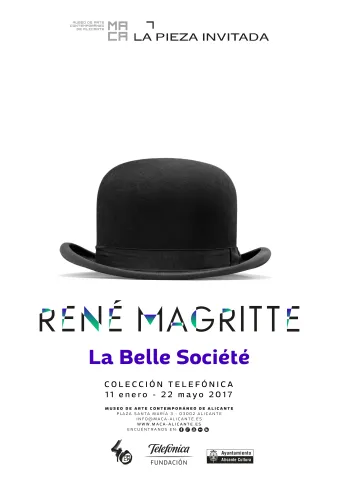
In 1927 René Magritte [Lessines, Hainaut, (Belgium), 1898–Brussels, (Belgium), 1967] moved to Paris, where he befriended André Breton and became one of the most prominent members of the surrealist group. His compositions are characterized by the juxtaposition of everyday objects in unusual contexts, represented with refined painting in clear colors and flat backgrounds. This work captures one of his most celebrated motifs, the man wearing a bowler hat and faceless, which has often been interpreted as Magritte's own alter ego. Here, the figure appears duplicated and silhouetted to contain, respectively, dense foliage and a landscape with sky and clouds as protagonists. This peculiar mixture between reality and fiction produces a disconcerting image, characteristic of the Belgian master's style.
In La Belle Société, painted by the artist shortly before his death, he superimposes two silhouettes of the same character, but replaces the image of a man with contours that contain natural and landscape motifs; dense vegetation, and in front, an identical profile of beach and horizon. The silhouettes act as if they were two windows onto external reality; perhaps they observe each other, perhaps there is a perpetual conversation between two different types of nature that fail to intertwine. Far from succumbing to the automatism of the freest current of surrealism and yet without abandoning the taste for the dreamlike or psychoanalytic, Magritte draws with a sure, clean, almost simple line, with simple forms in pursuit of freedom and expressiveness of thought.
Magritte explained his conception of painting thus: "The painted image is, on one hand, the description of the visible world modified by a way of thinking, or on the other hand, the painted image is the description of the visible world understood in a spontaneous way".