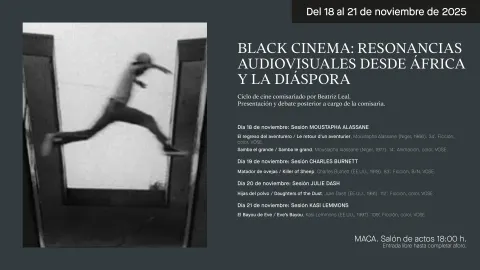
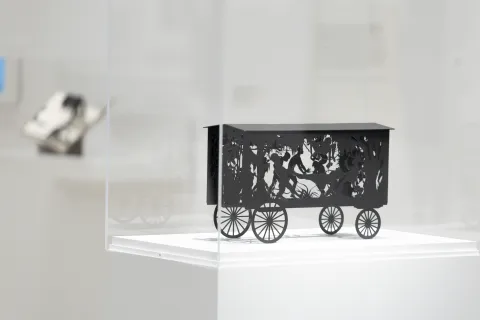
The 5 fiction titles that make up the cycle span two continents, with prominent presence of women and African and African American directors who are pioneers in a vanguard and critical art that frees itself from European references and seeks its own grammar and references. In line with the investigation of form and mastery of artistic techniques that Kara Walker employs to delve into the historical and psychological aftermath of slavery and social injustice, the films have been selected for their thematic, poetic, historical and geographical connections with the artist's production.
Beatriz Leal Riesco is an independent researcher, professor, critic and programmer specializing in contemporary African, European and Middle Eastern art and cinema. She is programming director of the Wallay! Bcn African Film Festival (Barcelona) and AFRIKALDIA: Basque Festival of African Cinemas (Vitoria). She has worked for the NY African Film Festival and other film festivals in the past. She combines her work as a lecturer and curator with her activities as a writer, publishing articles in a wide range of newspapers and academic journals, including El País, Cinema Journal, Secuencias, Caracteres, Ars Magazine, Asymptote, GuinGuinBali and Okayafrica. She regularly collaborates with institutions such as the Filmoteca Española (Madrid), MUSAC (León), CCCB (Barcelona) and the Filmoteca de Cataluña in Barcelona, where she is currently curating an exhibition and film cycle on the phenomenon of Ghanaian film posters from the 1990s titled COL.LISIÓ EXTREMA. Cartells de Ghana pintats a mà, anys noranta. (October 2025-January 2026).
November 18: Moustapha Alassane Session.
-The Return of an Adventurer / Le retour d'un aventurier, Moustapha Alassane (Niger, 1966). 34'. Fiction, color, VOSE.
-Samba the Great / Samba le grand, Moustapha Alassane (Niger, 1977). 14'. Animation, color, VOSE
The first session is dedicated to the "father of African animation": Nigerien Moustapha Alassane (1942-2015). Trained in animation techniques in Canada under the direction of Norman McLaren, Alassane is an example of constant experimentation with genres (animation, ethnography and vanguard auteur cinema), techniques (painting, stop-motion, drawing) and materials (metal, wood, wires or characteristic African fabrics).
In Le retour d'un aventurier (1966), the "first African western," Alassane uses satire and the popular western genre to question the racist, white supremacist and patriarchal dynamics of American expansionism, based on the cult of violence. In the animated film Samba le grand (1977), he uses stop-motion technique and hand-painted puppets to introduce a wide audience to the adventures of a legendary African hero, erased from history by colonizers.
November 19: Charles Burnett Session.
-Killer of Sheep, Charles Burnett (USA, 1978). 83'. Fiction, B/W, VOSE
Killer of Sheep is Burnett's first film, an African American filmmaker who was a prominent member of the LA Rebellion movement or Los Angeles Film School of Black Filmmakers (UCLA, late 1960s-80s), which emerged as a response to the Watts riots (LA, 1965) and was characterized by bringing together young African and African American directors who, starting from anti-colonial critique, Third Cinema postulates and auteur cinema, proposed a vanguard Black cinema alternative to Hollywood cinema.
In Killer of Sheep, made during weekends in 1972-1973 as a master's thesis at UCLA, Burnett demonstrates his ability to maintain tension between the narrative and the conceptual, presenting us with episodes of domestic life of the working-class Black population in the mid-70s in the Los Angeles neighborhood of Watts. Burnett wrote, directed, produced, filmed and edited the film, composed as vignettes with high poetic charge in the shots, through amateur actors and masterful use of black and white in 16mm, in line with Italian neorealism, Yasuhirō Ozu and Jean Renoir.
November 20. Julie Dash Session
-Daughters of the Dust, Julie Dash (USA, 1991). 112'. Fiction, color, VOSE.
Julie Dash is another illustrious figure of the LA Rebellion. Daughters of the Dust was the first film by an African American woman to be commercially distributed. In this filmed poem we learn the story of three generations of Gullah women from Saint Helena Island (South Carolina) in the year 1902, as they prepare to emigrate from the rural South to the urbanized North. It is no coincidence that the director places this family at the forefront of the Great Migration and alludes to the emotional and psychological effects of the massive internal American migratory movement that would transform the country's history with the arrival in the North of millions of Black people fleeing the racism of Southern policies. Filmed in Gullah dialect (Southern creole with African influences that emanates stories of slavery) and highly visual, it is composed of elaborate pictorial shots (thanks to production design by Kerry James Marshall -whose work is in MACA-) filmed by renowned artist Arthur Jaffa. Dash deliberately moves away from Western linear masculine narrative by using circular narrative in the form of vignettes where times, sensations and experiences overlap through the account of an unborn child, who uses the stories of her ancestors. The dialect, celebrations, clothing, food and rituals are an extreme act of poetic-political resistance of these women, whom Dash honors in this classic of late twentieth-century cinema that Beyoncé would pay tribute to in Lemonade (2016).
November 21. Kasi Lemmons Session
-Eve's Bayou, Kasi Lemmons (USA, 1997). 109'. Fiction, color, VOSE
The cycle closes with another debut feature, Eve's Bayou (1997), by African American Kasi Lemmons. Through her eyes we enter the imaginary and mythology of Southern Gothic terror, so beloved by Walker and successfully developed in the twenty-first century. Guided by a child (Eve), we are transported to the memories of a summer in the mid-1960s within a wealthy African American family in Louisiana. Women govern this Gothic world forged on the basis of secrets, voodoo and mystical forces of Afro-Caribbean heritage where forced sex, love and premonitions compose a world that Eve tries to make sense of. The child's gaze, surrounded by ghostly presences and magical rituals, allows us to discover the anxieties, fears and survival strategies of Black women inherited from a complex history of oppression and racism. This intimate work on memory and the human capacity for constructing personal and collective history, the play with terror to dissect relationships between sexes and races, the use of vignettes and the presence of childhood are elements that connect powerfully with the work of Kara Walker. Endorsed by critics and audiences (it was the most profitable independent film of 1997 in the USA), Eve's Bayou is preserved in the Library of Congress of the USA for its cultural, historical and aesthetic value.