Eusebio Sempere

Submitted by brandcode_deweloper on

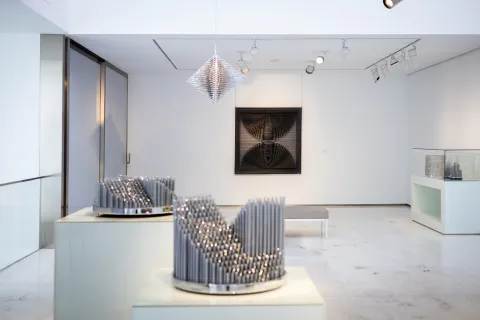
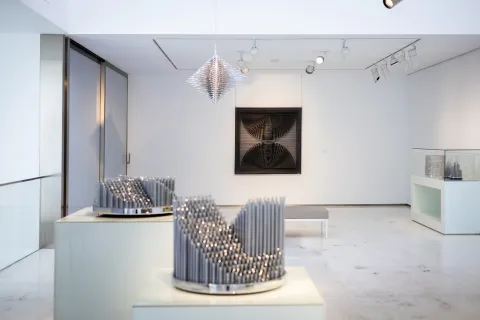
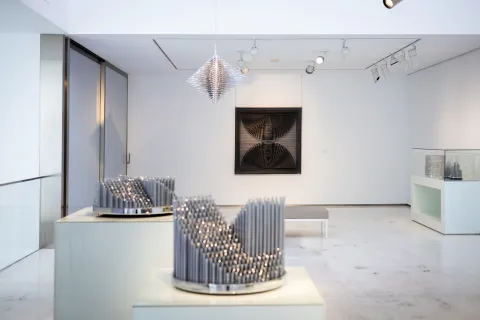
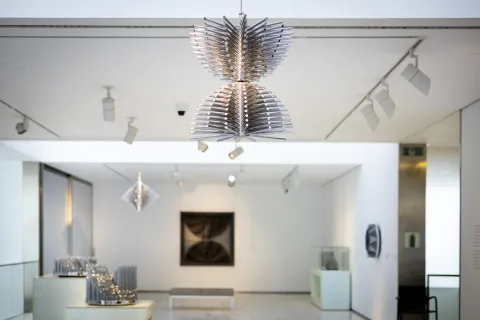
He is the most internationally renowned artist from Alicante and one of the most genuine Spanish representatives of geometric abstraction and optical and kinetic trends. His work is the fruit of continuous and rigorous work on geometry, movement and optical illusion, in which he also develops, from composition and form, a lyrical poetics of singular beauty.

The Eusebio Sempere Municipal Collection is made up of works by the Alicante artist that the Alicante City Council has acquired from 1978 to the present day. It consists of 575 pieces including drawings, paintings, sculptures and graphic works. Chronologically, this set of works spans a very extensive period of Sempere's production: from the early 1940s (drawings and oils) to the first modern works the artist created in Paris in the 1950s (a wide selection of watercolors and gouaches), continuing with the paintings on panel from the 1960s so characteristic of his production and sculptures in iron and chrome-plated steel, typical of his work in the 1970s. Likewise, it includes an important selection of silkscreens and lithographs that showcases the most singular aspects of his graphic work. This is a collection that traces the creative evolution of one of the most interesting personalities in the Spanish art scene of the second half of the twentieth century. It is—moreover—an authentic tribute to Sempere, protagonist of one of the most generous acts toward the city of Alicante: the donation of his art collection… a lifetime.

EXPO-0081
Imagen
KG2A8094-1.jpg
Rosa María Castells

20th Century Art Collection

Submitted by brandcode_deweloper on
From the essentials to the indispensables

From the Essential to the Indispensable

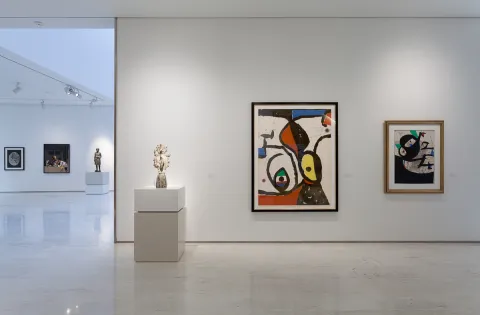
The Twentieth Century Art Collection donated by Eusebio Sempere to the city of Alicante is the cornerstone of this new Museum of Contemporary Art in Alicante. It is composed of 177 pieces including sculptures, paintings, drawings and graphic works, dated from the twenties to the early eighties and is the result of a most rigorous work of selection and acquisition of works by the greatest artists of modernity and the avant-gardes of the past century.

The Collection treasures authentic masterpieces that represent the main names and movements of Spanish art, where it reaches its highest peaks. With a decided international vocation, its creator, Eusebio Sempere, makes clear his great sensitivity, vision of the future and above all, his will to disseminate the aesthetic values of twentieth-century art.

Some of the most important creators of our century are represented here: Picasso, Braque, Julio González, Juan Gris, Gargallo, Delaunay, Arp, Cocteau, Chagall, Giacometti, Miró, Dalí, Max Ernst, Calder, Bacon, Matta, Fautrier, Clavé, Tàpies, Chillida, Millares, Saura, Vasarely, Agam, Soto, Rosenquist, Oldenburg, Rauschenberg, Adami, Dine… among others. But it is in the realm of Spanish twentieth-century art where we find the best works of the Collection and a more extensive range of trends, movements and significant groups of avant-garde art in our country with works by Alberto Sánchez, Ferrant, Palazuelo, Guerrero, Viola, Feito, Rivera, Canogar, Juana Francés, Pablo Serrano, Alfaro, Guinovart, Ràfols Casamada, Hernández Pijuán, Farreras, Manrique, Mompó, Torner, Rueda, Zóbel, Lucio Muñoz, Equipo Crónica, Julio López Hernández or Genovés, among others…

An impressive display of paintings, sculptures, mixed media works, drawings, engravings, lithographs and silkscreens completes the extensive list of indispensable artists, traversing the most suggestive territories of the artistic framework of the past century.

EXPO-0080
Imagen
IMG_2311.jpg
Rosa María Castells

The Invited Piece. Arcadio Blasco: Object-Idea

Submitted by brandcode_deweloper on

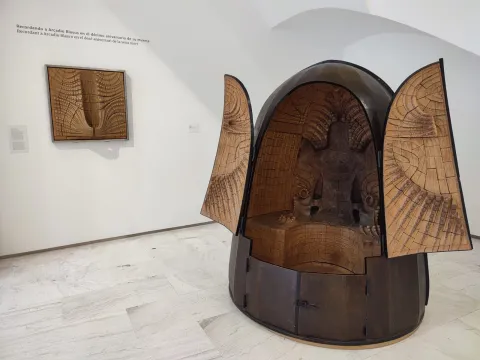
The MACA now has the piece "Objeto-idea" by Arcadio Blasco on the occasion of the tenth anniversary of his death. The work has been deposited for a period of five years by José Piqueras, and has been on display since today on the ground floor of the museum. The artist

Arcadi Blasco Pastor (Mutxamel, Alicante, 1928 – Majadahonda, Madrid, 2013) was a painter who in the second half of the 1950s found in ceramics the ideal material for plastic expression. His artistic training as a painter took place at the School of Fine Arts in Madrid, where he arrived at the age of 19, completing his teaching course at the School of Fine Arts of San Carlos in Valencia in 1953. That same year he moved to Italy, where he lived for two years at the Academy of Spain in Rome, where he had his first contact with ceramics through the work of Nino Caruso and Carlo Zauli.

Upon returning to Spain, he carried out his first ceramic experiments and became interested in artisanal ceramics, which led him to work with the potter from Cuenca, Pedro Mercedes—with whom he exchanged knowledge—and in other popular ceramic workshops in Agost and Triana (Cerámica Montalbán). In 1955 he set up his first workshop in a space—ceded by architect Luis Feduchi—the half-built building of the Museum of America located in the University City of Madrid, which he shared with José Luis Sánchez, Jacqueline Canivet and Carmen Perujo; there he would create, among other works, many stained glass windows, mosaics and ceramic murals intended, in large part, to decorate the churches that were built by commission of the Institute for the Colonization of the Towns of Spain, collaborating with architects José Luis Fernández del Amo, Ignacio Gárate, Luis Cubillo, García Benito, Luis Feduchi, Fernández Alba and Fisac, among others. The immense space of this place of work for creativity was also occasionally used by painters such as José Vento, Hernández Mompó, Rafael Canogar, Antonio Saura, etc., who needed to create large-format works and did not have sufficient space in their studios. This provisional workshop became a meeting place for artists of the young Madrid avant-garde.

Precisely, one of the most notable characteristics of Arcadio Blasco's trajectory as a ceramicist is his direct participation, between the years 1945 and 1974, in the new development of contemporary art, as he was—as Carmen González has rightly pointed out—"the only ceramic artist who, through a series of 'coincidences'"—as he himself defines them—participates in the field of plastic arts, and who has held a large number of national and international exhibitions in contemporary art forums, always bringing ceramic work.

After an initial direct approach to ceramic work, which consisted of using the surface of vessels as a support for his pictorial vocabulary—creating works with a certain decorative charge—Arcadio Blasco felt strongly attracted to the qualities and expressiveness of this material, and as a consequence his Ceramic Paintings (1956-64) were born.

In all his subsequent work cycles: Idea Objects (1969), Ornamental Proposals (1969-74), Architectures and Walls to Defend Oneself from Fear (1970-86), Archaeological Ruins (1984-86), Mill Wheels to Commune (1985), Tributes (1992-95), clays of different tones, slips, glazes—less frequent and very nuanced—and applications of coloring oxides in earthy tones will be—often subjected to reduction firing—the protagonist materials of his works.

In that whirlwind of searches that the 1950s became for the most nonconformist Spanish artists, Arcadio Blasco investigated the possibilities of ceramic material and found in fired clay the ideal medium with which to realize in volume his latest pictorial investigations, which would lead—in ceramics—at the end of the 1960s to reliefs and sculptures of social commitment and political criticism.

With his return in 1985 to his birthplace (Mutxamel) and the installation of his workshop in a country house in the Bonalba area, Alicante, an artist in full maturity returned who made an effort to activate Alicante's culture through various initiatives, some related to ceramics and its teaching.

Some of these "Idea-Objects" from the late sixties were shown in the Arcadio Blasco exhibition at the Spanish Pavilion of the XXXV Venice Biennale in June 1970, and were the prelude to his "Ornamental Proposals for Dialogue" and "Proposals for Torture," series to which fundamental works of his artistic production from the early seventies belong, such as "Enclosure for a Legal Murder" from the MACA collection.

Ceramics is the protagonist and the reliefs begin to wrap around themselves, to want to hide, acquiring a more sculptural and even architectural aspect with the insertion of usable openings. These works are crafted with artisanal meticulousness through a set of very personal resources: touches and impressions like cuneiform and repetitive writing; rows of balls or pearls of clay added and of different sizes; necklace beads or radiations as if they were pieces of goldwork from ancient cultures, refined and barbaric at once, with all kinds of roughness and reliefs where the matter still seems to boil.

EXPO-0079
Imagen
WhatsApp-Image-2023-06-14-at-12.18.58.jpeg
Rosa María Castells

Over time 3

Submitted by brandcode_deweloper on
Mediterranean Foundation Collection

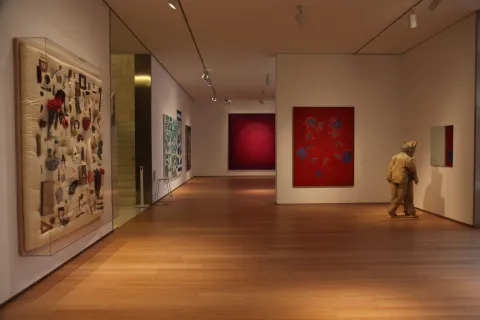
This exhibition showcases a selection of works from the Mediterranean Foundation Collection that is deposited in this Museum of Contemporary Art in Alicante thanks to the agreement signed between the City Council of Alicante and the Mediterranean Foundation.

The Mediterranean Foundation Collection consists of 212 pieces and covers the work of 125 artists, the most essential names in the contemporary Spanish art scene. It spans a chronological arc that runs from the democratic transition to the present day: an artistic period in Spain that corresponds to the last 40 years, so generous, filled with hope, energy, disenchantment, excess and naivety… but also with reflection, denunciation, commitment, adventure… A period in which several generations of artists coexist in a normalized way as had never happened before, enriching each other mutually, with the younger artists learning from the undisputed masters, and rediscovering in the younger generation the persistence of what is essential.

With time 3… wants to reflect on the contemporaneity of the works shown, beyond the historical references already known in the 20th Century Art Collection and what is to come. References that are linked to gesture and matter where the work is the process in a continuous search for the purest painting, the one that represents itself. But also with a generation of artists who will deeply review reality to address figuration from a thousand points of view. Or with the most essential ones, those who deal directly with the sublime in a stripping away of everything to find spirituality, the hidden breath of beauty.

EXPO-0035
Imagen
publicacion-instagram-02.jpg
Antoni Tàpies, Joan Brossa, Manuel Hérnández Mompó, Joan Hernández Pijoan, Equipo Crónica, Equipo Realidad, Eduardo Arroyo, Esther Ferrer, Jordi Teixidor, José María Yturralde, Soledad Sevilla, Carmen Calvo, Eva Lootz, Joan Cardells, Rafael Armengol, Juan Muñoz, Rogelio López Cuenca, José Manuel Broto, José María Sicilia, Miguel Ángel Campano, Miquel Barceló, Victoria Civera, Ángeles Marco, Juan Navarro, Antonio Murado, Prudencio Irazábal, Ferran García Sevilla y Pamen Pereira.
Rosa María Castells

Over time

Submitted by brandcode_deweloper on
Mediterranean Foundation Collection

This exhibition showcases a selection of works from the Mediterranean Foundation Collection that is deposited in this Museum of Contemporary Art in Alicante thanks to the agreement signed between the City Council of Alicante and the Mediterranean Foundation.

The Mediterranean Foundation Collection consists of 212 pieces and covers the work of 125 artists, the most essential names in the contemporary Spanish art scene. It spans a chronological arc that runs from the democratic transition to the present day: an artistic period in Spain that corresponds to the last 40 years, so generous, filled with hope, energy, disenchantment, excess and naivety… but also with reflection, denunciation, commitment, adventure… A period in which several generations of artists coexist in a normalized way as had never happened before, enriching each other mutually, with the younger artists learning from the undisputed masters, and rediscovering in the younger generation the persistence of what is essential.

EXPO-0033
Imagen
IMG_3597.jpg
Rafael Luis Armengol, Eduardo Arroyo, Miquel Barceló, José Manuel Broto, Carmen Calvo, Ferrán García Sevilla, Curro González, Luis Gordillo, Xavier Grau, Joan Hernández Pijuán, Prudencio Irazábal, Ángeles Marco, Juan Muñoz, Juan Navarro, Jaume Plensa, Santiago Segura, Soledad Sevilla, José María Sicilia, Amparo Tormo, Juan Uslé y José María Yturralde.
Rosa María Castells

Over time 2

Submitted by brandcode_deweloper on
Mediterranean Foundation Collection

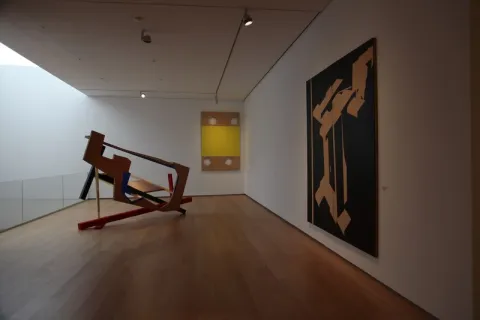
We present the new exhibition of the Mediterranean Foundation Collection with a vocation for permanence that occupies the second floor of the MACA, thus becoming part of the reading of the museum's permanent collections.

We have titled it With Time 2 in a double sense. With time is contemporary. That which is closely linked to the present time. What is happening. Like us, contemporaries of these works and sharing with them the space and time, sharing the aesthetic assumptions that gave them birth and their ultimate meanings. With time is also that which has passed since the Twentieth Century Art Collection that we show on the first floor of the museum and which Eusebio Sempere donated to us in 1977. Inevitably his collection became closed in the early 1980s. Since then and With time what has been happening is what we are showing through the Mediterranean Foundation Collection now revisited.

The Mediterranean Foundation Collection is composed of 213 works from which we have selected 18 works among painting, sculpture and photography of unquestionable plastic force. Works that have accompanied us in the different temporary exhibitions of the Collection that have been held in different spaces and cities. It is always a surprise to discover the artists represented in the Mediterranean Caja Collection, but it is even more surprising to discover which work of theirs has been acquired. It is always a fundamental work within their artistic trajectory, an example of the best of their aesthetic proposal and by which an artist is recognized as a singular artist. A work for its contemporaneity, roundly "classic". And this is evident in this exhibition. It is a contemporaneously classic exhibition.

EXPO-0018
Imagen
IMG_2978.jpg
Ignasi Aballí, Juan Uslé, Carlos León, Joan Hernández Pijuan, Jaume Plensa, Carmen Calvo, Hannah Collins, Esther Ferrer, Francesc Torres, Joseph Beauys, Jana Sterback, Pello Irazu, Miquel Mont, Manu Muniategiandikoetxea, Juan Ugalde y Daniel Verbis.
Rosa María Castells