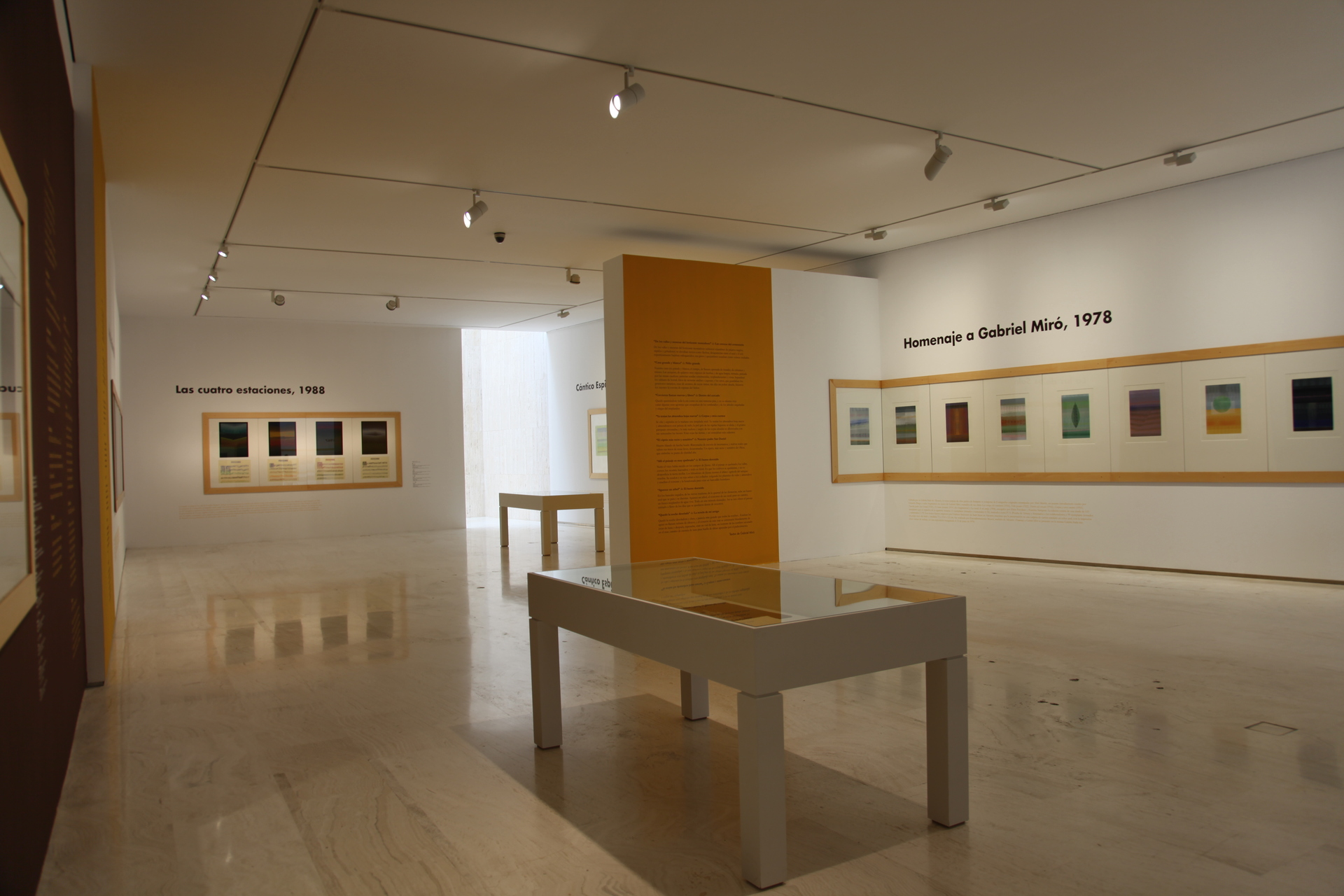
The Four Seasons of 1965 is the first portfolio of artistic silkscreens printed in Spain. It was 50 years ago and the presentation at the Juana Mordó Gallery became an unprecedented success with the public, critics, and sales. It was the beginning of one of the most important sets of graphic works created in twentieth-century Spain, that of artist Eusebio Sempere, exceptional both for its quality and its quantity. Approximately two hundred works among silkscreens, lithographs, and engravings, elaborated by hand in which the highest levels of meticulous perfection are achieved and sometimes, precious craftsmanship.Nine portfolios of original silkscreens by Eusebio Sempere are presented, all printed by Abel Martín, as if it were a team effort, which trace the vital trajectory of both artists and demonstrate their joint artistic collaboration, the union and spiritual communication. Sempere would be the mind behind the forms and colors that Abel Martín, an excellent printer, then captured on paper through the superposition of silk screens, one for each of the colors used. Sometimes more than 40.The Four Seasons of 1965, Nayar Album of 1967, Alarm Book, Transparency of Time or The Alhambra of 1977, Homage to Gabriel Miró of 1978, The Light of the Psalms of 1980, Spiritual Canticle of 1982 or the posthumous portfolio of The Four Seasons of 1988 that Abel Martín completed alone, combine the music of numbers that do not exist with the precise literature for each line.All the portfolios are accompanied by literary texts, experimental, avant-garde, classical or mystical. Pedro Laín Entralgo, Julio Campal, José Miguel Ullán, Edmond Jabés, the Arab poets of Granada, Gabriel Miró, the biblical psalms or Saint John of the Cross presented in turn by Rafael Alberti, Gerardo Diego, Vicente Aleixandre, Juan Cantó or Vicente Aguilera Cerni, words kindled in the forms and colors that inspire souls with the desire to stay there and take a seat.